EARLY ON
TOKYO BATHROOM
INTRO
I began this project by writing about the Date Paintings of 1966. But working on On Kawara's codes of 1965 has caused me to look back at the work he made in 1964, the so-called 'Paris-New York Drawings', and that in turn has led me to the work he made before leaving Japan in 1958. All I can say is "Wow!" Not for the first time, it has to be said: "Wow, On"
The following portrait, Thinking Man, was made in 1952. On Kawara was living in Tokyo and he was 19-years-old. The atomic bombs had fallen on Nagasaki and Hiroshima in August, 1945, when he'd been 13. Is that what the naked man with the withered leg is thinking about? Or is he thinking about Picasso's pink/blue periods that the bookshops of Tokyo have introduced him to? Harlequin, now there's a concept!
On Kawara, Thinking Man, 1952
The person and the environment are 'stitched' into place. And the pot? Is that to excrete in? Or is it for his nutrition? Perhaps it's for everything. When he's hungry, he uses the pot. When he feels a bowel movement coming on, he uses the pot also. Uncomfortable images, but I'm just trying to prepare you for what's to come, gentle reader. On Kawara has said that he almost died several times while living on nothing in Tokyo in these years of trying to attain personal independence from social norms. Wisdom or bust!
Also, from 1952 is this next painting, Smallpox. It introduces motifs that we'll be coming across in the 'Bathroom' series from 1953, though finished in 1954. There are 28 drawings in that series and we'll be looking at every single one of them. But this striking image preceded the series, and needs to be considered first.
On Kawara, Smallpox, 1953
It's obviously influenced by Western art, Picasso's Guernica, especially. Lots of dismembered body parts, but rendered in a stylised way, suggesting cut pipes rather than flesh and bone. Looked at from this perspective, the main figure is a pregnant woman holding some kind of sceptre. But the painting can also be flipped 180 degrees and considered 'upside down':
On Kawara, Smallpox, 1953 (inverted)
From this viewpoint the main figure - though more in shadow that the swollen-bellied woman - is a masked man, I think. He has an open book on his lap, more books and a candle resting on a table in front of him, and is clasping a cross.
One of On Kawara's parents was a Christian, the other a Buddhist.
Every figure in the composition is pock-marked. More than that, every item in the composition is pock-marked. Clearly there was no escape from whatever has blighted this society. Smallpox? More like Bombpox, if you ask me. Other names for which are Anthrax and Onthrax.
A year later, in 1953, when On Kawara was 20 years-old, he set about making a series of 'bathroom' drawings that he donated to the National Museum of Modern Art in Tokyo. I think he did this a few years later, shortly before leaving Japan for Mexico, where his father was working as an engineer. Apparently, it was hard to get permission to leave post-war Japan, so it had to be done in this sort of way. Although his father was only in Mexico for a couple of months, On Kawara was there for four years before settling in New York, via a year in Paris.
Back to Tokyo in 1953, shortly before I was born. Perhaps I shouldn't have said that. But what is the difference between one war-torn nation and another? Though I wouldn't be surprised if 'baby boomer' was a phrase that didn't translate into Japanese.
Another word about 1953. I've read that On Kawara would haunt Tokyo bookshops, taking books off the shelves and reading them while standing in the shop. Well, in 1953 the first Japanese translation of Samuel Beckett was published and, given what was to come, it is all too easy to imagine On Kawara picking out Murphy and reading its opening passage:
'The sun shone, having no alternative, on the nothing new. Murphy sat out of it, as though he was free, in a mew in West Brompton. Here for what might have been six months he had eaten, drunk, slept and put his clothes on and off, in a medium-sized cage of north-western aspect commanding an unbroken view of medium-sized cages of south-eastern aspect.'
How exhilarating might those words have been to the curious and eager mind of the young Japanese artist? I must let them sink in before going any further with my own work. Perhaps that's even what On Kawara said to himself back in 1953.
ONE
On Kawara has left us with 28 numbered 'Bathroom' drawings. Looking at them is not going to be much fun. And yet on some level it is going to be a lot of fun. See how much fun you can stand, Western viewer, if that's what you are.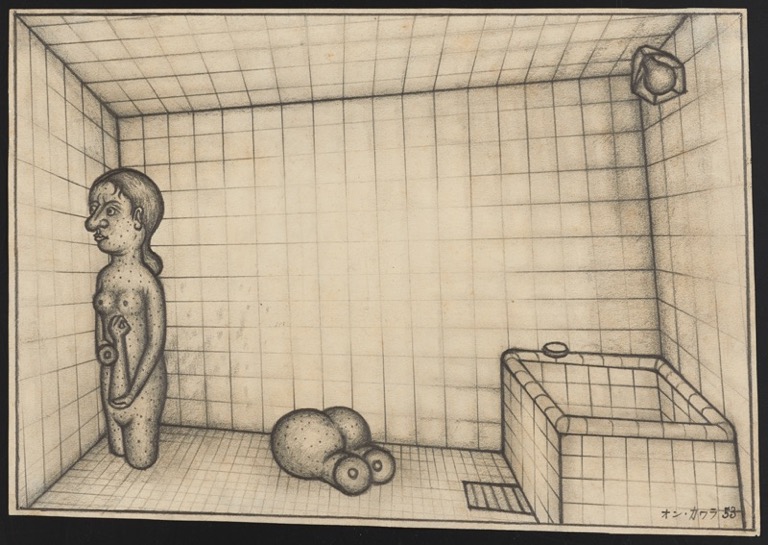
On Kawara, Bathroom, 1953-54, drawing one of 28.
The female figure is holding her own chopped-off arm. A pair of thighs go unclaimed. The whole room is tiled and there is a tiled 'bath' as well as a bath-mat, a soap and a lightbulb. Rich pickings for the curious mind? The beginnings of a vocabulary that will be put to robust use.
Isn't this the kind of work that George Grosz made in Berlin after Germany's defeat in the First World War? Would On Kawara have seen such work? I guess Tokyo's art scene and its bookshops would have had much to offer. Franz Kafka had been translated into Japanese since the late 1920s. Metamorphosis, The Castle and The Trial would all have been available in Tokyo for those who knew where to look.
Back to On Kawara's bathroom. In contrast to his Smallpox composition, here the people are pock-marked but not the environment.
I have read that both hard and soft pencils were used by On Kawara in order to produce this drawing. And an eraser has also been employed on the middle section of the back wall to get a more realistic, reflective surface. No effort has been spared to please the receiving eye, eh viewer?
Next?
On Kawara, Bathroom, 1953-54, drawing two of 28.
So what do we have in this second image? The same room seen from a different angle. The woman has turned slightly so as to face into the room's corner that she was nearest to in drawing one. The bath-mat has disappeared and a tap has appeared above the bath. Ah, the promise of clear, running water! The pot that appears in the Thinking Man painting has put in an appearance. The pair of thighs hasn't moved, how could they, but three lopped heads have appeared on the scene. At least that's what one assumes they are from the presence of ears and the consistent head-neck conjunction.
Neat rubber work, On Kawara. My eye loves to stare into the middle of the back wall. In that way getting a rest from the horrific environment. Does that parallel what the woman in the corner is doing?
Next?
On Kawara, Bathroom, 1953-54, drawing three of 28.
The tap has filled the bath and the fact that the water has settled to a true horizontal draws attention to the sloped lines of the room. The light has shifted from one side of the room to the other, so our minds know to expect these kind of changes. The woman is now pregnant, though her arms are coming and going a bit. Is her right arm bent behind her back or simply missing from just above the elbow?
The artist has used soft black pencil to suggest damp, top right. He has used his rubber to continue to reflect the light from the middle of the back wall. My eye soaks it all up.
Four?
On Kawara, Bathroom, 1953-54, drawing four of 28.
A similar scene to drawing three. But the tap has disappeared and the light has moved from one side of the room to the other. The woman is no longer pregnant. But nor is she pock-marked. In fact, this is the first image where none of the bodies, though missing parts, are pock-marked. Do we take that as a good sign? Are there grounds for optimism here?
Five?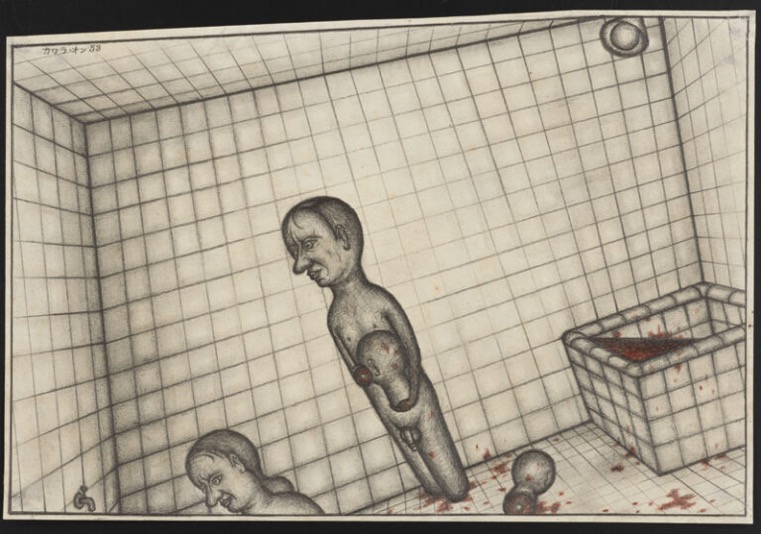
On Kawara, Bathroom, 1953-54, drawing five of 28.
Could it be entirely coincidental that the appearance of the first male figure coincides with a bathfull of blood? Has he killed his own child? Is this the time to notice that the features of the people are occidental rather than oriental? Or is that not quite the case? Are the eyes, for example, drawn in such a way that they could be seen as either Japanese or Western?
Six?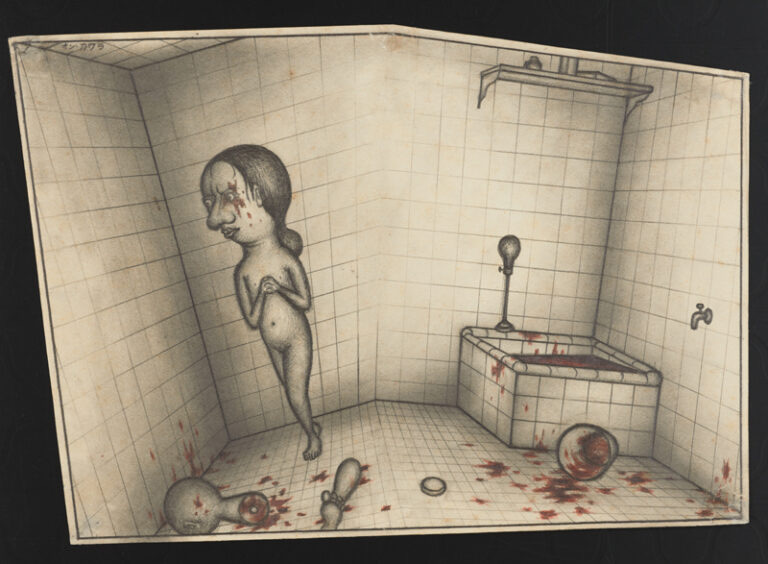
On Kawara, Bathroom, 1953-54, drawing six of 28.
Thank goodness the violent male has gone.
The tap is back. But is not usefully placed re the bath. The lightbulb on a stand looks like the 'sceptre' that the central figure, a pregnant woman, held in Smallpox. The woman in Bathroom six is neither pregnant nor pock-marked. Are things looking up? Does she have a future she can begin to plan for? Too soon to say. Though a glance towards the bath strongly suggests putting her hopes on hold.
Seven?
On Kawara, Bathroom, 1953-54, drawing seven of 28.
The woman is pregnant again. I wonder how that happens, since no-one looks capable of so much as talking to anyone else.
She would seem to have torn the lamp from its source of electricity. Not much light will be emanating from that, then.
This is the third image running that features a blood-filled bath. Though the first to have a bodiless head bobbing around on the surface. Actually, that's not quite true. One could imagine the male figure bathing in the bathfull of blood. Cleaning up after another busy day spent butchering other people's bodies.
The mirror is a new feature. It reflects nothing.
The tap is back in place. Could that be a positive development? I am always trying to look on the bright side. So was On Kawara, I suspect. Or at least searching for the merest glimpse of a way forward.
Eight?
On Kawara, Bathroom, 1953-54, drawing eight of 28.
Perhaps the reappearance of the tap above the bath has proven a blessing. The blood has gone and has been replaced with water, Fresh, re-freshing water, I trust. Though the truth is, it's only glimpsed.
Three women now. Something disturbing occurs to me. Are the women giving birth to the bodyless heads? If so, that is bad news. A head needs a stomach to survive, just as it needs its legs to walk around on.
And the pox is back. The pox is back with a vengeance.
Nine?
On Kawara, Bathroom, 1953-54, drawing nine of 28.
The mirror has got a lot bigger, but there is still nothing to see in it. No reflection.
The pox has abated, but butchery is rife. That may be because there is a man in there. At least one man.
On a technical note, I think this image can be viewed from four different perspectives. Let's give the rotating function in Photos a spin…
On Kawara, Bathroom, 1953-54, drawing nine of 28 (turned 90 degrees).
Oh Lord, we are in Hell. And I blame the legless man for that. He that is now dominating the scene below, surrounded by bloodied heads and limbs.
On Kawara, Bathroom, 1953-54, drawing nine of 28 (turned 180 degrees).
Violence, dismemberment and death from any angle that we look… 
On Kawara, Bathroom, 1953-54, drawing nine of 28 (turned 270 degrees).
This hell is what the mirror refuses to disclose. Don't think about it and it can't be happening. If those poor creatures don't think about it, then it can't be happening to them.
Ten?
Really? Am I ready for this? For I - like you, dear reader - am effectively looking at these images for the first time. 
On Kawara, Bathroom, 1953-54, drawing 10 of 28.
It's tempting to show the three rotations of this image, especially because of the orientation of the bath, but I'm resisting doing that. A man might be revealed. Less is more.
Picture the tap turning on, and the water spilling off the tiled 'top' of the bath and wetting the 'floor'. But don't let that distract us from observing that the pox is back. The blood is gone but the pox is back. Which means that when the head emerges from the womb it will already be marked by death. Marked by death for death. Though what would be the point in living in such nightmare?
If you feel like taking a break at this stage (I do) then please take one. Pluck a pheasant. Fill a bath. And then when you're ready for more mayhem, come back to this text.
Ten down, eighteen to go.
TWO
This eleventh image returns to the stitching technique, or hairy effect, used in Thinking Man and Smallpox.
On Kawara, Bathroom, 1953-54, drawing 11 of 28.
The worms are a new feature. They are all over the floor and some are climbing up the tiled walls in the left half of the image. Oh, and up the sides of the bath. This image is strongly orientated between floor and ceiling, there can be no thought of rotating it to try out the view from other angles. That wouldn't work.
The colour in the bath is not the same as the red that was used before. It could be a pile of radioactive dust, I suppose.
Many of the seven detached heads are smaller, suggesting children's heads. And the lightbulb is drawn in the way it is, swinging from the ceiling, for the first time.
Twelve?
On Kawara, Bathroom, 1953-54, drawing 12 of 28.
This looks to me like it was drawn before any of the others we've so far looked at. It's On Kawara that has numbered the drawings from one to 28, because that's the order in which he wants them to be considered, but that doesn't mean he drew them in that order. A few were drawn in 1954 rather than 1953, but the 1953 ones don't all come first. The 1954 Drawings are numbers 24, 26 and 28.
The face on the woman is more expressive. She is perhaps lamenting the loss of the woman (not a plucked chicken) that lies along the back wall.
I say again that the stitching of the figures, which looks like a covering of hair, is a hangover from Thinking Man and Smallpox. The tiling on the wall is faint and the floor consists of floorboards. These are all decisions that On Kawara would gradually revise until he had obtained an aesthetic that satisfied him for this series. And then he started with image number one, where all the main decisions had been worked out. Faces expressionless. Tiling on all four surfaces the same. And so on.
Thirteen?
On Kawara, Bathroom, 1953-54, drawing 13 of 28.
Whatever that is in the bath seems to have some relation to the purple-covered contents of image eleven. But rendered harmless by being colourless.
Again the head of the pregnant woman is done in a different way. It begins with an egg and ends with quite a detailed face. Preliminary decisions, I would suggest. And the headless child, which looks like a supermarket fowl, gives too much away. Indeed the infant's head and legs lie close to hand.
The two lights would seem to be alternatives. A wire dangling from the ceiling, or one that has been ripped from a wall? Both have been rendered inoperative by removing them from the electric circuit, so it's not much of a choice.
Fourteen?
On Kawara, Bathroom, 1953-54, drawing 14 of 28.
Now we are back up to speed. Or almost. Does the pock-marked pregnant woman in the above image have knickers on? Surely this bathroom is a knickers-free zone.
Fifteen?
On Kawara, Bathroom, 1953-54, drawing 15 of 28.
All mature pictorial elements would seem to be in place. Everyone pock-marked. I feel this is another drawing that can be rotated three times:
On Kawara, Bathroom, 1953-54, drawing 15 of 28 (rotated by 90 degrees).
A man in the mix again. But no blood this time. For how long will that state of affairs last?
On Kawara, Bathroom, 1953-54, drawing 15 of 28 (rotated by 180 degrees).
Not long, suggests the expressions on the two almost whole-women's faces
On Kawara, Bathroom, 1953-54, drawing 15 of 28 (rotated by 270 degrees).
One woman has forearms and is not pregnant. The other has no forearms and is not pregnant. I fear for them both.
Sixteen?
On Kawara, Bathroom, 1953-54, drawing 16 of 28.
Something of a population explosion seems to have occurred. The woman wearing knickers is still there, though the knickers are actually tights. She is one of four pock-marked figures, at least one of which has male genitalia, though I take that person to be the woman who has been the principal protagonist so far. What is she holding in her hand? The sceptre cum light-on-a-stick has develop a kink. Let's go for a spin…
On Kawara, Bathroom, 1953-54, drawing 16 of 28 (rotated by 90 degrees).
Almost an elegant pose is struck by the handless woman in the foreground of the above. Let's take it round another 90 degrees….
On Kawara, Bathroom, 1953-54, drawing 16 of 28 (rotated by 180 degrees).
Two women are not pock-marked, one of whom is pregnant.
It could be said that everything is floating around. Why not? It's up to On Kawara as to whether the usual laws of physics apply.
Seventeen?
On Kawara, Bathroom, 1953-54, drawing 17 of 28.
The male genitals are back with the person that looks like Hitler. While the main woman seems to have thought of a use for the straightened-up light on a stick.
Four figures, two legs between the four of them. Not a recipe for success in life. But add a shelf with a bottle of wine and who knows what might yet be salvaged from this scenario.
Eighteen?
On Kawara, Bathroom, 1953-54, drawing 18 of 28.
The colour green has been introduced. A day-glow green that bears some relation to the radioactive pink of two of the drawings. Green algae in the bath? Green goo all over the dismembered body parts. Green tears running down the cheeks of the man who reminds me of Hitler. Did Hitler only have one leg and no forearms? That would explain an awful lot of exaggerated posing and compensating behaviour of his. Hitler? We've long known he was principally responsible for Auschwitz. But for Hiroshima too? Well, On Kawara has thought harder about it than I ever will, so I'm going along with the conclusion.
All pox-ridden except for one head (detached). One flaccid penis (on Hitler) and one excited male member on a detached (I almost said dismembered) pair of thighs.
Nineteen?
On Kawara, Bathroom, 1953-54, drawing 19 of 28.
The worms are back. They are emerging from what may have been a plate of food.
Three adults in the room. None looking too happy. Pox-ridden and worm-infested, yes, but far from happy.
Twenty?
On Kawara, Bathroom, 1953-54, drawing 20 of 28.
The woman would appear to be in labour. She heaves and the world heaves with her.
Twenty-one?
On Kawara, Bathroom, 1953-54, drawing 21 of 28.
Same aesthetic as the last image. Poxy and bulbous. The swollen light swinging dangerously from the ceiling. Those elements which have been added to the scene sticky with blood. The room looking as if it's made of glossy paper walls that are folding in on themselves.
Twenty-two?
On Kawara, Bathroom, 1953-54, drawing 22 of 28.
Same aesthetic as the last two images, with bulging walls and increasingly bulbous heads and bodies. An eyeless woman is stamping on worms that crawl up the wall. Is that right? Perhaps the eyeless woman is trying to jump clear of the worms, into the upper chest and face of a legless woman whose long-suffering face we might recognise.
And who is that looking in vain into the mirror? Could it be Billy-the-Fish, the cartoon character that occasionally crops up in Viz? First Hitler, now Billy-the-Fish, were there no limits to On Kawara's vexatious vision?
Let's have another break. When you get back from your very own bathroom there will be six final images to engage with, all of which share the same kind of light-bulb and which, I would imagine, were drawn one after another in fairly quick succession.
THREE
Twenty-three.
On Kawara's note to self: 'I'm going to need a bigger bulb.'
On Kawara, Bathroom, 1953-54, drawing 23 of 28.
On had got himself a much bigger bulb. Though I still can't get comfortable with the egg-heads. No sign of the pox and no blood, though. And it seems that the tap is the source of the green that we've seen in just one other image.
The green and egghead motifs crop up in just one other image each. They could have been left out of the whole series, in my opinion. But it's On Kawara's opinion that counts.
Twenty-four?
On Kawara, Bathroom, 1953-54, drawing 24 of 28.
On has gone to Tokyo's IKEA and he has come back with much bigger bulbs, the size of Chinese lanterns. This is almost a positive scene. The two human figures could be flying. There is a lot of light coming from the glowing spheres.
No blood and no pox. For how could it exist in such lighting conditions?
Twenty-five?
On Kawara, Bathroom, 1953-54, drawing 25 of 28.
Hang on, we seem to be losing touch with the human. There are two feet attached to legs in this image but no heads. Also, which way is up?
On Kawara, Bathroom, 1953-54, drawing 25 of 28 (rotated by 90 degrees).
What has happened to the tap? And that mirror has never been so prominent. Though still reflecting nothing. There is no face, however blank of expression, to look into it any more.
Twenty-six?
On Kawara, Bathroom, 1953-54, drawing 26 of 28.
The bulbs are coming detached from the ceiling. I hope On has kept the receipt from IKEA.
The body-parts have lost all human detail, except for a few feet.
Twenty-seven?
On Kawara, Bathroom, 1953-54, drawing 27 of 28.
Everything in the bathroom is on the move.
The glowing spheres of light.
The body parts that would seem not to be body parts, mere metal or plastic tubing.
Twenty-eight and final?
On Kawara, Bathroom, 1953-54, drawing 28 of 28.
All the Chinese lanterns (traditional Japanese lighting?) are detached from their moorings.
Most of the body parts are pulling together, as if magnetised.
Or are they plumbing accessories? If you strip down a toilet is this not what you find? Ball-cocks, plastic tubing and metal piping.
OUTRO
Later in 1954, On Kawara made a single painting called Pregnant Woman that was also donated to Tokyo's Museum of Modern Art. Below is the way it's intended to be displayed. Upside-down, as it were:
On Kawara, Pregnant Woman, 1954.
We need to see it from all angles… 
On Kawara, Pregnant Woman, 1954 (rotated by 90 degrees).
No pox and no blood. One strong woman with four clear-eyed companions.
On Kawara, Pregnant Woman, 1954 (rotated by 180 degrees).
The woman is looking the viewer straight in the eye. The sceptre she is holding onto would seem to be a promise of pearl-white light, mindfulness and strength.
Not all is good, of course, the tap is pointing away from the bath which is filled with an opaque substance, whether liquid or solid it is impossible to say.
On Kawara, Pregnant Woman, 1954 (rotated by 270 degrees).
Does the baby stand a chance? One would have to say, yes, with a mother as resilient as that and no sign of a violent man (I remember with love-soaked gratitude my own, British parents).
But as the years went on, On Kawara didn't like the way that post-war Japan was evolving. A painful but necessary confrontation with the failure of patriarchal society just wasn't happening. He had tried to show the way - atrocious and painful though that effort was - but others were uncomprehending.
True, he was famous in his homeland. But what was fame in a bathroom? What was fame in a cold, comfortless, oblivion-embracing society?
And so he left.
Note
This chapter was begun on July 17, 2024 and finished the same day. Otherwise it would have had to be destroyed. That is a joke intended to be understood by those readers who are familiar with On Kawara's momentous achievements a few years later in a loft in New York (surely some relation to Beckett's mew in West Brompton).