THE ON KAWARA SHOW
I GOT UP at 4.50 A.M. That's because today, DEC.13, 2024, I'm making a return trip from Glasgow to London in order to see the exhibition of 24 On Kawara Date Paintings at the David Zwirner Gallery in Mayfair. Bring it On!
I knew it would take 35 minutes to walk from Kate's flat to Glasgow Central, and so it proved. Ten minutes wait now for the 6.29 A.M. train which will be the first to leave from platform one. Am I excited by the prospect of the day ahead? I am indeed. Could I do with still being in bed, deliciously asleep? Yes, sirree! I could justifiably have called this essay 'Deferred Gratification'. I GOT UP at 4.50 A.M. I still can hardly believe that fantastical claim…
The train is empty, obviously, given the time of day. I expect it will pick up passengers in the north of England by which time it will be after eight o'clock. Several stops around there, then like an arrow straight to Euston from Warrington. 
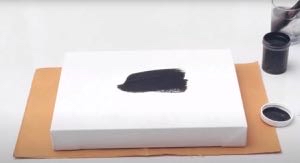
I have a Date Painting with me, which I made two days ago. If I'd been bolder, then perhaps I could have managed to do a 'DEC. 13, 2024' while sitting in my seat, finishing it off on the return journey. But then what if someone occupied the window seat as the electronic indicator suggests will happen in Lancaster? Every time I've attempted a Date away from my home space, it's turned out decidedly wonky. And there is no way I would be able to achieve any kind of acceptable result with the train moving at speeds of up to 125 M.P.H. So, DEC. 11, 2024, it has to be.
I haven't yet decided whether I'll be taking photos of my own Date amongst On Kawara's Dates. The gallery I am heading towards is an elite space and the gallerists are trying to sell paintings at several hundred thousand pounds each. So they won't want me playing games in their territory. They won't be interested in where I'm coming from, where the only wealth is life.
However, I have high hopes of this particular show. On Kawara specified when he died that there be no new exhibitions of his work for ten years. Now that ten years have passed, there are simultaneous shows up in Paris and London. Jonathan Watkins has told me that the exhibition I'm going to see has been curated by Hiroko and Angela Choon. The latter is senior partner at David Zwirner's London Gallery and, like Jonathan, personally knew On Kawara from about 2000. So that augurs well.
The show opened towards the end of November and is fully documented on the David Zwirner website. There are images of all 24 of the paintings and I already know that it manages to engagingly cover a lot of ground. Five different sizes of Date Painting are present, from size 'A' to size 'E'. The latter is pretty big, and I'm not sure there has ever been a size 'E' Date exhibited in the UK before. The show I saw at the Lisson Gallery in 1992 consisted primarily of size 'B' Dates, plus one size 'D' (I've checked). And the large show that Jonathan Watkins hosted at Ikon Gallery in 2002 were all near-black, pictures of various sizes made on a Sunday, but I don't think any were as big as size 'E' (I haven't checked).
Almost all of the Dates in the show are near-black, but there are two blue and two red Dates. Which is about right in terms of the spread of colours of Dates painted overall from 1966 to 2013. The red Dates in particular shine like jewels on the Zwirner site. I can't wait to see them in the acrylic flesh, as it were.
Most of the 24 Dates were painted in New York, but eight were made elsewhere. Two on the same day in Mexico City, and one in each of Halifax (Nova Scotia), Columbia (South Carolina), Detroit, Berlin, Munich and Montfavet (Avignon, the south of France). An obvious omission is any Date from Japan, as On Kawara and family spent months there every year from the mid-eighties onwards. But perhaps the Dates made in Japan tended to find homes or gallery representation there.
Each of the twelve months is represented, but the only months that crop up three times are June, July and August. So there is a slight summer bias to the show. Yes, I have done my homework, and am primed to get the most out of this visit. With that pleasant and self-congratulatory thought I will see if I can fall asleep…
OK, we have arrived. (I say 'we' as if everyone on board is going straight to the On Kawara exhibition in Mayfair.) The train is 45 minutes late and it is mid-day. It has taken me five hours and ten minutes to get here from Glasgow, whereas, dear reader, it will have taken you about four minutes to have read this far. That's a multiplier of at least 80. Just think how much of my finite time I have sacrificed so that you can conserve so much of your own.
Well, no, I have made this journey for my own selfish reasons, but am glad if a by-product of it - just might be - other people's pleasure.
*
Decision time. Do I take my own Date Painting into what is clearly a sublime show, or do I keep it in my backpack for the duration of my visit? Answer comes there none.
For a few seconds, let me just enjoy the juxtaposition of my size 'A' Date with Kawara's size 'E' one. Assuming the poster is a life-size reproduction, that is.
I'm in no hurry, so I step over to the other side of Grafton Street to take a few pics, which I will refrain from commenting on at length. But just in case of inspiration, I clear my throat.
Me: "Red is the new black."
Me: "Red is the new black." 
Me: "Red is the new black… Oh, forget it." 
Am I exaggerating, or are two of the last three passers-by dressed like David Bowie in The Man Who Fell to Earth?
As soon as I step into the gallery I am politely requested to leave my back-pack in the vestibule area. So that's that. Somewhat relieved not to have to think about my Date Painting dilemma any more, I walk into the first gallery…
And WOW! Five size 'E' Dates from the inaugural year of Date Painting. 
As well as the above three near-black diamonds, there is JULY 22, 1966 on an adjoining wall and OCT. 19, 1966 on the wall opposite the JUNE 8, JUNE 25 and JULY 11 Dates: a summer triptych. Of course, size 'E' was not typical of the Dates made in that year. The Dates began at size 'A' and only gradually got bigger with the first size 'E' being painted in April. But what the opening room's installation does is underline the momentous ambition/achievement of the Today project.
TODAY…………………………….TODAY ………………………TODAY…
WHAM!!!………………………. BAMM!!!………………………. THANK-YOU, MA'AM!!!
There is a perfection about the finish that is emphasised in these three large paintings. The white of the characters is flat and pure-edged. I could stare for a long time at those black circles inside the numbers 6, 8 and the 9 of JUNE 8, 1966. Having tried and failed to get anything like as good a finish as is displayed here, I have to acknowledge the superb craftsmanship of On Kawara.
In an adjoining room on the ground floor are a 1967 Date, a pair of Mexico City (same day) Dates, and a painting from when On had returned to New York in 1969. 
It's the red, 1967 painting that I scrutinise for longest. 
Reproduced thanks to the understanding of the One Million Years Foundation
It was on June 2, 1967, that Nobu Fukui - On's close friend and neighbour, as attested by innumerable 'I MET' lists and 'I WENT' maps - told me he borrowed On Kawara's set of templates to make an upside down, back-to-front Date on an orange background. What strange fruit. He volunteered so much detail about this previously unspoken about event - it was a birthday present to himself - that it was obviously a true story. Which implies that On was using templates at this time, though the slow evolution of the font he was using suggests that he wasn't using templates to begin with, at least for the first half of 1966. The use of templates was something that, according to Nobu, On Kawara didn't want the general public to know about. 
Reproduced thanks to the understanding of the One Million Years Foundation
I've never had such good view of a Date Painting. This must partly be because of the lighting in the David Zwirner Gallery. Although the white paint of the characters is perfectly flat, the red paint close to the curves of the numbers and letters shows evidence of heavy working.
Look at the '2' for example:
On the inside of the top curve, the red sweep of a brush is evident, all the way down the slope to the acute angle at the foot of the number. Just the tiniest piece of evidence that a human eye has worked in conjunction with a hand-held brush to get this exquisite end product.
And look closely at the '9'.
It seems to me that On has been guided by a very sharp pencil line. Not something that could have been achieved by hand and ruler alone. I believe that a template (or a compass) would have been needed to get such a perfect result on a curve. Which On has rendered into paint through the careful application of fine brush to canvas over several hours. Nobu Fukui told me - in answer to a question I put - that he never saw On Kawara use a stencil to aid the accuracy of his painting (template, yes; stencil, no), rather that he always used a fine brush directed by his unaided eye.
I don't think it really matters what On Kawara used in the way of tools. He invariably used a ruler to draw two horizontal lines across the canvas to mark the top and bottom of the characters, for example. More important was the rule that each painting began and finished in the same 24-hour period. Another anecdote told me by Nobu emphasised how seriously he took that rule. Today, in other words. Never tomorrow. Or yesterday. 
It's quiet in this room. I am facing NOV. 13, 1969 as I take a photo of JUNE 21, 1967 over my shoulder. I consider going back to my pack, extracting my DEC. 11, 2024 from it and calmly walking back to this gallery, placing it on the floor underneath JUNE 21, 1967 and taking a photo of the paintings one above the other. Nobu would be so proud of me! However, I have no intention of doing that. Not while I have so many original works by On Kawara to feast my eyes on. Let sleeping dates lie.
The show is on two floors. As I reach the top of the spiral staircase I take this next picture. Same carpet as on the Avanti train? More or less.
In the first gallery upstairs is hung a row of ten Dates, one from each year in the seventies. A fabulous (and fabulously simple) piece of curation. The eye is drawn to the biggest Date, third from the left, and the red Date, third from the right.
On Kawara was Date Painting at full blast throughout this decade. Moreover, 'I GOT UP', 'I WENT' and 'I MET' were produced every day until late in 1979. So that meant two postcards being composed (with use of rubber stamp) and sent out every day, just for starters. I've written an all-text book about this period in On Kawara's working life, called Timeshine, and I expect it will be published sooner or later.
Reproduced with the forbearance, I hope, of the David Zwirner Gallery, London.
But the seventies wasn't just the decade of On Kawara. If you're looking for a decade to commemorate the cultural achievement of the second half of the Twentieth Century, it has to be the seventies because of when World War 2 occurred. The Western world was recovering throughout the fifties, began to get going in the sixties, and caught fire during the seventies. After that came burn out, down-time and decadence. Or am I putting the seventies on a pedestal partly because I went from being twelve to twenty-two in the decade, a time of growth, potential and optimism for me, as I went from keeping my head down at school to taking a place to read Geography at Cambridge University?
I could go through the seventies, saying what each year meant for me. But in saying this I realise I'd be just as interested in going through, say, David Bowie's 1970s. He produced an album every year throughout the decade. And I can't resist adding the 1970s of Samuel Beckett. He had been awarded the Nobel Prize in 1969 (as highlighted in On Kawara's 'I READ' in October of that year) and every scrap of writing that he managed throughout the seventies was published as a slim volume by John Calder's publishing firm in London. 
The seventies in terms of cultural product? For me, that primarily means these wonderful acrylic-on-canvas Date Paintings by On Kawara. Plus the 12-inch vinyl discs with their glorious covers featuring an image of David Bowie. Plus those slim volumes with Samuel Beckett's name on the dust wrapper and Calder and Boyar's address on the back.
Actually, the line of Date Paintings in front of me insists that the seventies are to be savoured. We will not see its like again. So let's slow down and take one year at a time.
In 1970 I was living in Hamilton near Glasgow. My diaries exist as physical objects but can also be found online on a private website. My 12-year-old self's diary entry for AUG. 27 of this year can be accessed via my iPhone. Alas, it is embarrassing, but it must be disclosed: 'Beat Red Rovers 6-2 at football. I scored one goal. Played freezy-in. Played shoots. Kenneth came up. Got more cards. Jean and Escel bought us tablet.' Could the 'cards' be a reference to receiving 'I GOT UP' cards from On Kawara? If only! If only, then my childhood would have taken a different shape to what it did. But I've no complaints. You take whatever portal to a spiritual plane presents itself to you. We all do.
Bowie released his third album, Man Who Sold the World, in 1970. A young dude's best friend. And Beckett's Lessness was printed in hardback that year, large print over 20 pages. A bibliophile's wet dream.
OK: 1971. Let's line up the shot…
Did I make a diary entry for NOV. 6, 1971? I did indeed. It was a Saturday. 'Played golf got a 63. Was second out of three. Rangers 4 St. Johnstone 1. Liverpool 3 Arsenal 2. Went to see Motherwell v Hearts. Motherwell won 5-3. Heron got a brill hat-trick. Swotted statistics.' I had just turned 14 when I wrote that overly competitive twaddle.
What does On Kawara's three-part diary tell us about his day? For this all I need do is switch to Tama Art University's On Kawara database. The 'I GOT UP' card went to Dr Jost Herbig (the first person to buy any Date Paintings; he bought ten, mostly from May of 1971, but also one from April and one from October of that year) telling the art-collecting scientist that the artist got up at 9.29 A.M. On woke at 65 East Broadway, which was Kasper König's New York address. The 'I WENT' tells us that he went north a few blocks and then came back and went south to Brooklyn, from where he did not return that day. The 'I MET' list begins with Hiroko, then it's Ilka (Kasper König's first wife), then Soroku (another of On Kawara's closest friends), then Joseph Skorupa, Shu Takahashi and Takako Takahashi, all of whom were people that On regularly met.
By checking out the 'I GOT UP', 'I WENT' and 'I MET' for the day before and the day after, the picture of NOV. 6, 1971 becomes sharper. On was living between his own and the Königs' address (Kasper, Ilka and their daughter Lili all crop up on 'I MET') and socialising with the Japanese-New Yorker artist community.
In 1971, Bowie released Hunky Dory, which is full of songs that have remained popular ever since. There's even one about Andy Warhol on the album. Meanwhile, Beckett's Imagination Dead, Imagine was reprinted by Calder and Boyars, the tidy/tiny little volume running to 14 pages. Though the pages with the text on them start at number 7.
OK: 1972. Let's consider this larger Date Painting. Though it's size 'D', not as big as those five size 'E' Dates from 1966 that glorify the downstairs gallery:
My diary entry for Tuesday, APR.18, 1972: 'Played football. Walked from school. Swotted physics, one hour.' Which doesn't tell us much, just that the playing of football was my main escape from school at the time, though there were others. One of whom I'll come to very shortly. But first, what does On Kawara's self-observation for the day reveal? Over to the Tama website…
The 'I GOT UP' card is addressed to Doug Waterman at Nova Scotia College of Art and Design, Halifax, Canada. It tells us that On got up at 11.05 A.M. from his bed at 340 East 13th Street, New York, 'I MET' tells us that On didn't see anybody except Hiroko that day, though he did travel to a place near Grand Central Station according to 'I WENT'. When I say he didn't meet anybody, a meeting with his good friend Soroku and the Iimuras (Akiko and Takahiko) must have gone on until after midnight the previous day. In other words, these names are at the bottom of 'I MET' for April 17, and appear again on the April 18 list.
Back to me. It was 1972 when Ziggy Stardust and the Spiders from Mars was released by David Bowie. I've never stopped listening to that album. The cover shows Bowie standing under a streetlight in an alley lined with cardboard boxes and parked cars. That was Heddon Street, which is in Soho, as is Brewer Street where Beckett's publishers were located. My present location at 24 Grafton Street, Mayfair, makes a neat little, walkable triangle when put with 18 Brewer Street and 23 Heddon Street. What else do I want to say in a 1972 context? Calder and Boyars published Beckett's The Lost Ones in a 63-page volume.
And so I have at the front of my mind, the following things. My growing self. On Kawara's paintings, David Bowie's music and Samuel Beckett's writing. The youngster soaking up the other three. Though at the time, I realise, I only had access to Bowie's music. That was the portal my adolescent self was able to take advantage of.
I have to say I'm feeling a little self-conscious standing here doing all this. There is an invigilator in the room and I dare say he's wondering why I'm taking photos of a white wall (the wall opposite the line of seventies Dates is blank). Though I dare say he's worked out what I'm actually doing with my iPhone and is comfortable with it. Next:
My diary entry is not very exciting. Anyone would think I was receiving 'I GOT UP' cards from On Kawara as 'got' appears to be my favourite word: 'Got our chemistry paper 1. Got English Language and started a good picture for the art exam. Talked in creative studies. Did physics revision.'
Let's switch to the Tama Art University resource. On Kawara 'GOT UP' at 9.23 A.M, in his digs at the Nova Scotia School of Art where he was artist-in-residence at the invitation of Kasper König. He did a fair bit of walking around Halifax that day, in the company of Hiroko, Kasper, Ilka and Hiroko. The second Hiroko, named after the first, being the Königs' second daughter whose name was shortened to Coco. No doubt that avoided a lot of confusion in the intermingling Kawara-König households.
In 1973 Bowie released Aladdin Sane, with the unforgettable album cover of Bowie's face made up to feature a flash of lightning across it. Meanwhile, Calder and Boyars reprinted More Pricks than Kicks, something Beckett had written long previously which accounts for the fact that - at 204 pages - it's a respectable size of a book. A page-turner, no less? Not exactly, no. Though it is well worth turning those pages by hand so that the mind can take in all the hard-won wisdom.
Actually, what Beckett and Kawara have in common, apart from being minimalist modernists with a highly developed sense of the absurd, is that both, in their maturity, made very simple, spare statements. They did this though they were both coming from places of complexity. On Kawara's code works, for example, show the artist being completely comfortable while dealing with extreme complexity.
Hmmm. I'm going to drop myself, Bowie and Beckett, and just carry on with the main man, otherwise I'm going to miss my train back to Glasgow. Besides, you must have got the idea by now. Picture ten albums, circular vinyl inside a square cardboard sleeve on the wall of the gallery: Man Who Sold the World, Hunky Dory, Ziggy Stardust, Aladdin Sane, Diamond Dogs, Young Americans, Station to Station, Low, Heroes, Lodger. Those can be mounted above the ten Date Paintings. Plus, below the Dates, ten slim volumes by Samuel Beckett which I would be pushed to name from memory.
And now remove the albums and the books, leaving just the paintings. Leaving room for your own personal pantheon, dear reader. Anyone who lived through the seventies can relate to this set of Date Paintings. Anyone can use the Dates to conjure up their own cultural heroes. Or whatever. I dare say some viewers would be content to refer to the cardboard boxes (not exhibited) that contain an extract from a newspaper printed on the same day in whatever city the artist was in when he made the painting.
Next:
Reproduced thanks to the understanding of the One Million Years Foundation
What does the Tama database tell me?
On March 31, 1974, On Kawara GOT UP at 8.12 A.M. in the 'Heart of Columbia Motel', Columbia, South Carolina. Hiroko and On were enjoying a road trip down the east coast of the United States. One of the two cards went to Claire Copley at her gallery in Los Angeles, a place that Hiroko and On had visited in autumn of 1973 when on a road trip from New York to California. On (and Hiroko?) seem to have just walked or otherwise travelled along a single road on the last day of March, 1974, and didn't meet anyone else.
A common pattern when on these road trips was to arrive on day one, make a Date Painting on day two, and depart on day three. If that doesn't sound like a fun lifestyle then I don't know what does. Or put it this way, it leaves a lot of degrees of freedom. Every day a new adventure in time and space.
I shuffle a little further to the right. Ready for my own next adventure:
Reproduced thanks to the understanding of the One Million Years Foundation
SEPT.13, 1975. I know without looking it up that On and Hiroko were on another road trip, this one to the Great Lakes. Sure enough, the Tama database tells me that On and Hiroko were in Detroit. They were staying in a Holiday Inn, which they preferred to do because they knew what to expect from the brand. (On did require a table on which to make his size A or B Date Paintings, which were the only sizes he attempted when on the move.) One of the postcards was going to a mysterious man called Frank Donegan in New York. On 'GOT UP' at 10.12 A.M. Hiroko and one other person were met, but I don't recognise the name, possibly an employee of the Holiday Inn. As it was a Date Painting day, On didn't walk far. It was on another day in Detroit that they went to the city's art gallery, something On and Hiroko did at every stop of their Great Lakes tour. Were they paying special attention to the glorious van Gogh paintings in the permanent collections of the municipal art galleries of Cleveland, Detroit, Chicago and Minneapolis? I like to think that they might have been.
Next, please…
Reproduced thanks to the understanding of the One Million Years Foundation
The full stop after the 28 tells us that this painting was made in Germany. On Kawara was artist-in-residence in Berlin for most of 1976. That's where he was on the 28th of August 1976. He didn't venture far from his flat on Damaschkestrasse and only met Hiroko. I hope it's as clear to you as it is to me that Hiroko was crucial to On Kawara's life and art. They travelled the world together. Shame they didn't meet Koichi and Yuri Ono on this particular day, the Japanese-Berliners that they became good friends with for most of the year of On's residency.
I have to mention in passing that both David Bowie and Samuel Beckett were also in Berlin in 1976. Bowie was there for much of the year, first teaming up with Iggy Pop and then making his solo album, Low. Beckett was there from August 29 until October 2, 1976, during which time four of his plays were staged. Why so many artists in Berlin? Well, West Berlin was spending a fortune on culture so that the Western world wouldn't forget about the city. The policy worked, in that the Berlin Wall came down in 1989 and West Berlin was not absorbed into the sea of communism that had surrounded it. Instead, West Berlin attracted East Berliners, Germany was reunified, and the Soviet Union retreated east towards Moscow.
Is all that implied by the pellucid size 'B' black canvas? It is to me.
Next:
Reproduced thanks to the understanding of the One Million Years Foundation
This is as arresting visually as the single red canvas downstairs. And there's also a story attached to it. Hiroko must have known she was pregnant by the autumn of 1977, and as soon as On was informed he began to paint red Dates almost exclusively. He had never done this before. Previously the proportion of red Dates being less than 10%. Much less than 10%. From November 1977 to April 1978 I have seen 17 red Dates and only three black ones and no blue ones. Red in Japan stands for protection and strength. I would suggest that On Kawara was rooting for his wife and child-to-be.
But let's not ignore the ongoing self-observation. On December 29, On Kawara 'GOT UP' at 9.54 A.M. and sent a card to Hans Bohning in West Germany. He rose from his bed on the sixth floor of 140 Greene Street, a loft that On and Hiroko had bought, encouraged by Nobu Fukui's advice, and which would remain their permanent home. On went north to the junction of 86th Street and Second Avenue. The only people he met that day were Herbert and Dorothy Vogel who were humble art collectors (a post-office worker and a librarian). They had a small income which they bought minimalist and conceptual art with, only buying what they could carry home to their New York flat. It says on Wikipedia that they lived on Manhattan's upper east side, and that they stored their art in closets and under the bed, so I would guess that the art-stuffed flat was where On was going according to the red line of biro on his 'I WENT' map. On sent them 'I GOT UP' cards in 1968, 1969, 1970, 1972 and 1973. And the very first 'I AM STILL ALIVE' telegram went to the Vogels in 1970. So he must have valued Herby and Dorothy's approach. I'd like to research that further but now is not the right time.
Next:
Reproduced thanks to the understanding of the One Million Years Foundation
Akito was born in the middle of April, 1978. By May, On could afford to relax. He could go back to black. Akito had been named ten days or so after birth, as was the Japanese custom. In other words, he had begun to appear on the 'I MET' list from April 23, 1978. However, he wasn't on the May 2 list.
The people On Kawara met on May 2 were Hiroko; Hiroko's mother (having flown from Tokyo to New York to help look after the baby); three members of the Torres family, who lived above the Kawaras at 140 Greene Street; and three members of the Bray family, being Ansell Bray, his wife Dina and their child Samantha. Ansell Bray is another of the few New Yorkers who have been willing to answer my questions about On Kawara. Mind you, he asked Hiroko for permission before doing so.
On Kawara was part of a tightly knit friendship group, and the surviving members of that group continue to show great loyalty to his memory. They knew he chose secrecy and privacy and they are helping to preserve such a legacy. Which doesn't leave much material for potential biographers to work with. Though I would maintain it's perfectly possible to write about On Kawara in a way that respects his privacy, simply by joining the dots of his self-observation series. By which I mean, dotting the 'i's and crossing the 't's, of his 'I GOT UP', 'I WENT' and 'I MET' material.
Which is what I've been doing. It's only because Nobu Fukui's name is on so many 'I MET' lists, and his address is on so many 'I WENT' maps, that I approached him in the first place. I think I know why he broke ranks and said as much as he did to me. But that's for another day.
Next:
Reproduced thanks to the understanding of the One Million Years Foundation
Again, the full stop after the 12 tells us that this painting was made in Germany. If it had been painted in France it would have been exactly the same but with no full stop after the 12. This painting was made just a few days before the three self-observation series came to an abrupt end. The 'I MET' list for the next day, the 13th of September, includes Kasper König, Kasper's wife, Ilka, and Kasper's lover, Edda Köchl. The 'I GOT UP' for 12 September, and until the end of the series on 17 September, would go to to Anna Astner in New York. Anna being, I strongly suspect, Kasper's previous lover and the woman he was trying to get physical distance from when he moved his family from New York to Munich. Only for Kasper to make a new attachment with Edda…
It seems unavoidable that Edda, Ilka and Anna would feature on 'I MET' lists. But On was making things trickier for himself (and Kasper) by sending 'I GOT UP' cards to Anna Astner from Munich, following a set of 'I GOT UP' cards to Edda Köchl from New York, following a set of I GOT UP cards to Lili König (Ilka's first child) from New York, Hong Kong, Seoul and Tokyo.
The story is that On's briefcase was stolen from him in Stockholm on September 17, 1979. Without his rubber stamps he couldn't compose the 'I GOT UP' cards. In my view this alleged robbery may have been a device to stop people focussing too much on the 'I GOT UP', 'I WENT' and 'I MET' data in those last few months of it.
So thats's it: the seventies. On Kawara would never have a more creative period. (Nobody would.) That's partly because, during the eighties, On had two children that needed raising. He wasn't the sort of guy to leave all the parenting to Hiroko.
There is one Date Painting on a side wall of the seventies room. I guess this has to stand for all the Dates that On Kawara made in the eighties. 
Reproduced thanks to the understanding of the One Million Years Foundation
By this time there was no 'I GOT UP', 'I WENT' and 'I MET' to provide a biographical skeleton. All I can say is that On Kawara was in New York when he painted this oily blue picture. How do I know that? Oh, just take my word for it.
And so into the final room of the show. There are three pictures in it. Again there is only one Date to represent a whole decade: the nineties. 
One thing to point out about On Kawara's Date Painting in the nineties, is that for four years in a row he recorded his process by staging a series of still photographs of his work-in-progress. He had never done this before. The first occasion was June 9, 1991 in New York. There is a little book taking us from white canvas to finished Date in 30-odd photos. Similarly documented days are… let me think… 6 AUG, 1992 (Tokyo, where he lived for part of the year)… 20 FEV. 1993 (Paris, where he bought a flat) and 5. SEPT. 1994 (Dusseldorf, where Konrad Fischer had a gallery in which On Kawara regularly had exhibitions).
I've listed these Dates because I've just realised something. In all four of the photo-sequences there are only a few images of the drawing stage. But each time the number 9 is made in the same way. That is, the upper, closed loop part is created using two complete circles, one inside the other. I don't know why I didn't realise before that this strongly suggests On was using a pair of compasses to make sure he got perfect circles. Maybe I didn't think of it because the photos are apparently being transparent in showing the equipment the artist was using, such as the brushes, paint, ruler and set-square. You even see a hair dryer on occasion, as On Kawara would use that to dry the various coats of paint. (On would start with two coats of reddish-brown, providing a symbolic link to 30,000-year-old cave paintings. Then he would apply four or five more coats of the final background colour of near-black, red or blue. Each of which needed to be dry before the next could be applied.) But in the sequences of photos there is never any sign of a pair of compasses, never mind those templates that Nobu Fukui told me about.
As we know, On Kawara was secretive and private about his life and his art practice, though he felt compelled to record certain things about both. To help square this circle, he indulged in a fair amount of game-playing. The elaborate Codes tell us as much. But I can see game-playing even in the photographic documentation of his Date Painting. Picture On Kawara with a wide grin on his face. (I know you can't, because there are no photos of his post-Japan face in the public realm.) The smiling artist is presenting an open palm on which rests the most wonderful things, which tell us so much about what it is to be alive. But you can't help wondering what's in the other hand that's hidden behind his back.
But there is another thing about these documentations of the Date Painting process. The pencil marking seems to have been done with a wide rather than sharp pencil, so that it would only be a rough guide for the paint brush even if it was a perfect circle.
Let me take a close look at the 'D' of DEC. 4, 1991:
I can see some black working on the inner side of the curve. But an excellent finish has again been achieved. I suspect that On Kawara was so in control of his technique that he could arrive at perfection by different routes. I know that when he began to paint the characters, sometimes he would start from the first and systematically work his way along the line. At other times he would start with the vertical lines, such as in the figure '1', perhaps because these are easier to do. I think he just did what he wanted on any given day, knowing that the painting would come good in the end. He knew this because the essential parts of his technique were patience, perseverance (he was truly relentless), concentration and judgement. 
Reproduced thanks to the understanding of the One Million Years Foundation
After regarding this exquisite Date for a few minutes, I picture myself asking the artist a question:
"How did you get three such perfect zeroes, On? I can't see that using a pair of compasses would have helped much."
Joyful laughter comes from somewhere just out of sight.
That's how I read this work:
JULY 16, 2000
JOYFULLY 16, 2000.
Next is the penultimate painting in the show. It's a small size 'A', like the one in my bag downstairs. It was made in Montfavet, Vaucluse, a district of Avignon in Provence.
Reproduced thanks to the understanding of the One Million Years Foundation
Provence? Arles is in Provence, the town where Vincent Van Gogh tried his best to set his visions down on canvas. Is that little upturned V over the U, a V for Vincent? I know that On Kawara had a flat in Paris at this time, bought in the 1990s, and that when Jonathan Watkins visited him there On was keen to point out the nearby flat where Vincent had lived pre-Arles with his brother, Theo.
But this is getting tenuous, let me get things back on track. In August of this present year of 2024, Kasper König died, aged 80. He'd already set up a sale at auction of his art collection, and this took place in October, with two Dates being sold, one being from the early 2000s.
21 NOV. 2003, a black Date, size B, which had been a present from On Kawara on Kasper's 60th birthday, was sold for 290,000 Euros. While MAY 7, 1967, a red date, size C, was sold for 800,000 Euros, excluding auction house fees, which took the sum actually paid by the British buyer over the million mark. The 1967 painting would have looked very like the red JUNE 21, 1967 exhibited here today, though that is size D. In other words, from the template era.
1967 was when On Kawara and Kasper König first met. On would have told Kasper that he intended to make Date Paintings for at least 20 years, possibly for the rest of his life. Kasper König would have said that they should make no attempt to sell or exhibit any Dates until On had been working on the project for five years. What a productive alliance their friendship turned out to be.
Why would the 2003 Date be sold for so much less than the 1967? Firstly, because it's smaller. Secondly, I imagine that Dates from the classic 1966 to 1979 period are more sought after. Thirdly, it's clear from the Dates held in private collections, as photographed by Candida Höfer, that red Dates are particularly popular with collectors. And fourthly, the 2003 Date was painted in Japan, so the extract from a newspaper used to line the Date Painting's box is in Japanese, drawing attention to the fact that the language used for the Date itself is Esperanto. There is something incongruous about that. In some ways, On Kawara distanced himself from his homeland, though he spent much time there when his kids were growing up so that they could benefit from an education split between New York and Japan. The best of both worlds?
I come out of the second upstairs room, and I walk back through the adjoining room with its glorious line of seventies memorabilia… 
…on my way to look at the single painting I deliberately avoided looking at the first time around. 
Reproduced thanks to the understanding of the One Million Years Foundation
This was painted when On Kawara was 79 and approximately two years away from his death. On had been given a lung cancer diagnosis. After all, his butt-filled ashtray can be seen alongside the canvas in some of the photos recording his Date Painting process. He smoked heavily all his life; child of the Twentieth Century that he was, child of the atom bombing of Japan ditto. After receiving his bleak diagnosis, On rented a flat in New York so that he could more easily be alone. Obviously, deeply, he loved his wife and children and continued to spend a lot of time with them, but equally obviously he valued his own consciousness and needed to focus on that more than ever in the short period he had left.
'I AM STILL ALIVE'. As those telegrams insisted, back in the seventies.
'I AM STILL ALIVE'. Such telegrams were sent until the year 2000, by which time the telegram was fast becoming an obsolete form of communication.
'I AM STILL ALIVE'. On never took to computers, and it is not he who is responsible for the ongoing tweet in his name on Twitter.
Is there any sign of waning powers in this 2012 Date Painting by an elderly, frail man? Not much. Perhaps the top horizontal part of the figure '1' is thicker than the width of the zero throughout its course. At corners, there is a very slight loss of sharpness. But it's still a phenomenal finish. Much better than I have been able to achieve so far. Or ever will.
I have been talking with the invigilator, trying not to bore him with my knowledge about On Kawara or the Date Paintings before us. I bring our friendly chat to an end by asking if he'll take a photo of me standing by the final Date in the show. 
I suspect the invigilator can't read my mind. But if he realised I was looking across the room at the conspicuously large APR. 18, 1972, then perhaps he would hear this:
"Keep your 'lectric eye on me, babe
Put your ray gun to my head
Press your space face close to mine, love
Freak out in a moonage daydream, oh yeah!"
But that's not how I want to end this text. Let me calm down and say what I'm seeing and feeling. I can imagine On Kawara alone in his rented Manhattan flat thinking back through the years of his Date Painting. He made about 4,000 Date paintings between 1966 and 2012, and I've had the privilege of regarding 24 of them today. Lots have been sold over the years. And lots must remain in the hands of On Kawara's estate, the Million Years Foundation.
But that's not what On Kawara would have been thinking about while standing in his rented flat looking out over New York. Perhaps he thought back to Paris in 1977, when an 'I WENT' shows that he took a lift to the top of Montparnasse Tower, the highest building in Paris, on a day when he had seen three months' worth of 1970 Dates (97 in all) installed at the newly opened Pompidou Centre. A wondrous vision manifested in a world class art venue. Time all but tamed.
2024 meets 2012 meets 1977 meets 1970 meets 1966. And so many years - indeed and momentously, days - in between. The continuous but finite present. Can I put it like that?
The On Kawara show.
Duncan McLaren
Blairgowrie
DEC. 11, 2024 - DEC. 29, 2024.