1993
MONTHS AND MIRRORS
This will be the third time I've written about the Chateau d'Oiron commission. Do I have something new to say about this permanent installation that exists in a grand old house in the middle of France? I'll leave that for you to decide at your leisure, dear reader.
What has specifically prompted this essay is the realisation that in 1993 On Kawara's relatively unusual use of mid-blue as background colour for Date Paintings went a lot farther than the twelve size 'A' Dates that made up the one-per-month installation for the Chateau:
I have seen 27 of the 42 Date Paintings made in 1993. 19 of them are blue and eight of them are black. Which means that there were at least seven blue Dates made over and above the ones produced for the Chateau. That could only be of interest to me, the On Kawara nerd. My self-appointed task is to make this of general interest through the considered use of language and image.
All of the information I have about the year's 42 Dates is included in this next, hand-crafted table. The table's shabbiness comes from the use of a pencil that was slowly getting blunter as I went along, but which I could not be bothered to sharpen. Do I have no commitment to perfecting my process? you will be asking yourself, assiduous reader. Or perhaps you will be wondering why I didn't use a black pen. The answer to that is that I kept making the odd mistake on the first sheet and I no longer have Tippex to hand, as in the good old days.
Anyway, if you can bear to focus on the table, please do so. The column titled 'WHERE?' means 'WHERE PAINTED?'.
Of course, it would make things a lot simpler - and what follows a little less speculative - if I knew what colour those remaining 15 Dates were. (The blank cells in the column marked 'COLOUR'.) The information will be in On Kawara's Journal for the year, but I have asked One Million Years Foundation about this and have not received a reply. That's only to be expected. I've long accepted that while OMYF seems comfortable for my work to be online, they seem to wish it to be understood as an independent project, and I have not received any advice or inside information from those individuals who run the artist's estate. Why would they start now?
So let's use the incomplete table to guide us through On Kawara's year. He began it in New York and the first two Dates are black, which is by far the most common colour for Date Paintings in most years. The artist made a size 'A' Date Painting on January 6, but I haven't seen that, so don't know what colour it is. He made another on January 10, which is blue, and that's the one that was chosen to be the first of the dozen for the Chateau.
Reproduced thanks to the understanding of the One Million Years Foundation.
Kawara was still in New York when he painted the second Date for the Chateau, and may have been somewhat distracted from it, because Dia Art Foundation were showing 1000 of his Dates over the course of the year, the choice of Dates changing every month or two, and taking the viewer, chronologically, from 1966 to 1992. In other words, the first installation shown in January and February would have consisted entirely of 1966 Dates, because there were so many of them in that first year.
When On Kawara flew to Paris (where he owned a flat), he painted 20 FEV.1993, but that is a black, size 'B'. His friend René Denizot had curated a show involving a handful of Dates from 1992, and I believe On Kawara would have been in Paris to see that show and to talk with the individual who he had entrusted to write essays for important catalogues of his work.
On Kawara then returned to New York in March, but didn't paint a March Date for the Chateau while he was there. The death of John Caldwell, who was the curator at San Francisco Gallery of Modern Art - where the show On Kawara: Date Painting in 89 Cities had been up since the end of February 1993 - may have distracted the artist. Because a black, size 'A' Date was made on March 16 and given to the San Francisco gallery. As ever it comes with a cardboard box, which also contains a cutting from that day's newspaper, featuring an obituary of Caldwell, who died at the relatively young age of 51.
Next, On flew to Tokyo where he painted the March Date for the Chateau just in time (29 MAR. 1993). Maybe he was in Japan just to achieve that, but I doubt it. The Kawaras had a property there also, and no doubt the odd family commitment. (On Kawara's parents would have died sometime, but that information is not readily available.) After a couple of weeks or so, he flew from Tokyo back to New York, probably to see the second set-up at the Dia Art Foundation. He made the fourth blue Date for the Chateau on the 18th. He also painted a black size 'B' Date that would eventually be part of Glenstone's collection of On Kawara Dates, all of the same size and all either black or near-black. In other words, as well as fulfilling the Chateau D'Orion commission he was keeping up with other long-term projects. The size 'G' Date painted on April 9 would almost certainly have been black (I haven't seen it), because all the size 'F', 'G' or 'H' Dates that I've seen have been black. This 'ongoing projects' aspect was further illustrated in May, when he made a black size 'C' Date on Sunday, May 16. Perhaps he already had in mind that one day he would present a display of black Date Paintings, one per year from 1966, all of the Dates painted on a Sunday. On Kawara, the ultimate Sunday painter. That day materialised at the Ikon Gallery, Birmingham, in 2002, courtesy of Jonathan Watkins.
On Kawara flew to Paris in the second half of May and painted the fifth, blue Date (30 MAI, 1993) for the Chateau while staying in the village of Oiron. A site-specific Date Painting, then. Though I don't suppose he made it in the chateau itself. 
Reproduced thanks to the understanding of the One Million Years Foundation.
The significance of this particular Date is that he took the opportunity to visit the room where the commission would be hung. The Chateau's website mentions that On Kawara met Stanley Broun in this room, Broun being an artist who also had been commissioned to produce a permanent installation for the same room. His contribution would be four vitrines (white tables), each of which contained a unit for measuring objects. I don't think Broun's installation needs to be thought about in connection with Kawara's. And I don't think On Kawara would have dwelt on it either. I think the two installations, while occupying the same room, exist in parallel universes.
Now the major exhibition (many artists had been commissioned to produce work for The Curios & Mirabilia Collection at the Chateau d'Oiron) opened on July 1, 1993. As usual, On Kawara didn't attend the opening, indeed he was back in New York by then to catch up with how Dia Art Foundation were presenting his Date Paintings. But before leaving France, presumably at home in Paris, he made the sixth Date for the Chateau. This next image shows the January and February dates on one wall in the room of the Chateau, and the March, April and May Dates on an adjoining wall. 
Reproduced with the forbearance, I hope, of the copyright holder.
There is a mirror (not visible in the above image) on the wall between the May Date and the June one, so it may be that only the first five Dates were shown and the June Date (4 JUIN, 1993, painted in Paris) was held back until the installation could be completed - all twelve Dates hung on the walls - at the end of the year. After his site visit at the end of May, On Kawara would have had in mind how the rest of the Dates would be displayed come the end of the year. But we'll get to that.
In New York, On Kawara made the 7th picture for the Chateau. Then he flew to Tokyo and the three Dates he made there in August were all blue, size 'A'. Let's pause to record that, via the reproductions that exist of the Dates. Please note that these were painted in the same shade of blue, as far as I know, and it's purely inconsistencies in the reproduction process that causes the considerable colour variation:


Reproduced thanks to the understanding of the One Million Years Foundation. Photo three is by Candida Hofer.
Only one of the three was for the Chateau, and it did strike me that On Kawara might be making a 'shadow' collection of blue size 'A' Dates that would be installed elsewhere. Or retained for his own purposes. But I abandoned that idea when I realised that, although he may have made a 'shadow' blue size 'A' during most months of 1993, he didn't (as you can see from the earlier table) make a 'shadow' in either April or July. So that's that.
But I think Kawara was absorbed in the blue size 'A' Dates by this time. If you refer back to the diagram, you can see that every Date from July 15 - that I have seen a reproduction of - is blue. There were several size 'B' paintings made in that period, and I expect they were black, but I haven't seen them, so I don't know for sure. As far as I know, On Kawara only made size 'A' Dates in blue in 1993. What I do know is that every painting made away from New York from 26 May was a blue size 'A'. That's 12 in a row as follows:
Tokyo
Bordeaux
Bordeaux
Orion
Paris
Tokyo
Tokyo
Tokyo
Frankfurt
Strasbourg
Paris
Cologne
How do I interpret that list? I think that wherever he was in the world (away from the Big Apple), his thoughts focussed on his work-in-progress, destined for that elegant room in a French chateau. It was only when in New York that he sometimes managed to put emphasis on some other aspect of his Date Painting project, the odd size B, for example.
Which of the paintings in the above list did not end up in the Chateau?
Bordeaux
Bordeaux
Tokyo
Tokyo
Paris
It's possible that the artist wanted to keep his options open, and didn't decide which paintings to include from July to December until the end of the year. Though actually that's not saying much. He could have included the painting made in Paris on October 5 instead of the one made three days earlier in Strasbourg. Same difference?
In December, On Kawara painted this in Cologne, to complete his suite. 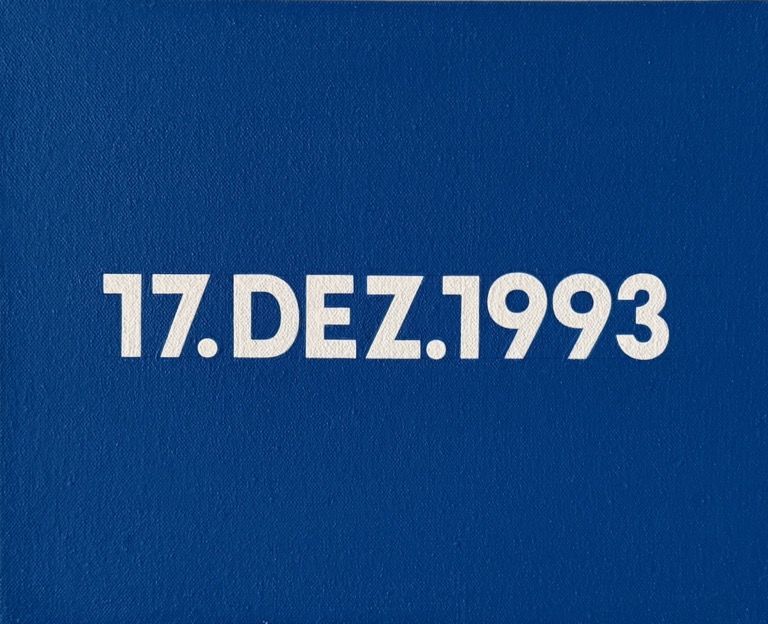
Reproduced thanks to the understanding of the One Million Years Foundation.
He may have been visiting Kasper König, just as he probably saw the König family while painting the Frankfurt picture in September.
I wonder if On Kawara visited the Chateau in the second half of December, before flying to Tokyo to see out the year. I would like to think he did, so that he could experience for himself the finished installation. In the book Whole and Parts, which he edited himself in 1996, Kawara included three images of the room so that each of the twelve Dates is pictured once. I will focus on these pics towards the end of this essay.
But first another diagram. There are enough photos of the installation around for me to have built up a plan view of the room: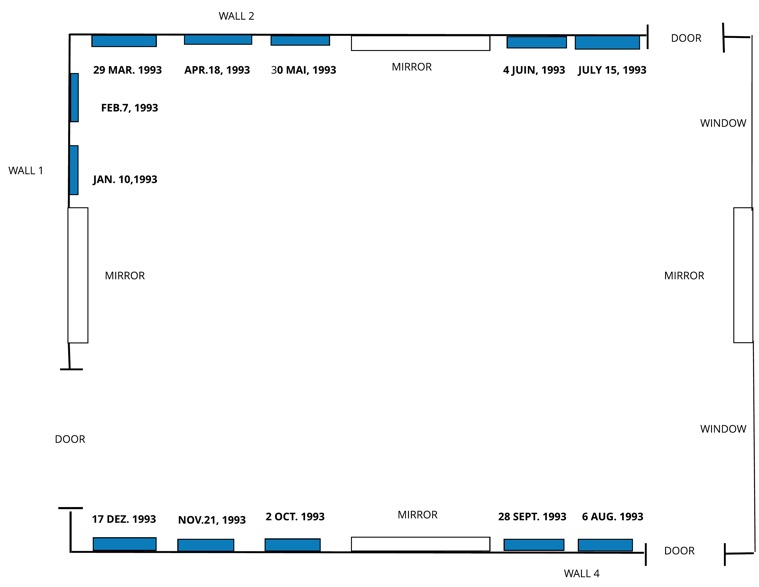
That diagram only becomes useful when I add the names of the cities (I know, I know: Oiron is not a city) in which the Dates were painted:
So on wall one (to the left) are the January and February Dates painted in New York. There are no Dates hung on wall three (to the right). There are five Dates (split into three and two) on wall two (top of diagram), facing five Dates (again split into three and two) on wall four (bottom of diagram).
June and July are opposite September and August. Paris faces Frankfurt and New York faces Tokyo. France v Germany and USA v Japan.
Similarly, March, April and May face December, November and October. Tokyo opposite Cologne, New York opposite New York, and Oiron opposite Strasbourg. That's Japan v Germany, USA facing off against itself, and France likewise.
Time and space interacting in quite a complicated way. Fourteen intercontinental flights it took to produce this installation. At least that's one way of looking at it.
……..TOKYO……………………………………………NEW YORK…………………………………………..PARIS+
It's another 2-5-5 pattern. Though I don't think that's significant. Let's get back into the room…
I can imagine On Kawara standing in the middle of his installation and getting a blast. From travelling all around the globe, to doing the same via his installation: at the turn of a head and the flick of an eye.
Maybe, standing in the middle of the room and looking around, he would have been transported back to his New York loft at the end of 1966. When the massive space was studded with two hundred-odd Dates. Many of the Dates hung on the walls; the bigger ones leaning against the walls underneath the smaller ones properly hung.
Or maybe, standing in the middle of the room, he was taken back to Paris in 1977. The day when he had taken a lift to the top of Montparnasse Tower to consider the fact that a gallery in the new Pompidou Centre was showing Dates from every day of the first three months of 1970. Some days On had made two Dates. One day he had made three. So there were 97 Dates covering the 90-day period from JAN.1, 1970 to MAR.31, 1970.
But once his thoughts had settled down he would very much have had 1993 in his mind.
If he had looked into any of the four mirrors he would have seen what the world was not allowed to photograph: his 60-year-old face. But out of the corner of his eye, he would see the five Dates on either side of the mirror on wall two, and the five dates on either side of the mirror on wall four.
On speaks to himself in the mirror:
"I AM NOT GOING TO COMMIT SUICIDE, DON'T WORRY."
He turns around and speaks to himself in the opposite mirror:
"I AM NOT GOING TO COMMIT SUICIDE, WORRY."
He looks around the room until his gaze settles on a Date Painting:
"I AM GOING TO STRASBOURG, FORGET IT."
He then takes a walk around the circumference of the room, addressing each of the Dates starting with the Strasbourg one: "STILL ALIVE…STILL ALIVE…STILL ALIVE………STILL ALIVE…STILL ALIVE…STILL ALIVE…STILL ALIVE…STILL ALIVE…….STILL ALIVE…STILL ALIVE………………STILL ALIVE…STILL ALIVE…"
And then he returns to the middle of the room.
On looks in the mirror and speaks to himself:
"I AM NOT GOING TO COMMIT SUICIDE, DON'T WORRY."
He turns around and addresses himself in the opposite mirror:
"I AM NOT GOING TO COMMIT SUICIDE, WORRY."
He looks around the room until his gaze settles on a Date Painting he has particularly fond memories of:
"I AM GOING TO TOKYO, FORGET IT."
He then takes a walk around the circumference of the room, addressing each of the Dates starting with the Tokyo one painted in August: "STILL ALIVE…STILL ALIVE……..STILL ALIVE…STILL ALIVE…STILL ALIVE………….STILL ALIVE…STILL ALIVE…STILL ALIVE…STILL ALIVE…STILL ALIVE……………STILL ALIVE…STILL ALIVE…"
After quite a lot of this sort of thing, On Kawara stops in the middle of the room and looks hard into each mirror in turn… I'm not quite sure what happens next. My clarity of vision seems to have gone for now.
Would he have seen some Dates hung on wall four when he looked into the mirror mounted on wall two? And would he have seen some dates hung on wall two when he looked into the mirror mounted on wall four?
To help answer that question, I thought that the three images reproduced in On Kawara: Whole and Parts (1996) might be useful. First this next image, which shows just the January and February Dates square-on. And it shows one of the windows in wall three open to the outside world. No reflections of Dates, as none of the Dates are hung on wall three.
Reproduced from On Kawara: Whole and Parts.
This is the view of wall two (which runs horizontal along the top of the plan diagram) from the middle of the room:
Reproduced from On Kawara: Whole and Parts.
So there are the March, April and May Dates on the left side of the central mirror, and the June and July Dates on the right side of it. But what is that small Date seen in the mirror? What is that small Date seen reflected on the far wall between two mirrors? Because there is only one mirror on the opposite wall as this next image clearly shows:
Reproduced from On Kawara: Whole and Parts.
Same problem when looking at this, the fourth wall (which runs horizontal along the bottom of plan diagram). There are the August and September Dates to the left of the mirror. And there are the October, November and December Dates to the right of the mirror. But again, what is the single small, reflected Date on a patch of wall between two mirrors apparently in the middle of wall two? Wall two (the previous image) only has one central mirror.
Maybe these are the 'shadow' Date Paintings I was alluding to earlier in this essay. Maybe the mirror takes us into another dimension where the size 'A' Dates made in Bordeaux in May, and those surplus ones made in Tokyo in August can be glimpsed, albeit just one at a time… I don't know about you, dear reader, but this Chateau d'Oiron installation is messing with my sense of time and space.
Shakespeare's A Midsummer Night's Dream is what I spoke about the first time I wrote about this installation in 2023. I used the line from the opening speech in the play, which I still think is apposite:
'But O, methinks, how slow this old moon wanes.'
Months and moons; midwinter months (December, January and February) and midsummer moons (June, July and August).
Now I'd like to add a few more lines of Shakespeare, in fact a whole sonnet of the stuff. I see myself standing in the middle of the room at Chateau d'Oiron, walking round the room with On Kawara's achievement in mind, pausing in front of certain Dates, and reciting as follows:
Shall I compare thee to a summer’s day?
Thou art more constant and more temperate:
Rough winds do shake the darling buds of May,
And summer’s lease hath all too short a date;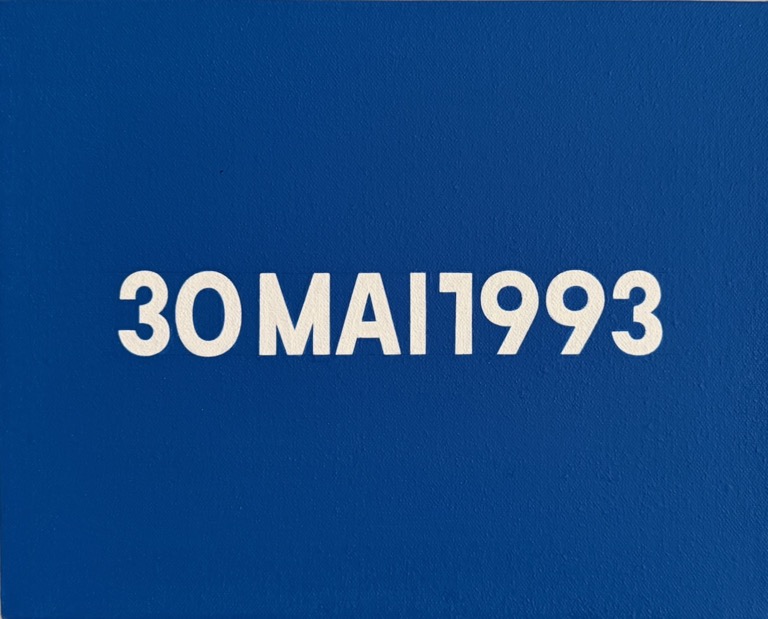
Sometime too hot the eye of heaven shines,
And often is his gold complexion dimm'd;
And every fair from fair sometime declines,
By chance or nature’s changing course untrimm'd;
But thy eternal summer shall not fade,
Nor lose possession of that fair thou ow’st;
Nor shall death brag thou wander’st in his shade,
When in eternal lines to time thou grow’st:
So long as men can breathe or eyes can see,
So long lives this, and this gives life to thee.
If anyone reading this essay has a chance to visit the Chateau d'Oiron, can they tell me in clear, simple language (and/or photos), what they see in this magical room. Oh, and could they tell me how much aircraft fuel was expended in getting them into position 'A': the absolute centre of On Kawara's world.
Thanks for indulging me with your attention at this third time of asking.
Duncan McLaren: MAY 13, 2026
Note
As I say at the top and bottom of this piece, this is the third foray into Chateau d'Oiron. The first can be found here. It puts emphasis on describing everything that On Kawara was up to in 1993, but ends by fairly briefly putting emphasis on the Chateau installation. The second can be found here. The Chateau provided me with a good reproduction of each of the twelve Date Paintings, so I took a close look at them, but finished by marvelling at all the travel involved in the painting of the suite.