MEET THE VOGELS
INTRO
A couple of years ago, when I saw that the first and largest batch of 'I AM STILL ALIVE' telegrams went from On Kawara to Dorothy and Herbert Vogel, art collectors, I didn't think much about it. But when I recently realised what an unusual couple the Vogels were - collecting minimal and conceptual art with the money they had left over after paying for the essentials of life, out of their salaries as a librarian and a post-office worker, respectively - I decided I should look into it. I'm so glad I did, and I'm hoping that you, dear reader, will be so glad too.
Sol Lewitt also features in this story. He was the only person other than the Vogels to get an 'I AM STILL ALIVE' telegram in the first phase of the work's inception. He got a single telegram while the Vogels got 11. But I'll be bearing him in mind throughout this investigation. And you'll shortly see why. Oh, and Dan Graham puts in an appearance in this New York art world adventure.
ONE
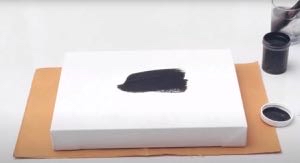
Dorothy and Herbert got married in 1962 and were soon spending their time in artists' studios where they bought work only after considerable discussion with the artist. Sol Lewitt was an early contact and the pair remained friends with him through the years. Below is the first piece they bought from Lewitt. The still is taken from a film currently available on Youtube, directed and produced by Megumi Sasaki in 2008.
Still from 'Herb and Dorothy', directed by Megumi Sasaki, with the forbearance, I hope, of the copyright holder.
It was in 1965 that Lewitt began to produce modular work and he wanted Herb and Dorothy to have a piece that reflected this current interest. So, later in 1965, he persuaded them to swop the gold T piece for the following construction, which is seen below being considered by Herb and Dorothy in a gallery setting:
The Vogels had a flat in upper Manhattan (which we'll be returning to with the help of On Kawara's 'I WENT' and 'I MET') and that's where they displayed and stored all the work they acquired. Unfortunately, this artwork is eight foot tall, almost the height of their front room.
Still from 'Herb and Dorothy', directed by Megumi Sasaki, with the forbearance, I hope, of the copyright holder.
No problem! - all Lewitt had to do was arrange for the vertical piece to be removed and replaced with a horizontal modular work. Which is what happened.
At this point in the aforementioned film, Herb is telling the viewer what he saw in Sol Lewitt's work at the time. If I remember rightly, Herb suggests that he didn't necessarily understand what Lewitt was doing, but that he felt he was a more than averagely interesting artist. 'More than averagely interesting'? Maybe that's quite a good way of putting it. 
Still from 'Herb and Dorothy', directed by Megumi Sasaki, with the forbearance, I hope, of the copyright holder.
On Kawara was not producing his self-observation series back in 1965, but Sol must have communicated the gist of the above story to On, and it's not difficult to postulate that the situation intrigued the latter. In any case, both the Vogels and Sol Lewitt were in receipt of 'I GOT UP' postcards when On Kawara was in Mexico in 1968. Which I'll now enlarge upon.
TWO
On Kawara was in Mexico and South America for a year. He began sending out two postcards each day while in Mexico City, something he kept up for more than ten years. In this first phase, one card went to Kasper König and the other went to a variety of friends and colleagues. In 2008, when Kawara edited an edition for Michele Didier of 'I GOT UP', a single card for each day was reproduced or reconstructed. So of the 326 days of the project until On Kawara's return to New York, there were 241 cards to Kasper König while the balance of 75 cards were to other people. The actual numbers to individuals were as follows:
Christine Kozlov 13
Joseph Kosuth 12 (Kozlov and Kosuth were artists and partners, interested at the time in recording day-to-day existence.)
Sol Lewitt 10
John Evans 10 (Evans was an established mail artist.)
Dorothy and Herbert Vogel 5
Others 25
As you see, Dorothy and Herbert make it on to the exclusive list, moreover the actual number of postcards they were sent in the period was 16. A relatively small number are in the aforementioned 'I GOT UP' book, published by Michele Didier, and those five are all reconstructions. I would suggest this is because On Kawara did not want to disclose the 1968 address of the Vogels as they were still living there when the book was in development prior to its 2008 publication.
All of which is simply to say that Sol Lewitt and the Vogels were part of On Kawara's conceptual art network before he left New York at the end of March, 1968. So what happened when On and Hiroko (who had joined On in Mexico City after a few months) got back to New York a year later? I have been through 'I MET' and 'I WENT' with this question in mind.
Well, it must be emphasised that On's day-to-day Manhattan life involved interaction with the Japanese-New York art community. Specific friends met almost every day, in addition to Hiroko, included Takashi Hashimoto, Nobu Fukui, Soroku Toyoshima and Hirotsuku Aoki. Nobu had received a single 'I GOT UP' card and maybe Takashi, Soroku and Aoki did as well, but if so On Kawara has hidden that information, as the choice of publishing the card sent to Kasper König most days allows much to remain secret. I only know about the card to Nobu Fukui because he told me about it. Nobu told me that On didn't like the way he had framed it, which he thought was the reason he didn't get any more, whereas Aoki was sent batches of cards in subsequent years (1970 and 1976, for example).
Having said that, there were regular meetings with both Joseph Kosuth and Christine Kozlov, usually together but occasionally just with one or the other. That is, nearly 30 meetings in the nine months of 1969 that On Kawara lived in New York. Sol Lewitt was met just once, a meeting on August 30 that continued into August 31, Sol being accompanied by his then partner, Mimi Wheeler. Oh, and Kosuth and Kozlov were there too, so quite a meeting of conceptual art minds.
On did not meet Dorothy and Herbert Vogel that year until November 25, when they came round to see him. I know the meeting was at the Kawaras' place because On did not leave his flat that day, and the red dot on 'I WENT' was always at his getting up place, in this case 340 East 13th Street. By the way, his getting up time was 3.54 P.M., a more than averagely interesting getting up time, I would have thought. That card went to Lucy Lippard, the art writer, who I'll be mentioning again in this essay. In the catalogue that was published on the occasion of the Vogels' art collection going into a public art gallery, Dorothy is quoted as saying, 'We used to have long, philosophical talks about art with On Kawara.'
Now it's in the aftermath of this meeting that On Kawara began his 'I AM STILL ALIVE' series. The very first telegram was sent to the Vogels on January 22, 1970. But a few things happened just before then that need to be contextualised. In December (and this is written about in most of the catalogue essays concerned with 'I AM STILL ALIVE') the artist contributed three preliminary telegrams to a show in Paris curated by Michel Claura. The messages were sent three days apart, and read: 'I AM NOT GOING TO COMMIT SUICIDE DON'T WORRY', (December 5), 'I AM NOT GOING TO COMMIT SUICIDE WORRY', (December 8). And: 'I AM GOING TO BED FORGET IT', (December 11).
On Kawara then met Sol Lewitt (and Mimi Wheeler) on January 5 and January 17 before sending the first 'I AM STILL ALIVE' telegram to the Vogels on January 22. And then guess what? On went to see the Vogels at their place on January 28. He didn't see anyone else that day. Maybe he had a long, philosophical talk with the Vogels about the art of staying alive. .

Reproduced thanks to the understanding of the One Million Years Foundation. Facilitated by Tama Art University's On Kawara resource.
I suspect he also went there to look at the telegram, the actual form of which he hadn't been in control of, as that was within the remit of the Western Union, the company who had typed and delivered it.
Reproduced thanks to the understanding of the One Million Years Foundation. Reproduction from On Kawara: Silence published by the Guggenheim, New York.
On Kawara would have gone into one of the many Manhattan outlets of the Western Union (he did move around the streets that day, JAN. 22, 1970) and either dictated the Vogels' address and the message he wanted sending, or handed the operator a note containing that information. As I understand it, the agent/operator would have typed this information into his teleprinter and instantly (again, as I understand it) the same info would have appeared as a teleprint at the outlet nearest to the Vogels. The operator/agent at this second place would have torn off the message, put it in an envelope, which would have been hand-delivered.
Presumably, that's what all the numbers and codes mean on lines one and two of the above telegram. Lines three, four, five and six are all much more straightforward. Lines one and two may have not been clear to On Kawara, but he would have had the option of asking the operator/agent at one of the branches. I don't have that option as this form of communication has been obsolete since 2006.
Let's mentally file all that and come back to it later. Because it has to be borne in mind that from January 1, 1970, On Kawara had begun a Date Painting project within his overall 'TODAY' project. That is, he had decided to paint at least one Date every day for as long as he could (which turned out to be until the end of March, 1970). So it's maybe strange that he embarked upon this further project given that 'I GOT UP', 'I WENT' and I MET' also continued. I prefer to think that this wasn't a strange development, it's just that he was having several great ideas, hot on the heels of each other, and enjoyed pushing himself to the limit.
So, as I say, after the three preliminary telegrams to Paris, the black jokes on suicide, On Kawara met Sol Lewitt, and maybe those three proto-telegrams were discussed, though after that the January 'I AM STILL ALIVE' telegram went to the Vogels and not to Lewitt. Maybe because of the lack of surprise element if the first 'I AM STILL ALIVE' message had gone to his conceptual art colleague. Anyway, the first 'I Am Still Alive' telegram was followed up by that visit of On to see the Vogels.
Address check from telegram………….365 East 86 Street, apartment 7K.
Address check from 'I WENT' map…Junction of 86th Street and 2nd Avenue.
Reproduced thanks to the understanding of the One Million Years Foundation. Facilitated by Tama Art University's On Kawara resource.
HV: "Look who it is!"
DV: "I expect he's come to see his own telegram!"
OK: "Thank-you, Dorothy. Would you mind if I made a note of these codes that constitute the first two lines of the printed matter?"
DV: "Not at all. Herb will read them out for you."
HV "Sure, I will. The first line reads: (31)BD3 15 NK243."
OK: "Got it."
HV: "Second line: NN NFR014 VW PDC NFR New York NY 22 106P EST."
OK: "Got it."
DV: "You know what we thought when we first received it?"
OK: "Please tell me."
DV: "I said to Herby. 'Oh, Herby, On is still alive. Which means we must be too.' And Herby said…"
HV: "I AM NOT DEAD YET."
OK "Ha-ha-ha."
On February 4, On Kawara sent - and the Vogels received - a second telegram:
Reproduced thanks to the understanding of the One Million Years Foundation. Facilitated by Tama Art University's On Kawara resource.
As you can see from the hand-stamp, the telegram went out for delivery at 5.37 P.M. On had GOT UP at 10.42 A.M. so that is consistent. On was 'ALIVA' in the morning and he was still 'ALIVA' by the evening.
Next day, the third telegram to the Vogels:
Reproduced thanks to the understanding of the One Million Years Foundation. Facilitated by Tama Art University's On Kawara resource.
By this time, a couple of things can be said. First, the hand stamping was an irregular thing and could not be relied on to be there at all (subsequent telegrams suggest that even when it was there, it wasn't necessarily legible). Second, the day of the month of the sending of the telegram is registered by the number at the end of the second line. In this case '5'. Third, 'NL' means 'Night Letter' (as opposed to 'DL', 'Day Letter') and was cheaper than to send a telegram during the day.
Also sent on February 5 was the single cable to Sol Lewitt. This is much reproduced in the On Kawara literature:
Reproduced thanks to the understanding of the One Million Years Foundation. Facilitated by Tama Art University's On Kawara resource.
Did On Kawara send it from the same Western Union outlet? There is nothing to suggest that he did, though I remain ignorant as to what the majority of the letters and numbers in lines one and two means. (Any help on this would be greatly appreciated!)
Is there anything to suggest it was delivered by a different outlet, given that Hester Street is in Lower Manhattan, south of where On lived? Yes, the typed part seems to have been on strips that needed to be cut out and pasted onto the telegram pro forma.
Next day, the fourth telegram to the Vogels, making it three days in a row.
Reproduced thanks to the understanding of the One Million Years Foundation. Facilitated by Tama Art University's On Kawara resource.
Remember that On was still doing his Date Painting every day. And his 'I GOT UP', his 'I WENT' and 'I MET'. The 'I GOT UP' tells us that he rose at 4.04 P.M. If that was the case (and who doubts On's meticulous word?) how did a telegram manage to be stamped for delivery at 3.47 P.M.? All I can think of is that Hiroko could have sent the telegram, following On's simple instruction.
Let's think that through. Firstly, On often played chess or mah jongg through the night, so getting up in the afternoon was common, especially in 1970. It's possible that On was playing a game with the degree of control he had over his art work. I'm envisaging Hiroko approaching the bed and shaking him awake while asking "Are you still alive?" On muttered something which Hiroko took to be a yes. She then went to a branch of the Western Union and set in motion the telegram to the Vogels. On got up (sorry, 'GOT UP') at his leisure. Does that ring true?
After this telegram, sent on the sixth of February, there was a lull. By which I mean, no telegram was sent on the 7th or the 8th. How might this have gone down in the Vogel household?
Still from 'Herb and Dorothy', directed by Megumi Sasaki, with the forbearance, I hope, of the copyright holder.
DV: "Are you all right, Herby?"
HV: "I guess so, considering I have absolutely no idea whether On is alive or dead."
DV: "That's not true! We know he was alive on Friday. "
HV: "But this is Monday, for God's sake!"
DV: "Maybe On didn't want to send a telegram over the weekend. Maybe we'll get one this afternoon. The day is yet young, Herbs."
Sure enough:
Reproduced thanks to the understanding of the One Million Years Foundation. Facilitated by Tama Art University's On Kawara resource.
One notices that if the teleprinter operator makes a hash of a name, in this case 'VOGEL', then they just complete it with 'XXX' and repeat the word.
As I said, the printed number at the end of the second line is the day of the month. But where does it say (other than in the hit-or-miss rubber-stamping) that the telegram was a product of February, or even of 1970?
The hand-stamping suggests the telegram was dealt with by the delivering agent at 12.57 P.M. (24-hour clock) on February 9. Alas, On didn't get up that day until 2.59 P.M. (12-hour clock). Which again makes me suspect that Hiroko may have organised the sending of the telegram.
So let's go through that process again. Hiroko approached the sleeping figure on the bed. She shook his shoulder and asked if he was still alive. On replied: "I'm going to sleep forget it." Smiling, Hiroko made her way to the Western Union outpost.
No telegram was sent or received on Feb. 10 or 11. But I can imagine the Vogels coped with this, and that they weren't unduly worried by the time the next telegram arrived on the 12th.
Reproduced thanks to the understanding of the One Million Years Foundation. Facilitated by Tama Art University's On Kawara resource.
'HERBART' with an 'A'? Quite apt really, but imagine how that would have made On Kawara feel. He who spent most of the day getting the numbers and letters of the day exactly correct through paint on canvas, through willpower and concentration.
What is the time of the delivery? It's 6.24 but I can't be sure if that's A.M. or P.M. Imagine how that too would have made On Kawara feel. He who spent part of every single day getting everything stamped on two 'I GOT UP' cards just so.
Next telegram arrived on the 13th:
Reproduced thanks to the understanding of the One Million Years Foundation. Facilitated by Tama Art University's On Kawara resource.
The telegram was delivered - or given to the telegram boy - at 10.43 P.M. The day's 'I GOT UP' postcard tells us that it was another late rise at 3.59 P.M. Given that On had a Date painting to make that day, I suspect he would have left the organising of the telegram to Hiroko, but obviously I can't be sure.
Hiroko: "On!"
No answer.
Hiroko: "On!"
No answer.
Hiroko: "I need a sign of life."
On: "Mmmm."
Hiroko: "That'll do."
Of course, Hiroko had other commitments so it ended up being much later in the day when she actually made it to the Western Union outlet on this occasion.
Five days then went by without any more telegrams for the Vogels. At home, surrounded by a superb conceptual art collection, Herb must have been climbing the walls. Or maybe just the furniture. He had simply no idea whether On Kawara was alive or dead. In his despair, he may have phoned the Kawara household. Hiroko would have answered:
Still from 'Herb and Dorothy', directed by Megumi Sasaki, with the forbearance, I hope, of the copyright holder.
HV: "How is On? I mean is he still with us?…"
HV: "He's asleep?…Oh, thank God, I've been worried sick…"
HV: "What do you mean you'll be sending a telegram to us on the 19th?.."
HV: "Oh, it's you who does that, On just gives you the instruction. Well, well. That's like what Lawrence Weiner was talking to us about. His text piece is in the bathroom, Dorothy having put the letters up on the wall there as best she could…."
HV: "You want to know what the text in the bathroom says? Let me get that right: 'MANY THINGS PLACED HERE AND THERE TO FORM A PLACE CAPABLE OF SHELTERING MANY OTHER THINGS PUT HERE AND THERE."
HV: "Yes, Lawrence is a more than averagely interesting artist… Fine, I'll try and be patient until tomorrow. That seems like a lifetime away right now, but you're right, it's only a single night's sleep."
Reproduced thanks to the understanding of the One Million Years Foundation. Facilitated by Tama Art University's On Kawara resource.
At this point something else happened. What I mean is On Kawara met Dan Graham on February 21 and the same day he began a unique project-within-a-project, sending the same 'I GOT UP' picture postcard to Dan for 134 days in a row. That's the Statue of Liberty card as reproduced below. And I suspect the plan was for Dan to exhibit these in his gallery (Daniel's Gallery), only the gallery went bust before said exhibition could happen. Look at those getting up times!
Reproduced thanks to the understanding of the One Million Years Foundation.
Dorothy and Herbert mention Dan Graham in the 1994 catalogue published by the National Gallery of Art, Washington, which is where their art collection ended up. Here are a couple of quotes from an interview they gave to Ruth Fine, curator:
DV: "We developed this strong relationship with Dan Graham. He'd come over at least a couple of times a month and talk about art, and I really think these conversations were very important to stimulating us to continue buying minimal work because he really was very knowledgeable. He knew a lot of the artists and we were sort of leaning that way anyhow, and we were encouraged by him.... At the time, Dan was a dealer and a writer. Sol was always an artist, but Sol was also a collector and was always very open to new ideas. Dan was very intellectual and he had brilliant ideas. So knowing these two people and talking to them put us in a framework to be able to accept what was going on and to be able to absorb it, to be able to understand it. Not that they sat down and taught us, but just being with them and talking to them."
I've quoted that at length, because by suggesting - for humorous effect - that Herb's relationship to On Kawara's work had a naive aspect, I may be being unfair to the Vogels. So let's put the record straight:
Still from 'Herb and Dorothy', directed by Megumi Sasaki, with the forbearance, I hope, of the copyright holder.
On February 25, On sent the fifth Statue of Liberty 'I GOT UP' card to Dan Graham and the ninth 'I AM STILL ALIVE' telegram to the Vogels. 
Reproduced thanks to the understanding of the One Million Years Foundation. Facilitated by Tama Art University's On Kawara resource.
According to the rubber stamp on the telegram, it was delivered at 4.40 P.M. while On had GOT UP at 2.25 P.M. per his Statue of Liberty card to Dan Graham. So that makes perfect sense!
The next telegram was delivered on the 27th. 
Reproduced thanks to the understanding of the One Million Years Foundation. Facilitated by Tama Art University's On Kawara resource.
The teleprinter operator made a mess of the name 'KAWARA' on this occasion. But the re-type is fine. And, let's face it, by this time the Vogels would have known who such a communication was from. That made nine telegrams to the Vogels:
There was a single one sent in the month of March, on March 3. And at this point, when there were ten telegrams for On Kawara to inspect, he paid another visit to the Vogels. That was on March 5. .

Reproduced thanks to the understanding of the One Million Years Foundation. Facilitated by Tama Art University's On Kawara resource.
Perhaps On laid all the telegrams out on the Vogels' kitchen table and scrutinised them. He would have noticed the odd spelling mistake and he may have come up with a scheme to ensure that this didn't happen in future telegrams. All he needed to do was to hand the operator a note and emphasise that the spelling had to be perfect.
In April and May, On Kawara was sending telegrams to Teresa O'Connor, the English Professor who was Aoki's partner. This would give him a second set of telegrams to pore over as On regularly visited Teresa and Aoki in the normal scheme of things. In five of the six, the message is perfect, lines three to six reading:
TERESA OCONNOR
92 CHRISTOPHER ST NYK
I AM STILL ALIVE
ON KAWARA.
Alas, the sixth one reads:
TERESA OCONNOR
92 CHRISTOPHER ST NYK
I AM STILL ALIVE
ON LXXX LAWARA.
The artist probably came to accept that he wouldn't have complete control, and the occasional botch was inevitable. Perhaps that helps explain why most recipients got a few telegrams. On sent the Vogels four more telegrams in April, making 14 in all, then that was it. The principal recipients in 1970 thereafter were Adrian van Ravesteijn (tricky!) in Amsterdam and Tuomaso Trini (even trickier) in Milan, each of whom received nine telegrams. By this time the project was truly out of On's hands. He would have been reasonably confident of good results, but these were testing names.
Teresa O'Connor wrote an insightful and philosophical piece about the 'I AM STILL ALIVE' project for the 1992 book Date Painting in 89 Cities. Its opening paragraph reads:
'I am still alive' is about its opposite and complement: I am not yet not still alive - suggesting that the imminence of death is a hair away from us, the line that defines us. Receiving such a telegram is a startling experience. On first hearing On's news I wanted to cry out, 'Oh no!' As if, despite the good news, I'd heard bad. But, in fact, I had been reminded of the bad news too. I will die, you will die, we will all die. We are all only just not yet not still alive.'
Maybe that's what Herb was feeling in a couple of those stills I've used. He has been reminded that we will all die. On will die. Dot will die. Even Herb will die. Herb is only just not yet not still alive.
THREE
The relationship with the Vogels continued. When On flew to Tokyo in November 1970, the Vogels were sent 17 postcards before the end of the year. He hadn't been to see them in the days before flying to Japan, instead it marked the strength of their long-term relationship.
In February 1972, when based in New York, On sent the Vogels six more postcards. The unusual thing was that they were sent every fourth day. A little more research shows that On was sending four people postcards every fourth day, the others being Lucy Lippard, Ursula Meyer and Lee Lozano. Now these latter three women were all independent-minded, artists, thinkers and writers. So I'm reckoning that this was a tribute to them and to Dorothy Vogel. On didn't meet any of the four women just before or during this period, so it would seem to have been his own idea.
In June and July 1973, On sent 21 'I GOT UP' cards to the Vogels from his second stay in Halifax, Nova Scotia. He then followed this up with 17 more from December, when he and Hiroko had reached California in their east-west road trip across America. All in all, the Vogels received one of the most comprehensive and varied set of 'I GOT UP' cards.
The 1994 National Gallery of Art publication suggests there were 89 works in the exhibition that commemorated Dorothy and Herbert Vogels' gift of their collection to Washington. This included four pieces by Sol Lewitt, two by Dan Graham and one by On Kawara. The Kawara piece, according to the 1994 book From Minimal to Conceptual Art: Works from the Dorothy and Herbert Vogel Collection, was fifteen of the postcards. Now I suspect these would have been cards sent in 1968/69 as Dorothy can be seen considering this framed object while at the gallery: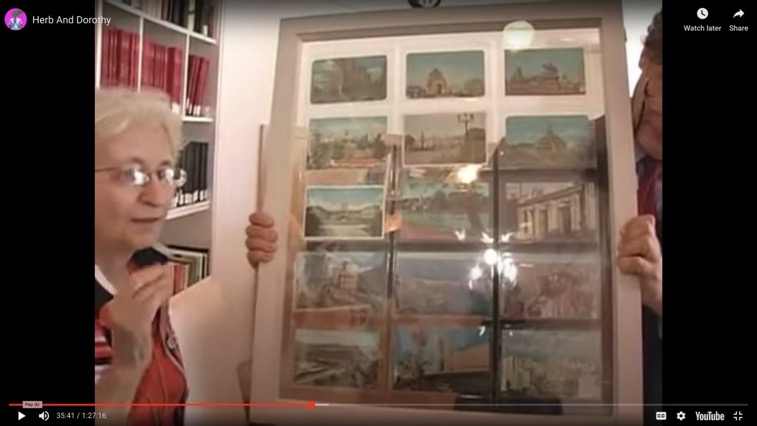
Still from 'Herb and Dorothy', directed by Megumi Sasaki, with the forbearance, I hope, of the copyright holder.
And the only On Kawara reproduction in the NGA book is this next one, which is a single card (top right of the array) in the above frame. Note the obscured address:
Reproduced thanks to the understanding of the One Million Years Foundation. Facilitated by National Art Gallery, Washington.
So none of the later postcards were exhibited, and none of the telegrams at all. If you look at the NGA (Washington) site today you'll see all the work listed but not illustrated. I suspect that is because of ongoing concerns about reproducing Herb and Dorothy's address. I don't think the same concern applies in 2025. Herb went into a care home in 2008, and I don't suppose Dorothy is living in their old flat seventeen years later. But if I'm told that she is then I'll block out the address whenever it crops up in this essay.
On did not send the Vogels any 'I GOT UP' cards from his year-long residency in Berlin. In fact he didn't send them any more cards (and the telegrams were confined to 1970). Perhaps he knew, either from visiting or from conversation with Sol Lewitt or Dan Graham, that their small apartment was packed with art and that it was all at risk from the three cats that roamed the apartment, the fish tank full of water and a second tank containing turtles. Herbert loved nature as much as he loved art, indeed I've read that the two were linked in his mind.
However, On remained friendly with the Vogels. They feature on three 'I MET' lists in 1977 and another three in 1978. Let me just spell that out, day-by-day:
SEPT. 17, 1977
On didn't leave his and Hiroko's flat, which by then was 140 Greene Street. Seven names on the 'I MET' list, beginning with Hiroko and ending with the Vogels. Though the meeting with them did not go on until midnight as they are not on the next day's list.
HV: "Guess we should be hitting the road, dear."
DV: "Sure. Sol is coming round to see us in the morning."
HV: "We love Sol and his work."
DEC. 10, 1977
On only went next door, to 132 Greene Street, but he met a lot of people, 18 in all. As well as the Vogels there was Aoki and Teresa, Soroku, three members of the König family and, of course, Hiroko.
DEC . 29, 1977
On only met Hiroko, Dorothy and Herbert this day. 
Reproduced thanks to the understanding of the One Million Years Foundation. Facilitated by Tama Art University's On Kawara resource.
And his 'I WENT' map confirms a trip north to the Vogels' neck of the woods, plus the return journey. Hopefully, they were still having long philosophical talks about art.
Reproduced thanks to the understanding of the One Million Years Foundation. Facilitated by Tama Art University's On Kawara resource.
The flat would have been stuffed with the Vogels art collection by this time. Hang on, is that true? Something is said about that in the Washington catalogue:
DV: "Well, we would buy drawings, and drawings don't take up much space. But then we'd have these shows and the drawings would get framed, and then the shows came back. I think after Philadelphia there wasn't much of a problem. But after the University of Michigan (11 November 1977 - 1January 1978), they came back in these crates, and we didn't have any room to put the works any place. The closets were full, so we just kept the crates in the living room and the works in the crates, and from there on as each show came back, we just kept the crates, and they became the base for all the work piled on top of them."
RF: "It was amazing, a mythic space."
HV: "I guess so. I will say it was a great pleasure to put the collection together. And when we did it, we didn't know we were doing it. We were doing it just for the joy. And I think we still get a great deal of joy, and we are very, very happy to share it with people. That's how I feel about it, and when I say 'I' , I mean 'we'.
You can understand why On Kawara wanted to visit once more the mythic space full of art; the flat that gave its owners such joy.
MAY 27, 1978
A few people were met this day. First, Toko and Kazuma Oshita, who may have been staying with the Kawaras and were there after midnight on the day before. Next on the list is Aoki. Then comes Hiroko and the Kawaras' month-old child, Akito. Next come Herbert and Dorothy who had surely come along to meet Akito. The only other name on the list is Cecilia de Torres, On and Hiroko's neighbour, who they may have bumped into going to or returning from the place on West Broadway that On (and whoever) visited that day. It might have been one of the many new galleries on West Broadway. I can imagine On, Hiroko and the Vogels might have liked to spend time in such places.
AUG 18, 1978
On met Hiroko and Akito (treasured child), the Naraharas (close friends from 1970 to 1974), Aoki (best friend) and Herbert Vogel.
Herbert on his own? I wonder if anything was wrong with Dorothy. Let's hope not. Again, On visited that same place on West Broadway and nowhere else, so either a food outlet or a gallery.
NOV 25, 1978
On met ten people this day, and in the middle of the list are the names of Herbert and Dorothy. 
Reproduced thanks to the understanding of the One Million Years Foundation. Facilitated by Tama Art University's On Kawara resource.
Again the Vogels were visiting On and Hiroko and Akito (sweet baby) at 140 Greene Street. Though it seems that On did visit Aoki at 132 Greene Street that day. After all, one can do a lot in a 24-hour period. On might even have slipped into a branch of the Western Union and sent Herb and Dorothy a telegram, which they would have opened - with joy filling their hearts - when they got home.
HV: "Can you believe that, hon? On is still alive."
DV: "I want to believe it's true, Herby, and that its truth will go on for ever via Akito."
HV: "Amen."
But On didn't send such a message. No need. Joy overfloweth in both households.
The child-blessed and the art-soaked.
Next essay.