2000
INTRO
A few days ago a Date Painting came up for sale from the year 2000: 
Reproduced thanks to the understanding of the One Million Years Foundation.
It penetrated my early morning haze. I realised what a special year that must have been in On Kawara's life. Since 1966, he had been painting '19' every time he made a date (1967, 1968, 1969 etc.). And in the last ten years he had invariably been painting '199' (1990, 1991, 1992, etc.). Indeed, for the previous year he'd been consistently painting '1999' (from JAN.1 to DEC. 31). That adds up to a lot of 1s and a hell of a lot of 9s. Surely the passing into 2000 would have come as a relief!
Of course, once he began on the 2000s there would be no end to it. Well, after a year, '2000' would finish. After which it would be '200' for ten years (2001 to 2009). And then '20' for the rest of his life (2010, 2011, 2012 etc.). Not to mention our lives. But that's getting ahead of the game.
Anyway, my reaction to that painting from July 2000 being for sale, which I'll talk about at some length later as there are a couple of surprising things about it, was to commit to writing this essay. A previous chapter covers On Kawara's years 1997 to 2007, and that does talk briefly about the year 2000. Re-reading it for this essay reminds me that On Kawara made 44 Date Paintings in the year. Obviously there were no 'I GOT UP', 'I WENT' or 'I MET' to help piece together On Kawara's life in 2000, but I reckoned I could still flesh out the story of On Kawara's year just by focussing on those Date Paintings. Or at least I'd relish the challenge of giving that a go.
I've gone through my books and consulted the World Wide Web. I realise that I have visual access to 21 of the 44 Dates. That's very nearly half the Dates painted, and hopefully one more will turn up as I go along. So this essay will not lack illustration.
Am I going to structure the essay chronologically? Any other organising principle would be obfuscating. There will still be surprises, but let March follow February, let February follow January, without messing about with the fabric of time. But It's May and July you should be hanging around for, dear reader. You can even switch off after that, if you think you're philistine enough!
ONE (JANUARY TO APRIL)
The first Date Painting made in the new millennium was 8 JAN. 2000. (Not a 9 in sight!) Swiftly followed by 9 JAN. 2000. (Maybe that steadied the artist's nerve.) On Kawara was in Taipei, Taiwan, at the time. And the novelty of being on that 'Chinese' island may have lessened the novelty of painting a single 2 followed by three zeros.
Let's line up the two Dates. 8 JAN is a reproduction taken from Museum fur Moderne Kunste's website. That's the Frankfurt gallery with a 'complete' (meaning one per year) collection of Date Paintings from 1966 to 2000. January 8 was gifted to Frankfurt in 2014 by One Million Years Foundation. While 9. JAN is an image taken from the book Date Painting(s) in New York and 136 Other Cities. 

Reproduced thanks to the understanding of the One Million Years Foundation.
I think it's just the different sources that account for any differences you can see. The whole of the illustration for January 9 includes the box with its newspaper cutting:
Reproduced thanks to the understanding of the One Million Years Foundation.
Now I don't have illustrations of the next two paintings made, that's 26 JAN. 2000 and 12 FEB. 2000. But what can I say about them? They may have been made in Taiwan but I imagine On Kawara went back to his base in Tokyo. Did he definitely stay in the Far East? I would say so, as if he'd been in New York, the format would have been very different (FEB. 12, 2000), and if he'd been in France the spelling of February would have been a variation (12 FEV. 2000).
Towards the end of February, Kawara did fly back to New York and made Dates which I haven't seen repros of, on FEB. 26, 2000; FEB.27, 2000 and MAR.4, 2000. Were these definitely made in New York? Oh, yes, there are two lists in Date Painting(s) in New York and Other Cities, and these Dates appear on the New York list. As does MAR. 5 2000, which is reproduced as an installation shot in Candida Hofer's book, On Kawara: Date Paintings in Private Collections:
Reproduced with the forbearance, I hope, of Candida Hofer.
The next repro I have is for MAR.12, 2000. It's from an auction listing. In other words, MAR. 12, along with a Date from each of the previous four decades, was sold in 2007. 
Reproduced thanks to the understanding of the One Million Years Foundation.
I don't have repros for the next three Dates, which is to say MAR.30, 2000 and the two Dates made on April the 1st (APR. 1, 2000; and APR. 1, 2000). But I do have another auction listing that shows the next Date to be painted, APR.16,2000.
Reproduced thanks to the understanding of the One Million Years Foundation.
Those four paintings were put up for auction in 2016. But I think that those two sale events (featuring MAR. 12, 2000 and APR.16, 2000) suggest that collectors may have been as seduced by the novelty of the new century as the painter may have been. I can imagine that many of the collectors who owned a Date Painting made in the 20th Century would aspire to be the owner of one from the 21st Century. It's a bit like the Million Years Past and Million Years Future conjunction. A Date Painting from the 20th Century might begin to seem like a backward looking object while one from the year 2000 would be looking forward. Oh, brave new world!
That means there were 10 Dates painted from late February to mid-April in New York. On and Hiroko had had their main residence at 140 Greene Street, Manhattan, since 1977. Their son, Akito, turned 22 in April 2000. While their daughter, Sahe, remained 20 until the end of the year. Would the children have been in residence in the loft apartment on Greene Street? I don't know, though I expect they would have been away at university. But On's old friend Hirosugo Aoki was still living next door at 136 Greene Street. And On's equally good friend, Soroku Toyoshima, was still living nearby in Manhattan. From 1968 to 1979, 'I MET' and 'I WENT' in particular show the strength of their relationships, meeting up at each other's houses most days. But without that source of information, I can't be sure of anything like that.
And so we make it to May, where things get a lot more unusual. I must break off there so as to be sure to do justice to a certain poet's favourite month.
Robert Burns: "O May, thy morn was ne'er sae sweet…"
TWO: MAY
On Kawara spent much of the month touring the south of France. I imagine Hiroko was with him, as she was so often when they went touring in the United States and Europe in the 1970s.
The pattern of Date Painting was distinctive:
3 MAI, 2000 (Wednesday)
4 MAI, 2000 (Thursday)
10 MAI, 2000 (Wednesday)
11 MAI, 2000 (Thursday)
17 MAI, 2000 (Wednesday)
18 MAI, 2000 (Thursday)
Those Dates were painted in Marseille (3 and, probably, 4), Toulouse (10 and, probably, 11) and Lyon 17 and, probably, 18), and I'll map those shortly.
Now I did make a note (in the 1998 to 2007 essay) that On Kawara often made two Date Paintings when he was in a new city. Perhaps he felt it gave him curatorial options. It certainly did in this case, because the three Wednesday Dates were purchased from the Micheline Szwajcer Gallery in 2001 by a French gallery, Institut D'Art Contemporain, which is located at Villeurbanne in the Rhone-Alpes region. That's a suburb of Lyon, one of the three city locations the Dates were painted at. The art institution in question's website tells us that the three Date Paintings have to be shown together and displayed with their boxes. An instruction that could only have come from On Kawara.
I'll build up to the triptych. The first one was made in Lyon:
Reproduced thanks to the understanding of the One Million Years Foundation.
(Sorry about the quality of these images. They seem to be the best available.)
The second one was made in Toulouse:
Reproduced thanks to the understanding of the One Million Years Foundation.
And the third was made in Marseille:
Reproduced thanks to the understanding of the One Million Years Foundation.
Put them together and you get this: .
 .
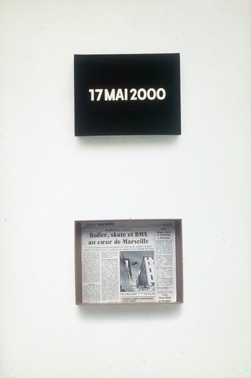
Reproduced thanks to the understanding of the One Million Years Foundation.
Apparently, this triptych can be see at Grenoble Museum, where the three paintings have been 'on deposit' since 2005.
I've been mentioning a number of French places in the south of France. It might help to take a look at this map:
The red dots are where On Kawara made his Date Paintings in Lyon (top), Toulouse (bottom left) and Marseille (bottom right). The triptych was bought by the gallery in Villeurbanne (purple dot, suburb of Lyon) and then given to Grenoble (purple dot a little further south.)
Now, dear reader, you'll be asking: "What about that yellow dot?"
I'm so glad you asked. The yellow dot is Arles, where Vincent Van Gogh spent 1888 painting Sunflowers, The Artist's Bedroom, Poet's Garden, Starry Night and so many more masterpieces. He made wonderful work almost on a daily basis. Yes, there would be a canvas blazing with life every two or three days. Marvellous.
And I know On Kawara thought so too. When he bought a flat in Paris in 1993, he knew where it was in relation to the flat that Van Gogh had lived in with his brother Theo in 1887. It was something he made a point of mentioning when Jonathan Watkins (then director of Ikon Gallery, Birmingham) visited him a decade or so later. And the road-trip that On and Hiroko made to the Great Lakes went from city to city where On Kawara Date Painted as well as making sure he visited the city museums that had such great collections of Van Gogh paintings. (Cleveland, Detroit, Chicago, etc).
Back to the red triangle formed by Lyon, Toulouse and Marseille. While not a formal region itself, this triangle encompasses the heart of the "sunbelt" of Europe, characterized by the Rhône valley and the Languedoc Mediterranean coast. Provence Plus, you might say.
Surely (it now strikes me) when On Kawara was touring the LTM triangle in May 2000, he and Hiroko stopped for a few days in Arles. But it seems that he didn't make a Date Painting in the town made famous by Van Gogh. Why not? Maybe he wanted to spend his time walking between the sites of great van Gogh paintings. Maybe it was just too much. When I was there in October 2025, just a few months ago, I made a Date Painting in order to juxtapose the two artists that have had the biggest impact on my life. This is a composite image:
The Date Painting and the resulting texts can be found on my datepainter.co.uk website, starting with this essay.
But stay here for the moment, dear reader. Or come back to this as soon as you can bear to leave the insights into van Gogh's existence contained in the three essays in question.
******************************************
Hiroko: "Are you sure you don't want to make a Date Painting while we're here?"
On: "I can't do it, Hiroko. It's Van Gogh's territory. Arles must be forever associated with Sunflowers not Date Paintings. But what I can do is make my Dates painted in Lyon, Toulouse and Marseille into a triptych."
Hiroko: "For Vincent?"
On: "Three dates in May corresponding to when Van Gogh was painting landscapes on the Road to Tarascon - to the north of Arles - and Langlois Bridge - to the south - 112 years before."
Hiroko: "Will you call it The Vincent Van Gogh Triptych?"
On: "No-one must know! Or at least let someone work it out over the next hundred years or so…. What are you laughing at?"
Hiroko: "I think I'm laughing from happiness… Don't you start."
On: "I have to laugh when you laugh."
******************************************
Right, let's not get carried away here. Indeed, let's get back down to earth.
Although I have seen the above low res. images of May, 3, May 10 and May 17, I can't say the same for the Thursday pics: May 4, 11 and 18. I haven't see repros of either May 4 or May 11, and the repro I've seen of May 18 is taken from a book published by Dia Art Foundation: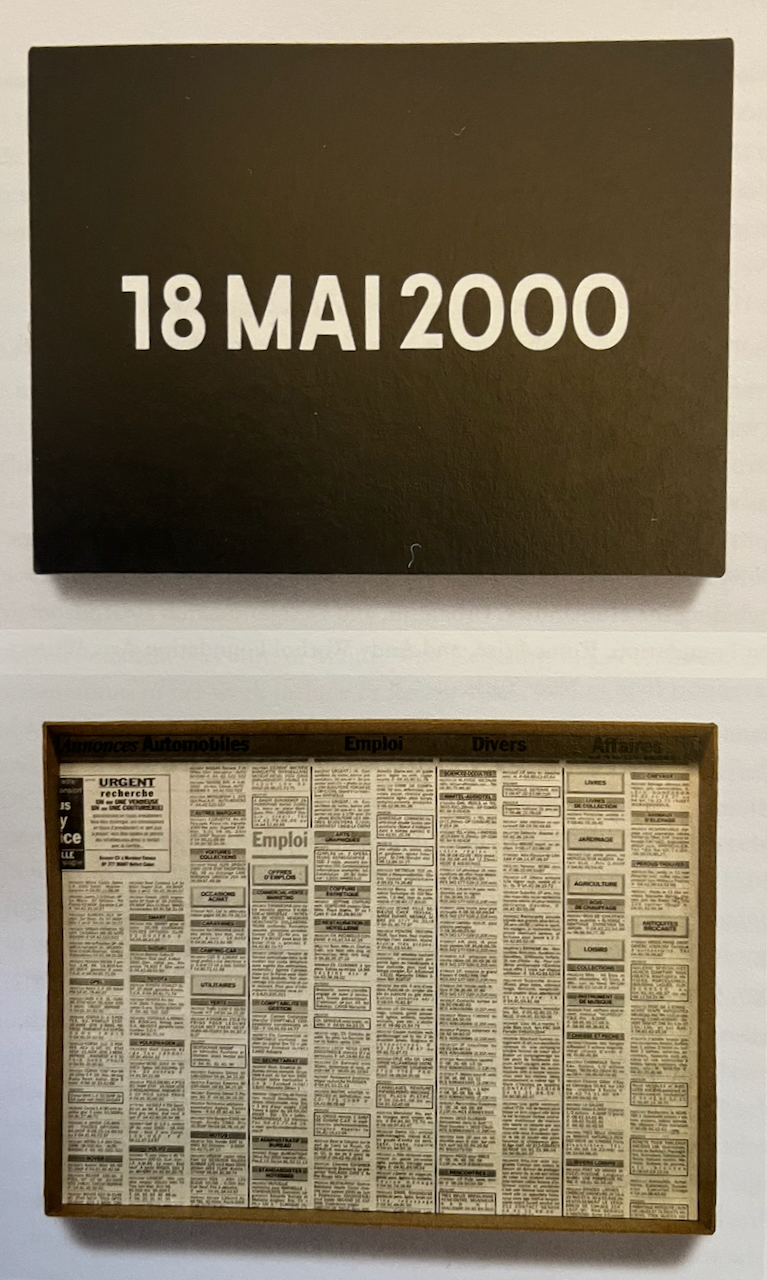
Reproduced thanks to the understanding of the One Million Years Foundation.
Dia Art Foundation's website tells us that this Date is a size B (the Lyon/Toulouse/Marseille triptych are all size A) and that it was given to Dia Art Foundation as a long term loan from One Million Years Foundation in 2025. Quite recently then, and in order to complete the 1966 to 2000 collection in New York that is matched only by the similar-sized collection in Frankfurt.
I'd need a higher resolution of the newspaper extract to confirm if the painting was made in Marseille. I suppose it's possible that May 4 or May 11 could have been painted in Arles. I expect not. But until the newspaper cuttings of these papers is checked, we can't be sure.
And another thing. For some reason, both Toulouse and Marseille are left out of the listing of 'other cities' in Date Painting(s) in New York and 136 Other Cities. Lyon is included, but only because On Kawara made an earlier visit to that city in December 1985. I suppose it's just possible that On Kawara made the three (six) 2000 Dates in Paris and simply used cuttings from a Paris paper that mentioned the cities in southern France. Paris appears in the Date Painting(s) in New York and 136 Other Cities due to the one painted 20 FEV.1993. So the absence of Lyon, Marseille, Paris and Toulouse from the painting places of 2000 could be explained, if that was the case. Though I don't think that will prove to be what happened.
Anyway, I must ask the Institute at Villeurbanne/Grenoble to confirm whether the extracted columns were from papers published in Paris or the regional cities. When I get the answers I'll update this text.
But that's not the thought I want to leave in your mind, dear reader. On Kawara going round the south of France with Vincent on his mind. That's the seed I want to sew. Sorry, that's the crop I want to harvest.
THREE: END OF MAY, BEGINNING OF JUNE
After his adventure in the south of France, On Kawara flew to Ivory Coast in West Africa. He did this because his set of seven Date Paintings from January 1997 were about to be shown at a kindergarten in Abidjan. This project, called 'Pure Consciousness', had begun in 1998, at the suggestion of Jonathan Watkins. The set of seven Dates was installed in a Sydney school in 1998, in a Reykjavic one in 1999, and Abidjan in the Ivory Coast was the third rendition of the project.
Just before 'Pure Consciousness' opened, On made couple of Date Paintings of which this was the first:
Reproduced thanks to the understanding of the One Million Years Foundation.
Jonathan Watkins has told me that at this time On Kawara was very interested in the work of Frederic Bruly Bouabre of the Ivory Coast. Bouabre's work was all about language and coding: he made a set of 600 pictograms to cover the range of syllables spoken in traditional local language, a language that was not being written down or taught in the French colonial education system.
'Pure Consciousness' was on show in the Abidjan school from 5 JUIN to 24 JUIN, 2000. On Kawara definitely Date Painted in Abidjan on 30 MAI and 2 JUIN (which I haven't seen a reproduction of). So for sure he was around when the Abidjan version of Pure Consciousness was up. On Kawara took a particular interest in this leg of the 'PURE CONSCIOUSNESS' tour, possibly because of the Bouabre connection.
A small booklet was produced at each manifestation of 'Pure Consciousness'. Jonathan Watkins was conscious that each show had almost no audience, except the children, so it was important for some kind of photographic and written record to be kept and made available to the art loving public.
Usually the booklet was written by someone who had been witness to the show, like a teacher. On this occasion, On Kawara himself chose a Kahlil Gibran text from The Prophet for the booklet which also includes a few photos, including this one.
Reproduced thanks to the understanding of the One Million Years Foundation.
The Gibran text begins:
And a woman who held a babe against her bosom said, "Speak to us of Children."
And he said:
"Your children are not your children.
They are the sons and daughters of Life's longing for itself.
They come through you but not from you.
And though they are with you yet they belong not to you."
Reproduced thanks to the understanding of the One Million Years Foundation.
The Master's words go on:
"You may give them your love but not your thoughts.
For they have their own thoughts.
You may house their bodies but not their souls,
For their souls dwell in the house of tomorrow, which you cannot visit, not even in your dreams.
You may strive to be like them, but seek not to make them like you.
For life goes not backward nor tarries with yesterday.
You are the bows from which your children as living arrows are sent forth.
The archer sees the mark upon the path of the infinite, and He bends you with His might that His arrows may go swift and far.
Let your bending in the archer's hand be for gladness;
For even as He loves the arrow that flies, so He loves also the bow that is stable.
On Kawara as a stable, powerful bow. I wonder if that is how he saw himself.
The 'Pure Consciousness' show went on touring post-Abidjan (I believe it tours still), and in 2003 it went to Madagascar. On Kawara did not go and see it there, but his children did. And it was Sahe Kawahara that wrote the text for the little publication that accompanied it. I wonder what On Kawara thought when he read this essay written by his daughter, full of references to her and Akito's travels. I expect he was suffused with pride for his far-flung arrows.
I should point out that On and Hiroko had been to West Africa as early as 1973. On had made Date Paintings in Dakar, Senegal, and in Freetown, Sirera Leone. So perhaps the return to West Arica, 27 years later, was his way of keeping a connection with his past.
On Kawara's West African triptych:
Dakar, Senegal: 3 MARS 1973, 4 MARS 1973
Freetown, Sierra Leone: MAR. 14, 1973
Abidjan, Ivory Coast: 31 MAI, 2000, 2 JUIN, 2000
Back in New York, On Kawara made Date Paintings on June 21 and 28, but I suspect he took it easy for whatever was left of the month. It is possible that Akito and Sahe were at home, back from university or whatever it was they were doing with their lives.
I don't have images of either of these June dates so I can take it easy also.
FOUR: JULY
Right, dear reader, you need to pick yourself up again for July. Following the Van Gogh and West African triptychs in May and June, what next from this least swashbuckling of adventurers in the year 2000?
Let's begin the month slowly. Below is an image from Candida Hofer's book, On Kawara: Date Paintings in Private Collections. The photo was taken in 2005. The collection in question was that of Gilbert B. Friesen, from the city of Los Angeles.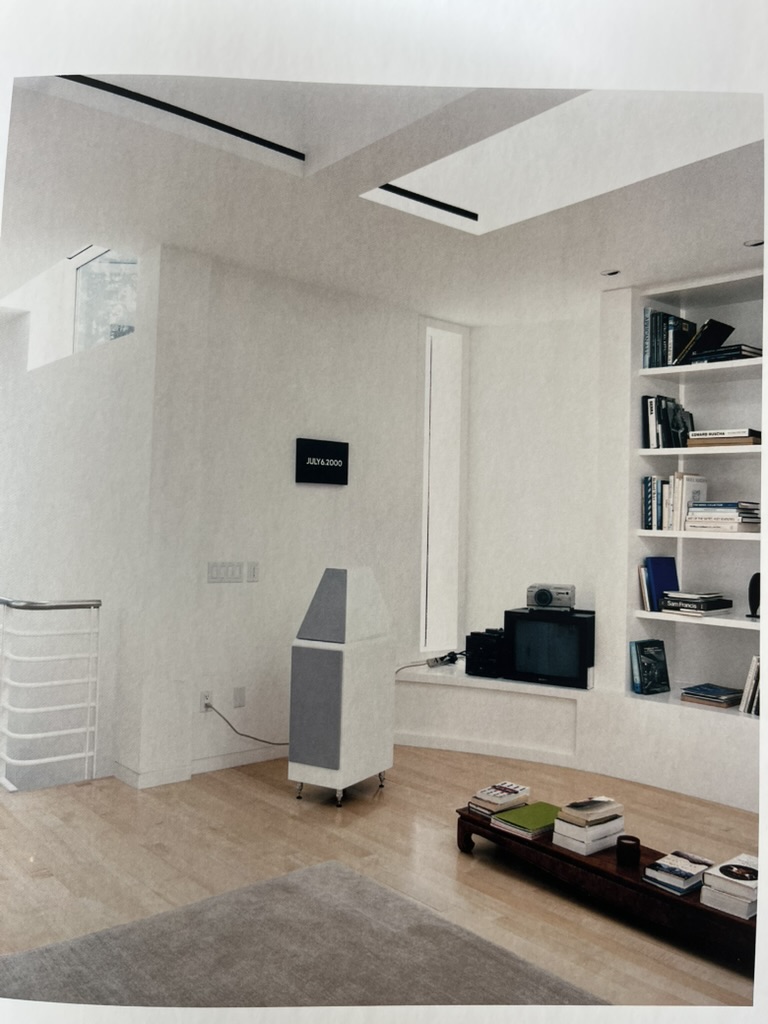
The same Date Painting was sold at auction in 2013. Had Gilbert got fed up with looking at this so soon?
Reproduced thanks to the understanding of the One Million Years Foundation.
The realised price was 27% below mid-estimate. I don't know how much that is, as I don't subscribe to MutualArt.
The Date Painting that is due to be sold tomorrow (correction, today, Sunday 29 March, 2026) is this one.
Reproduced thanks to the understanding of the One Million Years Foundation.
A peculiar thing about it, is that there is no sign of a brown background colour being laid down first. 
Reproduced thanks to the understanding of the One Million Years Foundation.
In other words, where are the smudges and scatterings of red ochre on the back of JULY 14, 2000? All I can see is blue paint and staples that are showing signs of rust.
Another peculiar thing is the pencil marks on the front. To put it mildly, I do not think On Kawara - famous for his meticulous attention to detail - would have let a painting go out into the world with such visible markings on it. I would suggest that - unless the pencil markings were added by someone else at a later date, and I don't think that's the case - then the blue must have faded over time, and that the pencil marks only became visible after the picture had long left the artist's possession.
Let me see if I can highlight the marks I am going on about. First, by simply enlarging them:
Reproduced thanks to the understanding of the One Million Years Foundation.
Secondly, by adjusting the colour and definition:
Reproduced thanks to the understanding of the One Million Years Foundation.
The horizontal line marking the top edge of the letters and number seems all right. It was observed by Henning Weidemann, who edited the book that consists of 31 photographs of JUNE 9, 1991, that On Kawara's curves went through the guidelines whenever a curved line hit a guiding horizontal. But the horizontal line marking the bottom edge of the characters has been done twice with a gap between each. Surely, On Kawara would have rubbed out the incorrect line and not left it there to distract himself.
What are those pencil lines to the right of such verticals as the 'L 'the '1' and the back of the '4'? They are not even straight in places. In particular, to the right of the 'L' and to the right of the upper right diagonal of the 'Y'. Perhaps On Kawara had set himself a challenge: to do this date as quickly as possible but to still to end up with something that was of high quality. The fading of the blue being the thing that gave him away. He may even have given simple instructions to a child as to the drawing of the Date, knowing that he would be able to pull things together in the painting process. Only, I say again, to be betrayed by the fading of the blue over time.
This painting is listed as having been sold for $399,000 at a Phillip's auction in September 2017. It was sold by Masamamichi Katayama, a famous Japanese interior designer, who had bought it from the Taro Nasu Gallery. Katayama may have got tired of seeing the pencil marks, because, as I've said, the painting is again for sale in March 2026.
Two days later, On Kawara painted this in the same colour:
Reproduced thanks to the understanding of the One Million Years Foundation.
Again, the pencil horizontals can be seen. But there is no sign of crude, pencil, character outlines as with the July 14 Date. 
Reproduced thanks to the understanding of the One Million Years Foundation.
I suppose these two July 2000 paintings remind me of the 1993 commission for a French house, Chateau D'Oiron. That same blue was used and there were several instances of visible pencil work.
So I've just taken a look at the images and something leapt out at me that I hadn't noticed before. The horizontal lines used as guidelines for the characters showed several sections of being 'double'. A section of the bottom horizontal in the July Date. A section of the top horizontal in the August date. The bottom horizontal in September. And the top again in October.
What was going on? I don't know. But I sense it was something deliberate, to do with On Kawara's complex, coded process. It's a question I will keep at the back of my mind. I've long been fascinated by On Kawara's creative process and this just adds fuel to the fascination.
There were no more Dates painted in July.
FIVE: AUGUST TO DECEMBER
August: AUG. 22, 2000; AUG. 24, 2000. But no reproductions anywhere.
September: SEPT. 8, 2000; SEPT. 18, 2000; SEPT. 25, 2000; OCT.10,2000. Again, no repros online or in books.
October: OCT. 10, 2000; OCT.12, 2000; OCT. 13, 2000. No trace of 10, but 12 and 13 are reproduced in the literature.
October 12 is reproduced as part of the annual Date Painting timeline in On Kawara: Silence. 
Reproduced thanks to the understanding of the One Million Years Foundation.
And October 13 is reproduced in the Candida Hofer book:

Reproduced with the forbearance, I hope, of the copyright holder, Candida Hofer..
This photo was one of three taken of the Jarla Partilager Collection in Stockholm. In 2006, this collection consisted of at least 5 On Kawara Date Paintings: JUNE 30, 1967; APR. 6, 1972. MAY 26, 1981 and AUG. 4, 1998. So that's five decades of Date Paintings, similar to the five decades collection that cropped up early in the year.
In November he made five Dates leaving a Date Painting-free day between each Date. They all ended up in one collection in Fullerton, California. 
Reproduced with the forbearance, I hope, of the copyright holder, Candida Hofer..
Perhaps this was another sale where the artist stipulated that the Dates all be shown together. But I don't know.
There was also a painting made on 27 NOV. 2000. Paris or Tokyo? Have a guess. I'll let you know shortly
In December, three Dates were made. 12 DEC. 2000, 21 DEC. 2000 and 30 DEC. 2000. I haven't seen 21 or 30, but the first of these was given as a gift to Konrad Fischer. That is to say, Kawara's Dusseldorf dealer.
Reproduced thanks to the understanding of the One Million Years Foundation.
The above photo is taken from the book Cloud and Crystal, The Dorothee and Konrad Fischer Collection. The book also has a small image of the Date's cardboard box:
Reproduced thanks to the understanding of the One Million Years Foundation.
As you can see, there is no newspaper clipping in the box. This happened more often when On Kawara was in Japan. But in any case, a study of a few years either side of 2000 shows that the Kawaras spent the winter in Japan at this stage of life.
Let me say a little more here. On Kawara began to spend his summers in Japan from 1984. I'm pretty sure this was so that his children could enjoy a Japanese education as well as an American one. Every year On, Hiroko and the children would travel to Japan for the summer. Then that didn't happen, either in 1996 or 1997, when Akito and Sahe were either coming up for 18 (Sahe) or already past that age (Akito).
On and Hiroko did begin visiting Japan every year again from 1998. Only they went in winter, not summer. They would fly out in November and return in the middle of February. Why? Well, I was wondering about that, and have concluded that it was simply the weather. By 1998, On Kawara was 65 years old. From November to February, the temperature is about 8 degrees higher in Tokyo than in New York. And there is less rainfall and no snowfall. Perhaps it was Hiroko that preferred the more temperate climate found in Japan.
Eventually their winters in Japan would come to an end, but not until On was unable to travel any more. Ultimately, they chose to live in New York, but that does not negate all those Japanese summers, from 1984 to 1995, and all those Japanese winters, from 1998 to the mid-2000s.
OUTRO
Let me come back to 2000 to finish with. The year that On Kawara chose a text from Kahlil Gibran's The Prophet for the little booklet that accompanied 'Pure Consciousness' in Madagascar in the summer.
I quoted a bit of it earlier in this essay. The paragraphs containing the Master's advice to a woman about 'Children'. With the parent being the bow and the children arrows. There were two further extracts from The Prophet published in the 2000 booklet. The Master's advice to a rich man about 'Giving'. And the Master's advice to an astronomer about 'Time'. This last extract must have been particularly important to On Kawara, as two years later he included it in the the first essay in the book accompanying his exhibition On Kawara: Consciousness, Meditation, Watcher on the Hills. This show began in Birmingham in 2002 and went clockwise to many venues around the world. Arriving back in Birmingham to be shown again, as 'Eternal Return', with four Date Paintings added, one each from the years 2003, 2004, 2005 and 2006, the time it had taken the show to tour the globe.
So what are these words of Kahlil Gibran about Time that really appealed to On Kawara in 2000?
And an astronomer said "Master, what of Time?"
And he answered:
"You would measure time the measureless and the immeasurable.
You would adjust your conduct and even direct the course of your spirit according to hours and seasons.
Of time you would make a stream upon whose bank you would sit and watch its flowing."
Reproduced thanks to the understanding of the One Million Years Foundation.
"Yet the timeless in you is aware of life's timelessness.
And knows that yesterday is but today's memory and tomorrow is today's dream.
And that which sings and contemplates in you is still dwelling within the bounds of that first moment which scattered the stars into space.
Who among you does not feel that his power to love is boundless?
And yet who does not feel that very love, though boundless, encompassed within the centre of his being, and moving not from love thought to love thought, nor from love deeds to other love deeds?
And is not time even as love is, undivided and spaceless?
But if in your thought you must measure time into seasons, let each season encircle all the other seasons.
And let today embrace the past with remembrance and the future with longing."
It seems to me that every one of On Kawara's Date Paintings deals with this dichotomy. In other words, the artist is both the astronomer and the Master. I suspect that On Kawara would have agreed with the conclusion of the Master's speech, even though he did sit on the bank gazing at the stream of time, watching its flowing. Truly, each Date encompasses all the other Dates. For sure, 'Today' embraces the past with remembrance and the future with longing.
MAR. 30, 2026
Postscript
I have found a 22nd illustration from 2000, meaning that I now have exactly half of the year's 44 Date Paintings illustrated in this essay.
It crops up in the On Kawara book published by Glenstone Museum in 2018:
It's a size 'B' Date (as is 18 MAI, whereas the Dates painted on 3 MAI, 10 MAI and 17 MAI are size 'A').
At the back of the book is a good quality photo of the cardboard box that comes with it: 
This confirms that On Kawara was indeed in Toulouse on both the 10th and 11th of May.
Nothing to stop On and Hiroko getting the train from Toulouse to Arles on the way to Marseille in time to Date Paint in Marseille on the 17th and 18th.
Indeed, I see them disembarking at Arles station and meticulously tracking down their first Van Gogh location, the yellow house.