1964: SKETCHBOOKS
INTRO
This chapter relies heavily on the book On Kawara: 1964 Paris - New York. My nearest publicly accessible copy is at Glasgow University Library. So I spent a day looking at the book there. Which day? July 5, 2024. Nearly three months ago.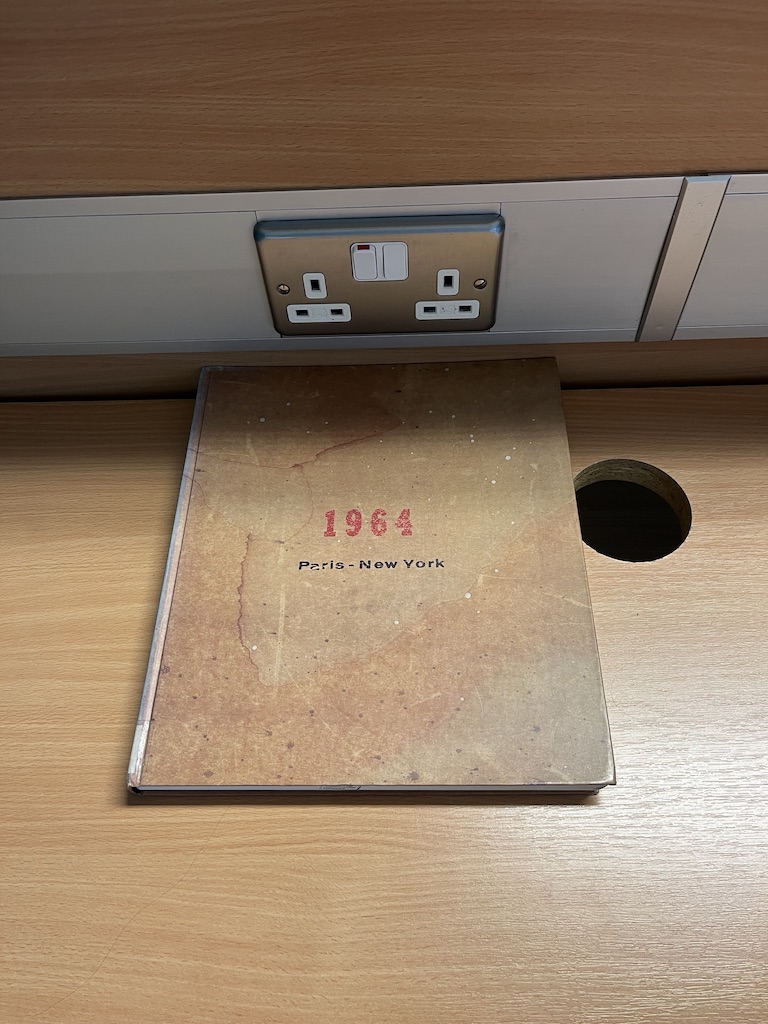
But after my day with the book I knew I would have to consult the material regularly, and Glasgow is a couple of hours away, so I sourced my own copy from Kunstverein St Gallen, a contemporary art gallery in Switzerland which had exhibited the original drawings in 1997, the reason that the book was commissioned. The pristine volume duly arrived (I wonder how many they've got left, 27 years after publication) and I took it with me on holiday to the Isle of Tiree. A good place to consider this distinctive but largely overlooked (by me, at least) phase of On Kawara's development. 

A wave comes in, you take in one image. The wave goes out, you let go of that first image and make room for the next. In other words, I let the material wash over me a few times. It's called preliminary research; it's called immersing yourself in your object of study so that you can begin to formulate an overview and decide on some different ways in. That was just a few days ago, the above pics being taken on the beach on September 20, 2024.
Why am I giving you seemingly irrelevant dates in my own life? There is no disguising that these 'EARLY ON' essays fronting the website are a prequel. The very first essay that I wrote deals with On Kawara in 1966, and there is no possibility of me pretending that that essay does not pre-exist the present one. It was written in February 2021 and I remain exhilarated by it to this day.
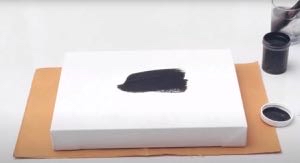
Having included three images of the book's cover, I need to include this next image. It's a page from the book, and shows the actual, cardboard box that On Kawara stored his 1964 drawings in, obviously the inspiration for the book's front cover. It's made in the same way as the boxes that On would make to store each Date Painting by the end of 1966. It references the cave paintings of Altimira, which he visited, and was moved by, shortly after having arrived in Paris in autumn 1963.
ONE: PARIS
Today's task is to get through the 196 Drawings that On Kawara preserved, mostly from his year in Paris, 1964. What should my organising principle be? Well, it looks as if On Kawara chose not to depart from chronological order, as the drawings go from one form of cartridge paper to another without reverting. In other words, I'll go through them from 1 to 196, not reproducing all of the images (no need for overkill) but not departing from Kawara's numerical order which he made concrete by writing the page number in the bottom right corner of each sheet. So here is number one:
Reproduced thanks to the understanding of the One Million Years Foundation.
I know, I know: the visuals in this chapter are less than stunning. Nevertheless, I could spend all day talking about this single drawing alone. An EGG is SOMETHING, isn't it? The hand-made lettering looks forward to the Date Paintings. But, more significantly, the subject matter looks back to those 'Bathroom' drawings made in Tokyo which included so many pregnant women whose babies were doomed. This egg stands a chance. On Kawara in Paris. Four or five years into his post-Japanese life.
This next drawing is the fourth in the sequence:
Reproduced thanks to the understanding of the One Million Years Foundation.
If nothing else, this tells us that On Kawara has flown from New York to Paris and that none of the drawings were done pre-Paris. (Or did he draw 'EGG' while in New York, thus depriving us of 'OEUF'?) Does he prefer the drawing of a plane inside the frame, or the spelling of 'AVION' outside it? He is just exploring the possibilities, I reckon. In the book's essay (German, English and French), Roland Waspe tells us that Kasper König told him that On Kawara set himself the task of making between three and five drawings each day. If he achieved just three per day, then in a year he would have amassed more than 1,000 Drawings, so clearly On Kawara has edited down to these 196. Perhaps there were a lot of unfinished sketches. All of the 196 Drawings seem formally 'finished', or can be understood as such.
This next I am choosing is numbered '7' in the bottom right corner: 
Reproduced thanks to the understanding of the One Million Years Foundation.
The above drawing is a collage, in that the actual envelope sent to the artist has been stuck to the cartridge paper. Roland Waspe refers to On Kawara's Paris address being at Hotel Carlton Palace, 207, Boulevard Raspail, Montparnasse. Waspe informs us that the back court of the hotel was given over to rented apartments. But he doesn't suggest why the address on the envelope, clearly one that On Kawara used while in Paris, is different.
Waspe does say vaguely that Hiroko Hiroaka was with On in Paris, and that she returned to New York six months before he did, but it's clear to me that the essayist, informative though he is, knew virtually nothing about On's circumstances in Paris, perhaps relying on a single conversation with Kasper König which took place on 21 April 1997.
And who was On Kawara's Mexican correspondent? I don't recognise the name N. E. Figuera from the 'I MET' lists made in 1968, but I will bear it in mind when I next consult them. 
Reproduced thanks to the understanding of the One Million Years Foundation.
The image of the baby is one of the very few figurative images within the 196 drawings. In fact, there are no other representations of the human form. Waspe tells us: 'Concerning the motif of the naked child on cushion (nos 12 and 15) the screams of a baby could be heard in the hotel room.'
'No symbols where none intended', then. And yet in the image above, the child is not just crying, it would seem to have been thrown through the window. It may be that On Kawara found the noise of the baby distracting and was fascinated by his own sense of disturbance. Was his concentration really so fragile?
Reproduced thanks to the understanding of the One Million Years Foundation.
Even if the artist did find the noise of the crying baby distracting, I suspect he managed to carry on working regardless. I choose to interpret the above image as On Kawara's total victory over noise.
Five drawings in a row feature a narrow, coloured framing effect. In the first and second, a simple 2-D square or rectangle for a painting is shown. In the third, many small corners of a frame are situated at various positions on the wall. Fourth, two columns of the 'framing' go from floor to ceiling. And fifth the image reproduced below: 
Reproduced thanks to the understanding of the One Million Years Foundation.
It is clear by now that the Drawings are showing a room - a gallery or a studio - and that each focuses on a drawing or painting on the wall, or a three-dimensional object in the room. Kawara could have focused entirely on the sculpture or drawing but he always implies the room in which it is observed. Apparently, On Kawara was looking for a studio while in Paris but couldn't find one. I would have thought that the variety of his work during this period was best served by the sketchbook. Focus on an idea for an hour or so, and then move on to the next idea.
This next image comes after several that feature a pin in the wall. In this case I interpret the image to be a wall drawing, the sort of thing Glasgow-based Richard Wright specialises in. 
Reproduced thanks to the understanding of the One Million Years Foundation.
In my opinion, some of the least successful images are of objects. Which takes us back to the studio idea. Good that On didn't have a studio in which he spent a few days making this object and situating it in a real space. Leave such groundwork to Anish Kapoor, or whoever! 
Reproduced thanks to the understanding of the One Million Years Foundation.
This next is image number 53. There are a lot like this. I'd suggest the two-dimensional drawing is getting to look like a map, with walls and tracks marked. Though a map hung on a wall. There is also some resemblance to a cave painting, or is that just my fancy?
Reproduced thanks to the understanding of the One Million Years Foundation.
What's interesting to me about this next drawing is two things. One, it is the first image to switch from the vertical (drawing on the wall) to horizontal ('map' on the floor). The doors to the implied room are towards the bottom of the right and left edges of the drawing. 
Reproduced thanks to the understanding of the One Million Years Foundation.
The second thing I note is the use of a few simple descriptive French words. Pilier (there are three pillars), barriere (there are several barriers), objet (there are two objects), lampe (there is one lamp). There is lots of other stuff as well in the drawing and it's not clear what is being represented. As I say, part map, part gallery-plan.
I've chosen this next one for two more reasons. First because it animates the studio/gallery in a new way, showing floor, walls and ceiling all being used for an installation. 
Reproduced thanks to the understanding of the One Million Years Foundation.
Second because the five colours used for the handholds and footholds speak to the five colours that On Kawara would employ while doing his Code Drawings in 1965. Stand by for those Code Drawings, perhaps the most significant of his pre-Date Painting work.
We're halfway through the book at this point. An appropriate place to quote from Roland Waspe's essay: 'During the second half of the year 1964, On Kawara's lifestyle became that of the Parisian Boheme. Around noon he would go to the Café Dome where he spent many hours in discussion. He spoke French there and only French with a Japanese whom he first became acquainted with in Paris. At night, back in the hotel room, he worked on his drawings.'
Moving quickly from drawing 98 to 125, a different theme is introduced. This must be what a French keyboard looked like in 1964.
Reproduced thanks to the understanding of the One Million Years Foundation.
The one I'm using today is much the same. In the first row of letters, E, R, T, Y, U, I, O and P are in the same place. In the second row, S, D, F, G, H, J, K and L are in the same place. And in the third row X, C, V, B and N are in the same place. There are important differences, but one would be astonished if there weren't.
Turn over. And on the next page there is a complication that is relevant for the rest of the book. The right-hand page was made in 1964, just as with all the preceding pages. But the left-hand page was made from the right-hand page under On Kawara's instruction in 1997. 
Reproduced thanks to the understanding of the One Million Years Foundation.
His thinking may have been that the Japanese symbols wouldn't mean much to a European audience. In 1997, on each key, the Romanised equivalents of the sounds were typed out. This still wouldn't and doesn't mean much to most Europeans, so I asked Hideo Mori, a friendly Japanese contact, what he thought was going on in the double page. He told me that the original drawing (on the right) reminded him of a game he played as a child in Japan, whereby you could make words by going from phonetic symbol to symbol either up and down columns, or along rows, or via diagonals.
Maybe that's why some of the keys were coloured yellow. But I didn't dwell on this too long. Because something even more interesting began to happen on the very next page. More interesting because it is sustained for sixteen double-pages. Welcome, dear reader, to 'ON language'.
First, the double-page, which is not quite clear enough to read. It's titled 'ON language 1' in the top right corner.
Reproduced thanks to the understanding of the One Million Years Foundation.
From now on, I'll tend to focus on the left-hand page, copied by On Kawara in 1997 with English typed on top of the 1964 image, a translation (I presume) of what On Kawara had originally written in pencil in tiny Japanese writing. I presume its standard Japanese. But it may be that page 126 is needed to decipher any coded aspect. 
Reproduced thanks to the understanding of the One Million Years Foundation.
Running the words together, the result is:
'east…it's morning…words as a group…look…and then…rectangle…
Let's all do it together…sometimes…dot…formlessness appears….
Therefore it's no good!…criticism laughs…'
But that isn't definitive, not least because, On Kawara has left much of teh Japanese writing in the left-hand side of the drawing untranslated.
What comes across most strongly is two things, the playfulness and the ambiguity. Sorry three things, the playfulness, the ambiguity and the experimentation. But I won't take that evolving Monty Python scenario any further.
Onto 'ON-language 2', drawing number 128. First, the original drawing from 1964, which again is effectively a map on a wall (or a cave painting):
Reproduced thanks to the understanding of the One Million Years Foundation.
Then in 1997, for publication in book form, On translated some of the tiny columns of Japanese characters into English words and had them printed on top of the copied map:
Reproduced thanks to the understanding of the One Million Years Foundation.
Running the English words together, and using a little initiative in deciding on line breaks, the result is:
'eventually…
baby…hello…welcome…
hello to crawl… therefore… is… would it be possible to…very…I think you should do….
fresh…(suddenly)…this…something…it…
you understand very well…'
Two of the earlier Drawings are of an actual baby, of course, so I'm assuming the artist is referring to baby as a small child and not as a romantic partner.
I find these text-strewn drawings of compelling interest. Here is 'ON-language 3', though I'll jump straight to the over-printed 1997 version:
Reproduced thanks to the understanding of the One Million Years Foundation.
Text, though bear in mind that much or the original Japanese is left untranslated:
'three times…enormous… upon looking… not at all…left over…
Hopeless, isn't it? early…already…
It is that… of quiz…inside…from now on…good…lie…(telling a) strange.'
That is a throwback to 'ON-language 1' in that it contains a playful negative. In other words, 'Hopeless, isn't it?' reminds me of 'Therefore it's no good.' I have to remember that Samuel Beckett was living and publishing in Paris at this time. Were his books translated from French to English immediately? Perhaps On Kawara read them in French anyway, as his French may have been as good as his English by this time.
'ON-language 4' demonstrates that the translation into English aspect of Kawara's work was thought of back in 1964. I mean, the English words were written in red biro. First, I'll reproduce the 1964 drawing:
Reproduced thanks to the understanding of the One Million Years Foundation.
Why English and not French? I don't know. Perhaps because he knew he would be returning to New York and the language spoken and written there.
And here is the same drawing but with the words over-printed in English, the same as in 1964 but with the very few additional words 'ON-language 4' and 'Four People on the Bed'.
Reproduced thanks to the understanding of the One Million Years Foundation.
The bed is schematic with four individuals at the corners of it. One assumes that the people are in pairs and that some of the women have come and gone as their names have been scored out. Though Dora has only changed positions from top left to bottom right.
And who is with who? The words 'homosexuality' and lesbian love' suggest we can't take it for granted that it's a boy-girl, boy-girl set-up. And where is this four-in-a-bed happening? Is it in Saint-Germain-des-Pres, a district in Paris, or on 5th Avenue, New York, both of which are mentioned?
The names are American rather than French (or Japanese). The word 'freedom' catches my eye. On Kawara had known freedom since he'd left Japan. But it wasn't quite clear yet how he was going to make use of this word, this feeling, in his life or in his work.
This drawing is one (of two, the other being the smiling baby) that also caught the eye of Ei Arakawa-Nash, a performance artist based in Los Angeles. He has an exhibition in Tokyo next month (October - December, 2024) and he intends to use the baby drawing as well as this one in his installation. He told me that Yoshito from Million Years Foundation has been very helpful to him, giving him access to the original drawing. Christ, I wish I could get access to On Kawara's archive so easily!
Ei told me that what caught his attention in 'ON-language 4' was the mention of homosexuality. He did not associate this with On Kawara and, being gay himself, he wondered what motivated On Kawara to come up with this work. I will look out for his installation.
'On Language 6' is reproduced below. It seems particularly experimental in its use of words:
Reproduced thanks to the understanding of the One Million Years Foundation.
From the repetition of letters within 'TTTThhhhaaatt'ssss iiittttt' to the repeat of the single word 'hand hand hand hand hand…'. Something has happened and it's happened quickly. Is it the act of drawing itself?
In 'On language' 8, only one word is translated, and that's 'child'. Well, no, the sub-title 'relations' is also typed out for the 1997 book. But the original drawing contains a mass of mysterious (to me) Japanese.
Reproduced thanks to the understanding of the One Million Years Foundation.
Below is 'On language 9'. My main reason for reproducing it is the cave drawing association. The whole thing looks like the flank of a horse, or bison, or elephant. 
Reproduced thanks to the understanding of the One Million Years Foundation.
But the words don't underline such an association.
take a walk to aid digestion
in a short time
laughing stock
everybody
uniform
suddenly
counter
prepare for
close
youthful
I'm reproducing more of these drawings than I should, but that's because I find them of more interest. Language adds a vital dimension. This next is particularly wordy. And it was all written in English from the start (1964). 'ON language 11' is written in Japanese in the top right corner. And a few words about materials are written in French ('noir en bois') but it looks to me that On was watching a film rich in colloquial American, and noting dialogue. Cop speak. 
Reproduced thanks to the understanding of the One Million Years Foundation.
'The hell we can't…good girl…be seeing you…you're going place… what the hell's the hurry.'
How hilarious if On adopted some of these phrases in his own speech. But I'm sure he'd already learnt irony, so he probably did.
From drawing 143 there are several that involve looking down on table-top displays. Sometimes the surface of the table is concave and sometimes it is convex, and Kawara indicates which at the side of the sketch.
Then there are a few that focus on looking down at a floor that has a door in it. And a couple where the floor has a window in it.
The final Paris images focus on more tabletops, the table supported by four legs or suspended from the ceiling by four cords. A chessboard crops up in two images, in one of which the chessboard is circular. In a sense, the artist has gone from sketching paintings on walls, to sculptures in rooms to table-top displays. But with other phases also, such as the use of text and map and colour.
The final image made in Paris is of a table covered in sand, crawling with ants. A transparent glass or plastic lid covers the sand/ant mass. Of course, that takes us back to some of the paintings On made in 1955, where a Japanese home was overrun by insects. Let's not go there. Or perhaps it's good to have a reminder of how far On Kawara has come in terms of feeling neutral or even positive about life.
TWO: NEW YORK
I wonder if On Kawara moved into a new studio straight away. There are another thirty or so drawings (according to Roland Waspe) that were made in New York. This is the first:
Reproduced thanks to the understanding of the One Million Years Foundation.
The drawing on the facing page, tells us that the lump of material is made of an opaque plastic. I don't know why On Kawara would be interested in this, except it does have the look of a cave painting. A bit of texture here, a bit of shading there, that could be made into the representation of an animal. There are six drawings containing lumps of opaque plastic, then transparent plastic is introduced in drawing 171.
The next significant motif is the grid drawn onto a wall, or drawn onto a canvas mounted onto the wall. There are five pages of this, including a grid made up of all the pages from the novel The Old Man and the Sea (two versions: drawings 175 and 176) and two versions of a grid divided up in such away as to produce a Calendar of 100 years (drawings 177 and 178). This is a creation that the artist would return to when making several different 100 year-calendars in his Date Painting decades.
Drawing 183 is an odd one. It's a rough sketch of an exhibition schedule.
Reproduced thanks to the understanding of the One Million Years Foundation.
'Bonapald Napoleon' is showing from October 17 to November 7. Someone else from November 10 to November 28 and a third personfrom December 1 to 19. Then down the side in Japanese the names of the people are listed. These names are typed in English on the 1997 copy that faces the 1964 version: Napoloeon, Genghis Khan, Lincoln, Gandhi and Alexander the Great.
If these dates apply to 1964, then the first exhibition was from Saturday to Saturday and exhibitions two and three both ended on a Saturday. But what about the names? Is it a comment on the leadership qualities - or the ego sizes - of contemporary artists in New York? An art world notorious for being dominated by alpha males (mostly white men).
Getting close to the end now. The book finishes with ten unnumbered drawings. Five of these are English lessons. Here is a typical example:
Reproduced thanks to the understanding of the One Million Years Foundation.
These emphasise that On Kawara was still either being given - or giving himself - English lessons. It may be that of his four languages at the time, Japanese, Spanish, French and English, the latter was the least fluent as he had not been in an English speaking country for a year, and only then for a single year or so.
Which leaves us with a final five drawings. Here is the fifth last drawing:
Reproduced thanks to the understanding of the One Million Years Foundation.
There is no implied room, just a sheet of paper with a box drawn in it. For the 1997 book, On Kawara has typed 'you laugh' as the translation for the top bit of writing. Then he has typed 'you are going' twice, at the end of the lines that are going away from each other. Where the lines meet, the typed words are 'indeterminacy of the idea'.
Is On going to do one thing or the other? He doesn't know. He laughs.
The fourth last image is humorous also. 
Reproduced thanks to the understanding of the One Million Years Foundation.
However, not too much should be read into it. Roland Waspe tells us that this was a copy of.a cartoon he found in the toilet of his new studio at the corner of 13th Street and First Avenue. The significance of this is the info that On Kawara at last had a studio. A chance to put some of his many ideas into practice!
Third last drawing. Below is the 1997 version with typed English.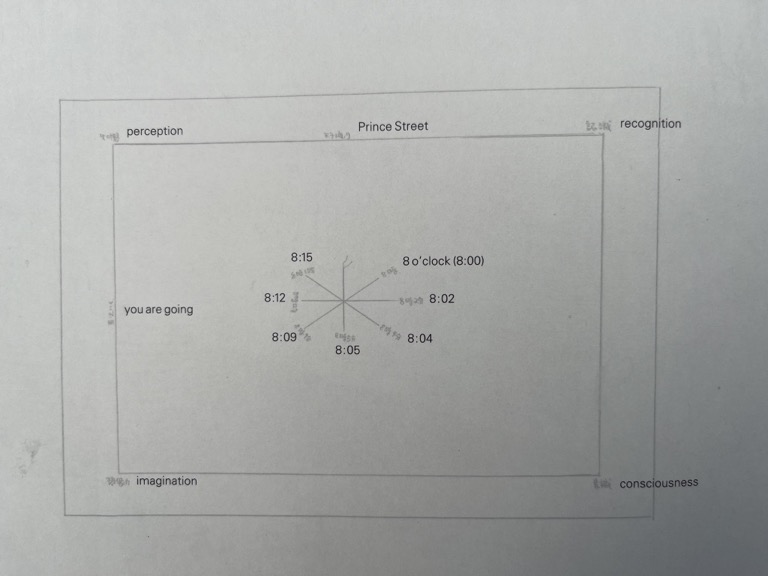
Reproduced thanks to the understanding of the One Million Years Foundation.
Prince Street is given a mention. In fifteen minutes from eight o'clock, On Kawara (I assume) is walking along that road. Or perhaps he is walking clockwise in a circle. The four corners of a drawn box read perception, recognition, consciousness and imagination. Perhaps his mind is jumping between consciousness and perception. Or between recognition and imagination. But it takes a few minutes to do so.
As you can see from this next map, Prince Street (red line in middle of map) is equidistant from Chambers Street (red pin towards bottom of map) where On lived with Hiroko, and East 13th Street (red pin towards top of map), where his new studio was located. 
In the light of this map, the penultimate drawing is of interest. 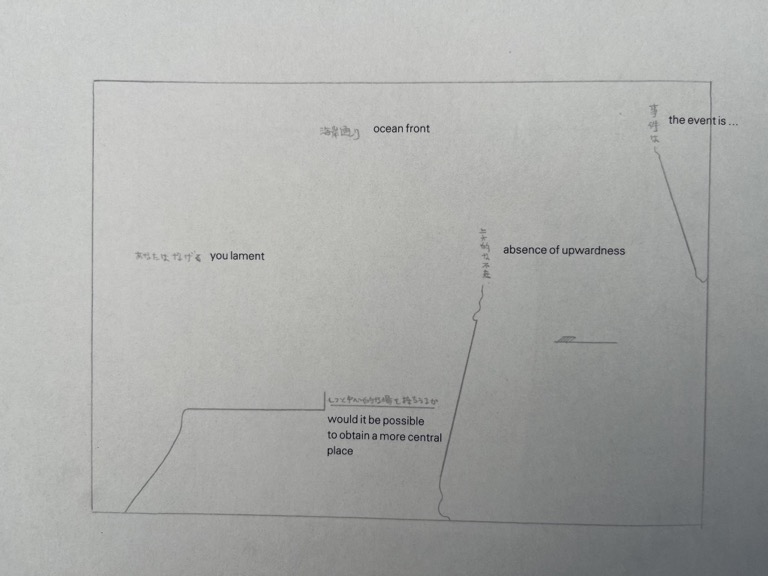
Reproduced thanks to the understanding of the One Million Years Foundation.
I take this to mean that On was not quite happy with the relative positions of his home and his workplace. It would have taken quite a while to commute by tube. It was Jonathan Watkins who told me that On and Hiroko moved from Chamber Street in the middle of 1966, so perhaps that was when they obtained the more central place referred to.
Last image:
Reproduced thanks to the understanding of the One Million Years Foundation.
This is the third time in five images that the artist has referred to 'you are going'. The first time he was talking about an indeterminacy of choice, and laughing about it. Then the options were just two. This time it looks as if things have turned serious. There are no less than nine options.
Choice is the enemy of focus!
196 drawings has been way too much for me. It has been impossible to structure the material in a compellingly interesting way. But I've done my best.
OUTRO
As already mentioned, the box of 196 drawing was published as a book in 1997. But the material has been made available by On Kawara or his close associates both before and after that. Let me summarise the publication history of the drawings.
In 1980, in the pages of On Kawara: continuity/discontinuity 1963-1979, just three of the drawings were published. All three were drawings made in New York towards the end of the phase. Two of the pages are grids (Old Man and the Sea and 100-year calendar).
Reproduced thanks to the understanding of the One Million Years Foundation.
The other one is an English lesson ('Give sentences with the following…') which is pinned to the wall. That is, there is an implied floor/wall division in a studio or gallery.
In 1996, On would again have been responsible for the choice of drawings included in On Kawara: Whole and Parts. Twenty drawings, each given a whole page of the book. Thirteen from Paris and seven from New York, which is again biased towards the inclusion of New York drawings. However, the sequence starts with these two:
Reproduced thanks to the understanding of the One Million Years Foundation.
Oddly, an unnumbered extra drawing appears adjacent to the Napoleon drawing which is number 183 and which I discuss earlier in this essay. 
Reproduced thanks to the understanding of the One Million Years Foundation.
As you can see, it is a network of connected events. The English words 'happenings' and 'chief event' are written in the margin, and are perhaps significant. It would be fascinating to have a translation of this whole drawing as it might provide clues as to On's knowledge of (and opinions about) the New York art scene, circa 1964.
But why is this page not included in the 1997 book? I suppose it's possible that On numbered 196 drawings (less the ten that are unnumbered) for retention in a box, but also kept a few more for his own purposes in another box, or whatever.
In 2002, Phaidon published its monograph on On Kawara. Over a double-page, twelve images from the box of 1964 drawings are reproduced: 
Reproduced thanks to the understanding of the One Million Years Foundation.
Lastly, in 2024, On Kawara: Silence reproduces sixteen drawings over eight pages. 
Reproduced thanks to the understanding of the One Million Years Foundation.
Whole and Parts, Phaidon and the Silence book each reproduces the EGG image, the envelope image, and the one of the box attached to a wall that can be seen in the above image, far right.
What more can I say?
It is with huge relief - and the expectation of being able to write something a lot more three-dimensional - that I pass onto the next essay, 1965.