EARLY ON
TOKYO WAREHOUSE
INTRO
If On Kawara's 1953 was dominated by the making of 28 'Bathroom' drawings, 1954 was much concerned with the series of 31 drawings that make up 'Events in a Warehouse'. Today I am going to reproduce all the drawings (presuming Million Years Foundation will continue to tolerate my use of their intellectual property) and I am going to write a few words here and there. Am I? Let's see how it goes.
The first seven drawings are collectively called 'Anxiety'. The next 16 are called 'Noise', and the last eight 'Rhythm'. Those middle 16 works really are dark and abstract, and I won't be able to say very much about them. But that's getting ahead of myself. Let's just see what happens when I consider each drawing consecutively over the course of today: July 18, 2024.
ONE: Anxiety
Drawing one:
On Kawara, Events in a Warehouse, 1954, drawing one of 31.
This may present a domestic interior, as suggested by four walls enclosing a certain size of space, shuttered windows, a stool and a floor. Set in the floorboards is an opening which might lead to a cellar. The majority of objects (a vase, a bottle, but mostly wooden-looking things such as a table and another stool) seem to be in mid-air. What is happening? We don't know yet.
It looks as if you could sit on the floor and take a drink from the bottle that stands there, nestling against the wall. So the situation could be worse. It's while mentally sitting there that I realise it's a metal panel over the hole in the floor, and that is not something you'd have in a domestic interior. So maybe this really is a warehouse.
Drawing two:

On Kawara, Events in a Warehouse, 1954, drawing two of 31.
A lot worse. Nowhere to sit, for a start.
Two tables can be discerned, one seen from above the other from below. Both moving through the air, it would seem.
Wooden poles and wooden planks. The spherical objects seem to be a throwback to the 'Chinese lanterns' that featured in the last six drawings of the 'Bathroom' series, but you wouldn't identify them as such just from looking at this drawing alone. The allusions to other spaces (via shutters and cellar door) have gone entirely.
A coffee pot, a bottle, and a kitchen knife on one of the tables are almost enough to ground the viewer, but not quite. Everything is on the move. Has there been an explosion? Oh yes, in August, 1945. Two explosions, one in Hiroshima and the other in Nagasaki.
Hold onto your own comfy seat, dear viewer, I suspect this is going to be a bleak ride…
Drawing three:
On Kawara, Events in a Warehouse, 1954, drawing three of 31.
The table is a less dominant motif in this composition. The pieces of wood seem to be re-assembling in a more abstract and threatening way. The biggest object that's coming together shows several sets of pegs or spikes emerging from its frame. Luckily the wooden arm doesn't look as if it's functional. No joints that would allow it to move other than as a block
The rectangular object, bottom right, I take to be the mirror from the Bathroom series of drawings. The mirror that never reflects anything. If tis image was to be rotated anti-clockwise by 90 degrees, the table would be resting on the floor and the composition would be a lot more stable. Just thinking that thought gives stability to the scene.
Drawing four: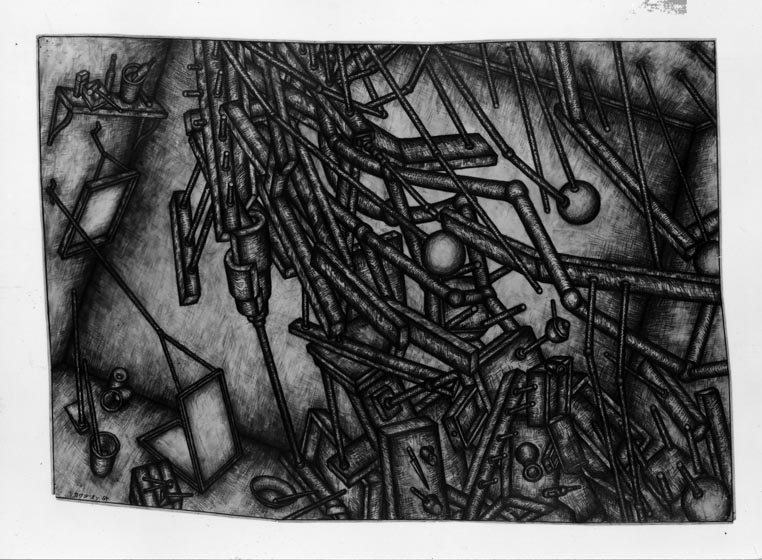
On Kawara, Events in a Warehouse, 1954, drawing four of 31.
Is it my imagination or is this drawing darker? And is there something greasy or oily about the darkness? Maybe we really are in a warehouse.
This is a large drawing. At 55 x 76 cm it's about twice as long and twice as high as the others in the 'Anxiety' group. Which means it's four times the surface area.
There is a shelf where most of the familiarity and civilisation on offer can be found. Otherwise, the scene consists of a cluster of poles and planks dominating the centre of the space. But hang on, what is the rectangular feature that crops up twice in the left end of the room? A long, Y-shaped pole attaches them to the wall, and in one case it seems to prop something open. Is that an allusion to the cellar door from drawing one? Though the other rectangle looks more straightforwardly attached to the wall, like a painting or a mirror.
This time I am going to rotate the image 90 degrees, to see if that makes more sense of the feature I've just ben describing:
On Kawara, Events in a Warehouse, 1954, drawing four of 31 (rotated by 90 degrees).
That doesn't really help. But it's like looking at anew drawing. And now I'm noticing one surface supporting a knife and a saucepan and another supporting what I take to be a coffee pot and a bottle.
I imagine On Kawara constantly turning the paper as he made his drawing. So that no one of the four edges was up or down or left or right for very long. It may be that he only decided which way the composition was intended to be looked at from when he made the signature line.
Drawing five: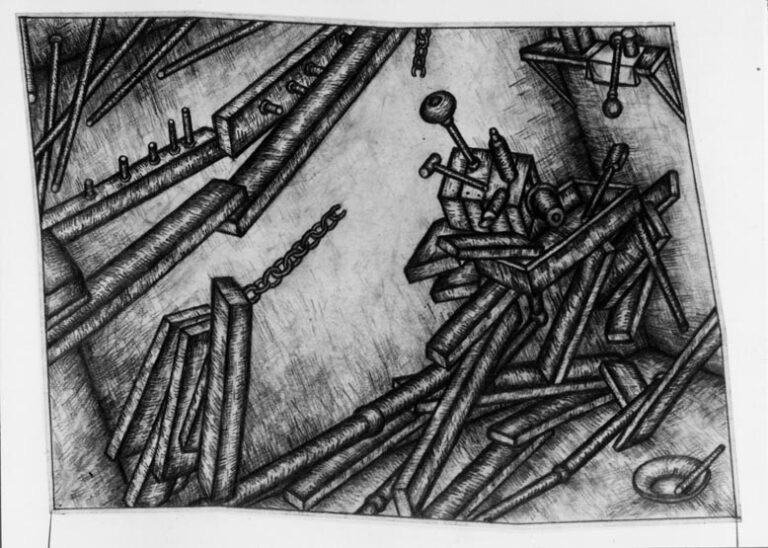
On Kawara, Events in a Warehouse, 1954, drawing five of 31.
Not so dark. Not so threatening. And I imagine it was drawn almost entirely with the paper positioned in this way. Though funnily enough, On Kawara does not seem to have signed and dated this drawing.
A lot of planks with pegs bolted on. A bit of chain that just ends mid-link in mid-air. A hammer on top of a box which is on top of a pile of wood. There is definitely work being done in this room. The workman may even eat his meals off the plate that one can see in the right foreground. Though what piece of cutlery is that stick?
There is still a sense of movement. Not so much in the right-hand side of the composition, but in the left-hand side, I'd say things were moving up and out of the frame, top left. "Let's clear some space," the brave workman might be saying immediately after his meal. "Let's throw some light on the problem."
Drawing six:
On Kawara, Events in a Warehouse, 1954, drawing six of 31.
The oil and grease is back, big-time.
Two of the walls seem to have spikes emerging from them. The table in the centre of the picture morphs into something else at its left side. There is so much tubing to the right that it's difficult to make out anything else there.
Anxiety? I'm rather anxiously awaiting the seventh of seven drawings in this section.
Drawing seven:
On Kawara, Events in a Warehouse, 1954, drawing seven of 31.
Those Chinese lanterns are back en masse. But they can be read as wrecking balls, swinging back and forth.
A table or tables and a chair can be seen amidst a mass of wood, some of it pegged or spiked. The wood may being knocked around by the swinging balls. The whole scene is greasy and oily black. Do things get brighter or darker from this point? Do things get messier or cleaner and more organised? I think I can guess the answer.
I will take a break at this point in the working day. The break sometimes called 'lunch'.
TWO: Noise
Sixteen more drawings in this section. So we go from drawing eight to twenty-three. God help us.
Drawing eight:
On Kawara, Events in a Warehouse, 1954, drawing eight of 31.
What is that?
What I mean is, all the wood and almost-identifiable objects have gone, and all that exists is a network of whatever this stuff is. In the catalogue that was published with the 1994 show, On Kawara: 1952-56 Tokyo, at Frankfurt (Kasper Konig territory) it is referred to as bamboo-like. I suppose I see that, but my principal association is scaffold poles. A network of what I think of as scaffolding comes close to filling the interior, achieving nothing useful.
Drawing nine:
On Kawara, Events in a Warehouse, 1954, drawing nine of 31.
Am I looking at a room, a warehouse. Or am I looking at a human brain, the mind of the artist? If the latter, the web-like network suggests the possibility of thought. Of exploring options. Though there are breaks in the network, short-circuiting any thinking that's going on. Notably right in the middle of the frame.
I wonder how On Kawara produced these drawings. They look like a lot of work. The scaffold poles, if I can call them that, go in and out of each other and the artist needs to be careful that he keeps things realistic. Ha! As if this is not primarily a psychological space.
But I think we have to consider it as principally a psychological space for the person making it, rather than the person looking at it.
Drawing ten:
On Kawara, Events in a Warehouse, 1954, drawing 10 of 31.
These 'Noise' drawings remind me of Paul Noble's work, Nobson Newtown. Paul spent hours, days, months, years, pencilling in the buildings of a fictional town called Nobson Newtown. I wrote about that at length on this website. I did mention On Kawara to Paul Noble, and Paul told me he was an admirer. I assume he was thinking of the better known work such as the Date Paintings when he said that, but I don't know.
Drawing 11:
On Kawara, Events in a Warehouse, 1954, drawing 11 of 31.
One of Paul's drawings is Nobson Central. A huge drawing, it was also made into a book, each page being a segment of the original drawing, all the pages adding up to the whole drawing. It was Walther König of Cologne that published such an enterprising and remorseless book, Kasper's brother. What a role the König family have played in supporting the work of some extremely original artists.
Each page is full of crumbling buildings, and nothing else. The buildings also spelled out a few lines of a T.S. Eliot poem, as each building was also a 3-D letter in the Nobson font. So the whole scene was also a complex code as well as an absolute riot of ruination. So hidden in the desolation was a delicate sort of beauty. Though I won't quote the poem here (It begins 'April is the saddest month…') as that would unbalance the picture that On Kawara is gradually building up through his drawings. If he introduces relief to the darkness, then I will too.
Is it possible that On Kawara has built in a double-meaning to these interiors? On Kawara was fond of codes himself, as you'll see elsewhere on this site, and by 1965 he was doing very complex codes based on pairs of coloured lines. But I don't think anything like that is happening here.
What we're looking at is just a (very organised) tangled mess. A visual noise. On Kawara's view of post-war Japanese society? I must develop that thought at some stage.
Drawing 12:
On Kawara, Events in a Warehouse, 1954, drawing 12 of 31.
The above scene is actually a lot simpler than the three previous. Most of the bamboo scaffolding is going from bottom left to top right. The eye can follow any particular pole from left to right…
It's almost a peaceful scene. It's almost constructive. Are things going to calm down?
Drawing 13:
On Kawara, Events in a Warehouse, 1954, drawing 13 of 31.
This is a bit different. One piece of scaffolding is more layered than all the rest, in that there is an inner layer covered by an outer layer.
Planking has been introduced again. In fact the partially stripped stretch of pole is pressed on several sides by planks of wood. Or what I take to be planks of wood.
Oh, for a door or a window. Or just a glimpse of either. Hang on, if this is a warehouse, doesn't the day's work come to an end? Don't we get to go home?
Not yet, apparently.
Drawing 14:
On Kawara, Events in a Warehouse, 1954, drawing 14 of 31.
More scaffolding, less planking. I can live with that. One stretch of scaffolding, middle of left edge, has been split into two or more curved sections.
But who cares? It's not enough detail. Not enough variation. Not enough to dim the relentless noise of scaffold poles, spiders' legs on the road to nowhere.
Drawing 15:
On Kawara, Events in a Warehouse, 1954, drawing 15 of 31.
Ah, the scaffolding has almost produced a ladder effect going up the middle of the composition, and from bottom right towards top left. One ladder morphs into another. You start by climbing up between two scaffold poles and before you know it you're climbing up another ladder which consists of at least one new piece of scaffold.
Potentially there are a whole lot of ladder rungs available throughout the room. It's bit like playing with a set of Meccanno.
Drawing 16:
On Kawara, Events in a Warehouse, 1954, drawing 16 of 31.
As with the 'Anxiety' section, the occasional drawing has dimensions double that of the majority of drawings, giving quadruple the area. In the 'Noise' section that's this drawing and the next one.
This is a very dark, very complex composition of pipes. It must have taken a long time to draw.
It could almost be a microscopic view of a human brain. But a healthy brain or an unhealthy one? I would say healthy. The links between nodes are numerous and none of the links are broken. This is a dense network of interconnectivity.
You could light up the universe with a brain like this!
Drawing 17:
On Kawara, Events in a Warehouse, 1954, drawing 17 of 31.
Ditto the above drawing. Just how significant/insignificant did On Kawara feel while labouring away in the top left quarter of this drawing…
And yet it must have taken all his concentration to keep his line true and his shading consistent. A pointless job done rigorously. Until seeming insignificance suddenly switches into significance. Don't ask me to elaborate on that. I don't think I could. Not yet.
Those last two drawings are the centrepiece of the whole series, but not the climax.
Drawing 18:
On Kawara, Events in a Warehouse, 1954, drawing 18 of 31.
Back to the smaller size of drawing. But more of the same intensity.
More of the same scaffolding. A scaffolding that allows for the construction of what?
It's a dark space because of the piping. But it's a dense network for the same reason.
Glass half full or half empty?
Drawing 19:
On Kawara, Events in a Warehouse, 1954, drawing 19 of 31.
Ah, a change of orientation. There's novelty for us.
The pipes, the pipes…. They keep playing the same tune. Up and across, up and across, ad nauseam.
Darkness or light?
Noise or pattern?
Drawing 20:
On Kawara, Events in a Warehouse, 1954, drawing 20 of 31.
Wow! - look at the bend on that pipe! Can you see it, left-middle of the composition? That is an event in a warehouse if ever there was one. Not sure I can take much more plot twist. Next it will be revealed that the scaffolding has enabled the erection of a building as magnificent as the Taj Mahal. But we don't see it until the scaffolding gets taken down.
Oh, but hang on. I'm focusing on that bend again. With that single turn, the scaffolding becomes a nest of worms. And darkness prevails.
Darkness that is the creation of a single, purposeful mind. Source of all light.
Drawing 21:
On Kawara, Events in a Warehouse, 1954, drawing 21 of 31.
Yes, I get the impression that the scaffolding is going up and up.
This building is a huge one. Perhaps the Empire State Building or similar high-rise.
Would On Kawara even have known what a skyscraper looked like back in 1954, languishing in Tokyo?
Drawing 22:
On Kawara, Events in a Warehouse, 1954, drawing 22 of 31.
This seems to have a luminosity.
Come to think of it, so did the last drawing.
Darkness has quietly, unobtrusively, turned into light.
I see a series of arms raised to the heavens. Joy is unconfined? Let joy be unconfined! Joy is unconfined.
Drawing 23:
On Kawara, Events in a Warehouse, 1954, drawing 23 of 31.
Are we ready for the big reveal? I am ready for such a thing.
But hang on, what have I just been looking at? Pipes within pipes. Whatever next?
Are there no limits to the artist's lack of imagination? Imagination Dead, Imagine!
It must be so hard to be this deadpan. Having said that, there is something of a loop-the-loop going on in the middle of that drawing, harking back to Drawing 20. And with that thought to cheer me, I will be taking another break any moment now.
How On Kawara managed to keep going on these drawings for hour after hour, day after day, beats me. He must have kept having to remind himself of what he was doing and why:
'It's an interior. I have to fill it with piping. I have to fill it with worms. I have to fill it with noise. So that nothing simple and logical and beautiful can happen.'
'It is terrifying. It is horrible. It is pointless and unnecessary. But it's what I see all around me.'
'I am looking for an answer. But I won't find the answer until I have fully delved into the problem. And for me delving means drawing.'
'Bear with me.'
THREE: Rhythm
Drawing 24:
On Kawara, Events in a Warehouse, 1954, drawing one of 31.
So what has changed?
Much less scaffolding. The wooden planking is back from 'Anxiety'. And the curved wooden spikes which are in drawing three are here twice. It looks like a threatening environment, though not as dark as the peak scaffolding pictures.
Drawing 25: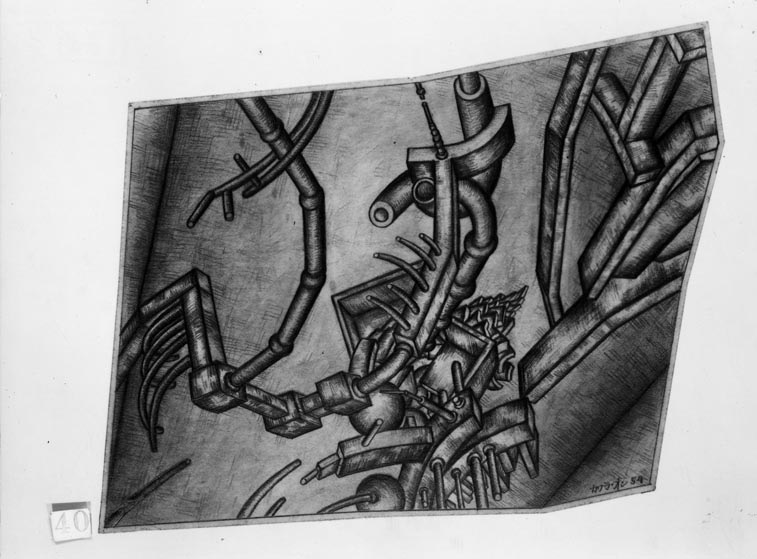
On Kawara, Events in a Warehouse, 1954, drawing 25 of 31.
The sense of levers and robotic arms. The danger of being swiped or otherwise caught up in the machine's business.
It's a bit Vorticist. But that was an art movement from the UK dating from 1914. Part of art history, true. But would Tokyo-based On Kawara have been aware of Wyndham Lewis and his crew?
Perhaps the scene is more likely to be a loose rendering of what it was like to be in a post-war Japanese car factory. But no, car making in Japan didn't get going until later, say 1970, but in any case not by 1954.
In general terms, what was actually happening in Japan between 1945 and 1954. Cue Wikipedia:
'Japan's highly acclaimed post-war education system contributed strongly to the modernizing process. The world's highest literacy rate and high education standards were major reasons for Japan's success in achieving a technologically advanced economy. Japanese schools also encouraged discipline, another benefit in forming an effective work force.'
If this was the case, it seems that On Kawara thought that the country was missing the point. What about imagination? What about morality? What about tradition? What about art?
Drawing 26: 
On Kawara, Events in a Warehouse, 1954, drawing 26 of 31.
The threat of being clamped.
And boxed up.
Or removed from said box and grabbed by the neck and shaken.
The big heavy objects may or may not be malevolent, but the vulnerable human would be best to stay out of harm's way.
Though how would that be possible if you were in this space? The space being post-war Japan.
Drawing 27:
On Kawara, Events in a Warehouse, 1954, drawing 27 of 31.
This is a large picture (four times normal-size), and so is the one following.
On the left wall is a structure that looks like a lintel, hung with curtains. The merest suggestion of a window?
A person stands in the corner to the right, facing into the corner. There's a surprise! It looks like she's holding a light bulb on a stand, that memorable motif from the 'Bathroom' series and from Pregnant Woman.
Do we fear for the woman's safety? Well, the heavy-looking ball could fall from where it is precariously balanced. The room is full of vices and other potential instruments of torture. Perhaps not torture, this may simply be an unfeeling, machine-led universe. No harm meant to any organic creature that may come to a sorry end when things start to pump and grind.
Drawing 28:
On Kawara, Events in a Warehouse, 1954, drawing 28 of 31.
The final large drawing.
The woman has turned around and is facing into the room. She would appear to be pushing back the forces of oily movement. Those robotic paddles are all falling back onto each other. Or seem to be. What are they afraid of?
It's that small ball of light that they shy away from, isn't it?. The spark of life in an AI universe.
Where has this woman come from? Perhaps her appearance came as a surprise to On Kawara. There he was drawing darkness day after day, and then suddenly he realised his pencil had come up with this woman. The power of life itself is held in her right arm. It's held in her tightly clenched fist.
Or perhaps her appearance was planned from the start. The artist's intention was to draw dark-and-industrial-interior after dark-and-hopeless-interior until a tiny bit of respite was called for.
She is good, She is God. She may be what On Kawara was hoping would be there at the end of his long journey into night.
It makes me think (and here I'm jumping forward a few years) it was inevitable that On Kawara would one day find someone like Hiroko. Yes, he was always going to meet a Hiroko, and hook up with her. Even if he had to travel across the world to do so. Which he did. If Hiroko hadn't existed he would have had to invent her. As happens here.
It makes me think too, of what On Kawara did in 1970 when he sent a copy of the same postcard on 120 consecutive days to his artist-friend, Dan Graham. The postcard was of the Statue of Liberty. And what is the Statue of Liberty? It is a strong, noble woman standing with a torch held aloft in her right hand. What is she signalling? She is offering respite to the wretched that wash up on the shore of America. Let me quote her:
"Give me your tired, your poor,
Your huddled masses yearning to breathe free.
The wretched refuse of your teeming shore.
Send these, the homeless, tempest-tossed, to me.
I lift my lamp beside the golden door."
Did On Kawara have an inkling that he might end up in New York? I can think about the implications of that once I get to the end of this work. Three more drawings left…
Drawing 29:
On Kawara, Events in a Warehouse, 1954, drawing 29 of 31.
I see on the left, a lumbering machine that's out of kilter. It may even be falling down. But, looking at the main clustering of mass, I see a monster of a machine taking aim at the right side of the warehouse. The wrecking ball is at the end of a long robotic arm. A powerful punch seems possible. A pummelling seems on the cards…
Drawing 30:
On Kawara, Events in a Warehouse, 1954, drawing 30 of 31.
Cut to another corner of the room. Heavy wooden pieces with spikes and capable of gripping like a vice.
Clumsy, though. Maybe not that dangerous after all.
And something has snapped in the left foreground. A vital component broken?
Drawing 31:
On Kawara, Events in a Warehouse, 1954, drawing 31 of 31.
The corner of the room - where the woman was - has taken a pounding.
Is that what's happened?
And even if that is what's happened, that doesn't mean the woman's been destroyed. She was the sublime creation of On's mind, and what he has created once he can create again. Indeed, the woman with sceptre had been cropping up in On's work throughout 1953 and 1954.
So fear not, gentle reader. Fear not.
OUTRO
I've made 'Events in a Warehouse' read a bit like an episode of Doctor Who. But maybe that's not such a bad thing, as there is a kernel of the authentic in that BBC sci-fi series. I mean, there is something good at the centre of it. And when I say good I mean of life as opposed to oblivion.
I'm reminded that On Kawara's Million Years Past, was dedicated 'For all those who have lived and died', while Million Years Future was 'For the last one'. I think we know who the last one is likely to be. At least in On's mind.
And I'm going to leave it there.
JULY 18, 2024 (sure enough).