SIZES A TO H
Having not long ago written about On Kawara's largest size of Date Painting, I realise that I have something to say about all the sizes from 'A' to 'H'. If the earlier story was a triumph (through On's curation of size 'H' as part of the 2008 show in Dallas), this one may be more nuanced, even touched with sadness.
In January, 1966, On began with size 'A' Date (8 " by 10"), plus a variation of that, long canvases that allowed him to spell out the month in full. But he gave that up before the end of February, having made a total of four spelled out Dates in all, two in 'JANUARY' and two in 'FEBRUARY'. That is typical, in that his practice evolved 'logically' over time.
The first 'B' sized Date (10" by 13"), was made on APR. 12, 1966. And the first 'E' sized Date (26" by 36"), was made on JUNE 2, 1966, with 'C' and 'D' still to make an appearance. Nobu Fukui has told me that On, Nobu's close friend, sometimes used plastic templates and that he had a box of them containing different sizes. It was the size 'D' template (18" by 24"), that Nobu borrowed (without permission) to make a facetious Date Painting for himself on his birthday, JUNE 2, 1967. Nobu was an ambitious painter and I guess there was a friendly rivalry between the two Japanese New Yorkers who often played mah jong with other members of the Japanese New York art community. On Kawara was the master of that game also.
I should say before I go any further, that the vast majority of On Kawara's 2700-odd Dates were size 'A' or size 'B'. Indeed, all the hundreds of Dates made away from New York were either size 'A' or size 'B' , except for some size 'D' made in Tokyo, where the Kawara family had a second home from the 1980s onwards. In all, there were a fair number of size 'C' and 'D' Dates as well. But this essay is going to focus on the larger sizes, 'E' to 'H', and a poignant pattern that is exposed.
A few more preliminary size facts up front before this essay takes off. Of the 241 Dates made in that first super-productive year of 1966, twenty were at size 'E'. But that mid-size was then neglected (size 'C' and 'D' were preferred) for nearly twenty years, until 1984, and from then until 1992 another 25 were made. Just bear that in mind if you will. I may or may not raise it again later.
There was a single size 'F' made in 1966. It was made to commemorate the Gemini 10 rocket. Here is a photo that On Kawara took of the painting as it hung in his studio.
Reproduced thanks to the understanding of the One Million Years Foundation.
It wasn't until planning this essay that I began to take an interest in the contents of what was resting on the table in front of the wall-mounted Date made on JULY 18, 1966. A pot with paint brushes. But could the bits of wood be something to do with an easel?
As a size 'F' Date was 41" by 56" (which is three and a half feet by four feet eight), I think it was too big to have been painted while resting on a table. Whereas size 'E', being two feet by 3 feet, probably could be done just as easily while resting on a table top.
That difference is what makes me think of sizes 'F', 'G' and 'H' as large Date Paintings. On Kawara would have used the same easel to paint them, I expect. Though this is a hypothesis, as there is no photo of any such thing. On Kawara was very careful about the info that emerged from his studio. All the exercises in recording of the Date Painting process that were made in the 1990s (about five of them) were documented by a sequence of still photos of size 'A' or 'B' Dates.
There is nothing like this:
Maybe it was too heroic a pose for On to make for even Hiroko's camera!
Before On Kawara painted anything at size 'G' he had painted ten of the eleven Dates he would ever make at his largest size, 'H'. He made his first three size 'H' Dates in 1969, to commemorate the Apollo space program, and the first of only four size 'G' paintings in 1987, the same year he painted his final size 'H'.
What am I saying? I'm saying that size 'H' was his preferred large format, but there came a time when he found such a huge area of canvas difficult to cover in the twenty-four hour period allowed. He was 55 by this time. And although that was not old by today's standards, he had been a heavy smoker all his adult life and that had made him physically frail according to people who knew him.
The following diagram contains all the size 'F', 'G' and 'H' size Dates that On Kawara ever made:
JULY 18, 1966
JULY 16, 1969; JULY 20, 1969; JULY 21, 1969
OCT. 29, 1978; OCT.31 1978; NOV.13, 1978
OCT.27,1982 NOV.18,1982
APR.22,1984; SEPT.8,1984
OCT. 22, 1985; OCT.28, 1985
FEB.27,1987 MAY 1, 1987
NOV. 17, 1988; NOV.21, 1988
APR.9, 1993
At least I think that's them all. Details of the size of Date Paintings were taken from the top left corner of 'I READ' documents made available by Tama Art University, and 'I READ' was discontinued at the end of 1995. Another sign that On Kawara was running out of energy.
Running out of energy? The two at size 'H' that he completed in 1984 meant that he only had one more day of the week to do at that size until he had his triptych of Moon Dates plus a set of seven Earth days of the week. The ten giant paintings that made the Dallas show in 2008 such a triumph!
But first he dropped to size 'F' in order to make a Daylight Saving Time pair. One just before and one just after the last Sunday in October when the clocks went back in New York. Which is to say on October 27, 1985. I only have access to one of the two size 'F' made in October, 1985. Otherwise I would be lovingly reproducing them both at this point:
Reproduced thanks to the understanding of the One Million Years Foundation.
The very first size 'G' painting that On Kawara attempted was FEB. 27, 1987. 
Reproduced thanks to the understanding of the One Million Years Foundation.
It was a Friday, which is the day of the week needed to finish his size 'H' week that he had begun in 1978. But surely six size 'H and 1 size 'G' doth not make an entirely satisfactory week. And so a special effort was made on MAY 1, 1987, which had a lot going for it in any case, what with the Japanese PM meeting the American President in Washington that day, the meeting featuring on the front page of the New York Times, that whole paper plus two others being boxed up as part of the artwork.
Anyway, making a size 'H' was now too much like hard work for On Kawara. And so any really large canvases made after that were size 'G'. Two in November of 1988. Of which this is one, bought by the Herberts and now part of the Herbert Collection: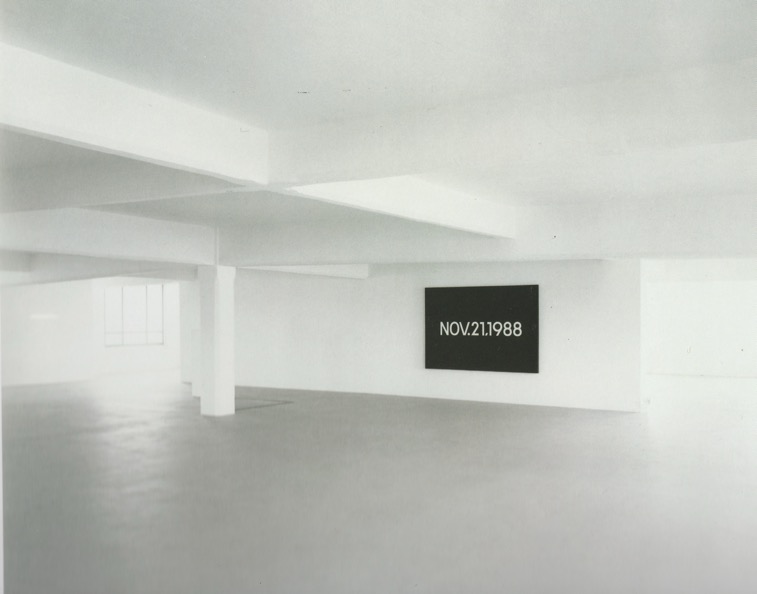
It looks big, doesn't it? The way to brighten up any multi-storey car park. I wonder what happened to the similar-sized Date painted four days earlier.
What is the difference in surface area between a size 'G' and a size 'H'? A size 'H' painting has an additional 35% of surface area. That could have become significant as the painter had got older and weaker.
So what I'm saying, is that APR. 9, 1993 was the last large ('F', 'G' or 'H') Date Painting that On Kawara ever made: 
Reproduced thanks to the understanding of the One Million Years Foundation.
That happens to have been a Good Friday.
Here is the first of two 'I READ' documents with the 'G' mentioned top left:
Reproduced thanks to the understanding of the One Million Years Foundation.
And here is the second:
Reproduced thanks to the understanding of the One Million Years Foundation.
What does that remind me of?
On Kawara was born on December 24, 1932. So he had not long turned 60. Every one of his Date Paintings explicitly refers to the birth of Christ through the rendering of the four-digit year. I wonder if that crossed his mind as he made perfect the '1993' on this Date. The anniversary of Christ's crucifixion.
Let's take it one step further and have me paying my respect to that last image. I felt I had some success when I employed Shakespeare's 18th Sonnet on the home page of this site. Here goes with the 19th:
Devouring time, blunt thou the lion's paws
And make the earth devour her own sweet brood,
Pluck the keen teeth from the fierce tiger's jaws
And burn the long-liv'd phoenix in her blood,
Make glad and sorry seasons as thou fleet'st,
And do what e'er thou wilt, swift-footed time,
To the wide world and all her fading sweets:
But I forbid thee one most heinous crime,
O carve not with thy hours my love's fair brow,
Nor draw no lines there with thine antique pen,
Him in thy course untainted do allow
For beauty's pattern to succeeding men.
Yet do thy worst, old time, despite thy wrong,
My love shall in my verse ever live young.
Verse? Is that what I'm writing? Love? Is that what I'm feeling? You decide, dear reader, you decide.
But let me finish off in a less sentimental way. On Kawara was a master artist of the 20th Century. Not the 21st. He was in decline by then. I don't think even a single size 'E' was attempted once 1999 had ticked over into 2000. Though I would love to be proved wrong.
18th Sonnet, 19th Sonnet, 20th Century, 21st Century: Don't you just love it!
Oh, and one more thing:
JULY 18, 1966
JULY 16, 1969; JULY 20, 1969; JULY 21, 1969
OCT. 29, 1978; OCT.31 1978; NOV.13, 1978
OCT.27,1982 NOV.18,1982
APR.22,1984; SEPT.8,1984
OCT. 22, 1985; OCT.28, 1985
FEB.27,1987 MAY 1, 1987
NOV. 17, 1988; NOV.21, 1988
APR.9, 1993
The most important thing that ever happened in On Kawara's adult lifetime? If those 19, LARGE, easel-made Date Paintings are considered as a whole, the Apollo triptych of 1969 loses prime position to the six or more Dates made to commemorate the clocks going back in the autumn.
Not so much: 'That's one small step for man, one giant leap for mankind', as 'We are going to pretend that last hour didn't happen. And go on pretending that until next spring.'
This is what On Kawara wrote at the beginning of his Journal for 1966:
'The paintings were made on the dates that are painted on them. The times are given in terms of U.S. Eastern Standard Time, except for those from April 25, through October 29, which are in Daylight Saving Time, in accord with American custom.'
Deadpan on the one hand, ironic on the other.
Daylight Saving Time? If only it could.