GLENSTONE
Last year I wrote the preceding essays about publicly accessible collections of On Kawara Date Paintings, principally a major gallery in Frankfurt and Dia Art Foundation in upstate New York. In so doing, I managed to ignore what is the biggest and best collection of Date Paintings, owned by Glenstone, a museum located near Potomac in Maryland, about 10-15 miles from Washington D.C.
Why did I make such a mistake? Maybe because the Frankfurt and Dia collections were built up over decades, whereas the Glenstone collection is a relatively recent one, which has come about through the massive wealth of its founders, billionaire industrialist, Mitchell Rales, and his art-historical partner, Emily Wei Rales, who worked at the Barbara Gladstone Gallery in New York. They met in 2005 and Emily began working for Mitch around then, and the most massive investment in contemporary art was underway.
I knew that Glenstone Museum had bought the most prestigious part of the 'Today' project, the triptych of size 'H' Date Paintings celebrating the Apollo moon mission of July 1969. A gallery, or a pavilion, was built around this, and On Kawara himself contributed to its design, suggesting that a kind of charcoal be placed in a layer under the floor, I believe.
Reproduced with the forbearance, I hope, of the copyright holder.
However, if I had looked at the superb book published by Glenstone in 2018, I would have realised that by then, four years after Kawara's death (but as a result of close negotiation with On Kawara and his estate, One Million Years Foundation) Glenstone had acquired 61 Date Paintings, Which is to say, the Moon Landing triptych, an installation called '48 Years in 16 Cities' (which consists of a black size 'B' Date for every year from 1966 to 2013) and eight other Dates, comprising one size 'A' (blue), two more size 'B' (of which one is red), two size 'C', and 3 size 'D' Date Paintings. "What about size E, F and G?" I hear you ask. "Why the 'duplicate' size B, C and D Dates?" Good points, dear reader. I said this was the best collection of Date Paintings in a gallery in the world, I didn't say it was perfect.
Now Glenstone had not just been investing in On Kawara. At their country park of an estate there are massive outdoor works by Jeff Koons, Richard Serra and Andy Goldsworthy, to name but three. And there are substantial collections of work by Jeff Wall, Robert Gober, Carl Andre, Andreas Gursky, Eva Hesse, and so many others. Even though the gallery contains many separate pavilions, each ideal for focussing on a single artist's work, it is impossible to show all of the work at any one time. At the moment, in spring 2026, it is On Kawara's Moon Landing triptych that is on view. But what about the hugely significant '48 Years in 16 Cities' set? I think that is in storage.
Potomac is a long way from where I live. It's a long way from where most On Kawara aficionados live. And in any case, as I say, the bulk of the On Kawara collection is often in storage. Thank goodness then for the following catalogue, put together by Emily Wei Rales and her team. It contains photographs of all 61 Dates in the collection as well as the other On Kawara work that Glenstone owns.
Reproduced with the forbearance, I hope, of the copyright holder.
The book was very reasonably priced when it came out, but its cost has been going up over the years. You may want to order a copy right now. I predict you'll be aching for a copy once you've read this essay.
As I set out the Glenstone collection, it is going to be impossible for me to resist making a few, semi-serious, curatorial suggestions. First, here is '48 Years and 16 Cities'. As you can see it consists of 50 paintings due to two being made on both SEPT.3, 1970 and DEC.18, 1996. Please note, all these Date Paintings are the same size, the first double-spread and the final double-spread have simply been reproduced at a different scale:


Reproduced with the forbearance, I hope, of the copyright holder.
I agree that these look like postage stamps in an album, dear reader, but I'm doing my best, Go to Potomac for a chance to see the Date Paintings themselves. Or buy the catalogue to see exemplary reproductions.
Anyway, there is a point to what I'm doing. You see, I now want to introduce something else. Glenstone owns the very best - aesthetically pleasing and utterly bizarre - set of postcards from the 'I GOT UP' collection. Which is to say the 131 postcards that On Kawara sent to Dan Graham daily between February and July 1970, each one showing the Statue of Liberty on the picture side, with On telling Dan what time he GOT UP (and nothing else) on the message side. 
Reproduced thanks to the understanding of the One Million Years Foundation
As you can see, the two conceptual artists lived not far apart in Manhattan. But Dan Graham was working in California at the time, so every day a postcard would turn up at his empty New York address. Imagine the growing pile. Quite funny, don't you think?
Reproduced thanks to the understanding of the One Million Years Foundation
I guess Glenstone was able to buy this superb work from Dan Graham because On Kawara was in on the negotiations. If Kawara was entrusting his Moon Landing triptych to the Rales, then it's natural that he would consider Glenstone Museum a suitable 'forever home' for this timeless piece of bravado. 
Reproduced thanks to the understanding of the One Million Years Foundation
I'm thinking how good it would be to display the postcard collection with the 50 Date Paintings. In other words, in the gap between the fourth dark Date Painting (MAY 21,1969) and the fifth (SEPT.3, 1970), would sit this little lot:


Reproduced with the forbearance, I hope, of the copyright holder.
Why so? Because it emphasises the playfulness of On Kawara, complementing the relentlessness of his process. On Kawara did not just make black Date Paintings several times a month. He was incredibly active on a daily basis. And at this time, as well as the Date Paintings and the 'I GOT UP' postcards, he was making 'I WENT maps and 'I MET' lists.
Glenstone also owns four 'I AM STILL ALIVE' telegrams that On Kawara sent to Harry Pollac in Berchen, a suburb of Antwerp in Belgium between October 7, 1986 and January 12, 1987. Who was Harry Pollac? Google doesn't know. The set of telegrams is nothing like as impressive as the set of postcards sent to Dan Graham in 1970, but it would still break up the relentless line of near-black Date Paintings, reminding the visitor that there was so much else going on in On Kawara's life. 
Reproduced with the forbearance, I hope, of the copyright holder.
Kawara was also involved in his Million Years project in 1970, and then 10 years later he made a second Million Years, called Million Years Future. The first work then becoming Million Years Past.
Reproduced with the forbearance, I hope, of the copyright holder.
It's this Future work that Glenstone has in its collection. I would (facetiously) advise Emily Wei Rales - if there are still funds available for further investment - to purchase the Million Years Past volumes as well. The 500th page in its tenth volume, takes us up to the millionth year in the work. That is, 1969. See it printed at the foot of the page?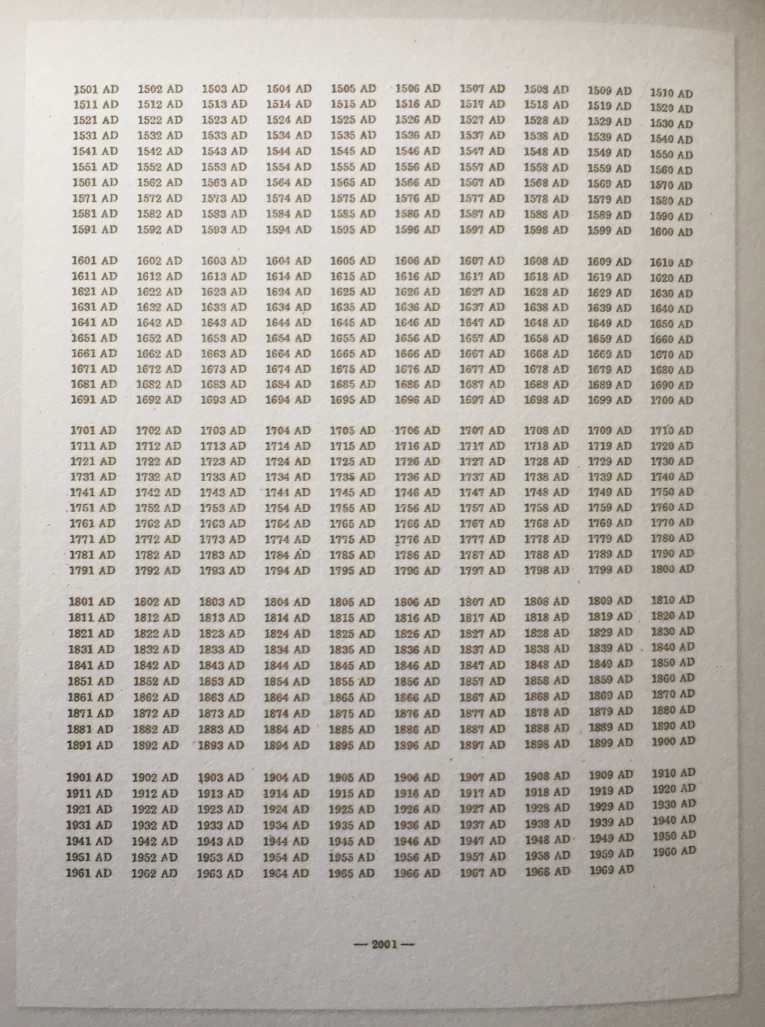
Reproduced thanks to the understanding of the One Million Years Foundation
I'm envisaging then - with my Glenstone guest-curator's hat on - presenting these Date Paintings from the '48 Years and 16 Cities' set.
Reproduced thanks to the understanding of the One Million Years Foundation
Oh and this one as well:
Reproduced thanks to the understanding of the One Million Years Foundation
And finishing the Kawara pavilion off with the opening page of Million Years Future:
Reproduced thanks to the understanding of the One Million Years Foundation
What would that achieve? I suspect On Kawara very much had in mind that there was a past, most of which he hadn't experienced, and there would be a future, from which he would be very largely absent. But that in the present, towards the end of the 20th Century, he was very much alive. And that the Date Paintings represented him taking full advantage of his consciousness and living one day at a time.
On Kawara was at his most present in those eleven years between the Million Years works. It may have been the birth of his son, Akito, in 1979 that inspired Kawara to think of producing the second of the Million Years pieces. Million Years Future is dedicated to 'the last one' by which he doesn't mean Akito. But Akito would have been the first one in the hopefully long line leading to the last one.
It might be argued that such a curatorial suggestion omits too much of the '48 Years and 16 Cities' set. I'm suggesting that to always have it on display in some way or other, would invite the possibility of a range of imaginative presentations. On another occasion, the 50 paintings might be split between the ones painted in New York, the artist's home city, and those painted in the 15 other cities. The others being:
Mexico City
Montreal
Halifax
Washington D.C.
West Berlin
Tokyo
Sydney
Hiroshima
Dusseldorf
Cologne
Toulouse
Fujinomiya
Fort Worth
Monte Carlo
Andorra
That list communicates something about On Kawara's incessant travel and the subsidiary importance of the United States as a whole, Mexico, Japan and Germany, to his life story. However, the list misses out Paris, where the artist owned a flat in which he made several Dates from 1993. Please also note that the list includes Toulouse, where On Kawara made two Date Paintings in 2000. He also made two in Marseille a week later. Yet the book, Date Painting(s) in New York and 136 Other Cities, omits both French cities. I'm pleased to be able to point out that it's not just me that makes mistakes!
One more thing. What about the absence of a size 'E', size 'F' and size 'G' date Painting from Glenstone's collection?
On Kawara painted 20 size E paintings in 1966, He didn't paint any size E from 1967 to 1979. Then he painted another 25 from 1983 to 1992. I'm kind of surprised Glenstone didn't negotiate to purchase one of the 1966 size Es for their permanent collection.
Size F was first used on July 18, 1966. It was only used twice more nearly twenty years later, in October 1985, possibly in a Daylight Savings context. (The clocks going back an hour.) Maybe none of these Dates was available for purchase. Though I would have thought that One Million Years Foundation still own them, so why not?
Size G was not used at all from 1966 to 1987, which was the year that size H (Moon Landing-size) stopped being used. I only know of four size G Dates, so again sourcing one of these might have been difficult, especially since the Herbert Foundation own one of them.
But these are cavils. In rounding this essay off, I need to emphasise what a superb collection of On Kawara work is housed at Glenstone. It's because it's so good that it gets the imagination going in the ways I've tried to suggest on this page.
What would really add to the collection, over and above a size 'E', 'F' and 'G'? Not a full set of Michelle Didier's edition of 'I GOT UP, 'I WENT, and 'I MET' because Glenstone already has that. (It would be good to present them alongside the Moon Landing triptych, so that visitors could see 'exactly' what On Kawara was up to between the days of July 16 and July 21, 1969.) What else then?
I'd suggest another postcard collection. Paerhaps the postcards sent to Anna Astner in 1979 which brought the 'I GOT UP' series to an end. Those tell a very human story. A story I've tried to tell in this earlier essay.
But look, final word about major collections of On Kawara Date Paintings. Both Dia Art Foundation in New York and MMK Frankfurt have collections that consist of a Date per year from 1966 to 2000. But for a collection that contains a full set, 1966 to 2013, your only option is Glenstone Museum, near Washington D.C.
A donation of $2 billion by Mitchell Rales to Glenstone Foundation in 2022 increased the museum's asset value to $4.6 billion, nearly the same as the Metropolitan Museum of Art in New York. So the Kawara collection should be there to stay. It's the day-to-day, year-to-year visibility of it that might be of concern.