THE ROME STUDIO
ONE
It's the last day of October 2026 and I've just realised how I might get to grips with On Kawara in October 1990 despite 'I GOT UP', 'I MET' and 'I WENT' having stopped in 1979. After all, it's only 36 years ago; hardly ancient history.
The artist made eight Date Paintings in Rome while he was undergoing a residency at Vicolo della Penitenza 11. This information has just bubbled up on the Internet, either that or it escaped me before.
Let's locate the 'Rome Studio'. It's not far from the River Tiber, on the left bank, about fifteen minutes walk south of the Vatican. I've marked it with a red pin in the centre of this map.
Google Maps facilitates a Street View, so let's have a look at the front door:
Ah, the authentic Rome! Not a tourist in sight, but rather a backstreet in the Trastevere district. Scooters parked haphazardly.
The residency program was set up by Barbara Gladstone and Thea Westreich. Gladstone is no longer with us, and Westreich is not contactable, but the person who managed the residency, which lasted for a couple of years - in which time about a dozen artists accepted invites to stay in Rome - is artist and curator, Janice Guy. Janice has long lived in New York and would seem to have recent connections with galleries. I find an email address that might work for her. In the mail, I reproduce this photo of On Kawara's Rome studio. It's reproduced over a whole page in On Kawara: Silence.
Photo of On Kawara's Rome studio, photographerAntonio Garbasso .
That photograph contains so much information. But let's not rush into it. I need to write again to this potential source of intel.
Dear Janice,
Thanks for responding to my earlier enquiry. I thought I would say a little more here to try and give you more confidence in sharing your On Kawara information (and perhaps anecdotes) from 1990.
What fascinates about On Kawara in Rome is that it echoes the trips to new cities he made between 1968 and 1979, which he was recording via ‘I GOT UP’ postcards, 'I MET' lists and 'I WENT' maps. Although I can use my knowledge of what he did and who he met when he visited various cities in this earlier period to suggest what he may have done in Rome in 1990, really the only way to get ‘I MET' and 'I WENT' info is to ask someone who was there at the time. Like yourself. Even then that would only build up a partial picture, but for me that would be invaluable.
Did OK visit the Vatican to your knowledge? I was recently in communication with a curator from a Frankfurt MMK who visited On Kawara at his studio in Manhattan twice a year for nearly thirty years until shortly before the artist's death. The curator was there to buy art and arrange shows for his museum but he and On Kawara would never talk about modern or contemporary art or artists. They discussed the Cave Paintings at Altamira repeatedly, as well as On Kawara’s own work which Frankfurt built up a superb collection of over the years. And yet I know when On and Hiroko were making road-trips across America in the mid-seventies, a very common pattern was to arrive at a city, and the next day to both make a Date Painting and to visit the city’s art collection. I suspect On Kawara would have been very interested in St Peter’s Basilica and the Vatican Museums but it would be great to know for sure. People change over time and On Kawara may have been a slightly different person in 1990 - the father of two children, aged 12 and 10 - than he was back in the seventies when he was living a particularly intense, art-focussed life.
In due course, we arrange a video call. For me it's a Date Painting day and I take this photo of 31 OTT. 2026 before changing my seat for the one where I can comfortably take the call and make a few notes while we're talking. 
The clocks in the UK went back last weekend, so the time difference is four hours: 2pm here, 10 am in New York. I may have to abandon this Date Painting, as I would usually have begun the white painted infilling of the characters by this time. But I hope to catch up with myself.
First, we try and work out how long On Kawara's residency lasted. The eight Date Paintings were painted between the 18th and the 28th of October. Janice thinks that he was there for just a few days before starting to paint, and I know he was Date Painting in the south of France by November 3, 4 and 5. So although the residencies were each intended to be for a couple of months, maximum, On Kawara's was probably for about two weeks. I'm told that he had chosen to come in October because of the 'OTT' abbreviation. That makes sense, On Kawara's other October Date Paintings are either 'OCT' (if made in English, French or Spanish-speaking territories) or 'OKT' (if made in German or Japanese-speaking countries.) I'm pretty sure that On Kawara never Date Painted again, before or after 1990, in Italy. Which means that opportunities to paint 'MAG' (for May) and 'GIU' (for June) were lost.
I ask if Hiroko was on the residency too. (She was there for his year-long residency in Berlin in 1976; but On Kawara was in Stockholm on his own for the last month of 1972 and the first of 1973.) Hiroko did not travel to Rome in 1990. She remained in New York (which makes sense given the ages of the children). And her involvement was to send over eight cardboard boxes - plus canvases - for Date Paintings, as On had decided that this is what he would do with the residency. Exactly eight dates.
Janice holds up a rare book called 'The Rome Studio'. It has a few pics of On Kawara's residency, including this one of the boxes, which she will send me a scan of once we have finished our call.
Photo taken from The Rome Studio. Courtesy of Janice Guy.
It looks like once the Dates were painted and stored in their boxes, they would fit back into the large box it all came in and be shipped from Rome to New York. And I bet that's 18 OTT. 1990 on the wall in the distance. That's the painting missing from the intriguing photograph of the studio a couple of images back.
Janice recalls that during the days On painted, he didn't go out of the studio complex. On such days - sometimes - she would cook for him. And on non-painting days she would take him to churches on the back of her motorino. (I believe that's a small scooter, like a Vespa.) Janice didn't take the artist to the Vatican and doesn't think he went there. Really? However, I did notice that in 1977, when he spent a week in London, the 'I WENT' maps suggest he didn't go to the British Museum or to the National Gallery. Maybe he didn't like such enormous, crowded places.
Her first anecdote refers to non-painting days when they would lunch together at a trattoria not far from the studio, one in sight of the high wall of Regina Coeli prison. That gave Vicolo della Penitenza its name. She recalls On telling her that the prisoners in the jail were like him: alone in their cells all day long, ticking off the days. That is a strong image. I make a brief note. And I realise that I'm going to have to revisit this scenario later.
Janice tells me that another task she would perform for On was to buy him newspapers. On requested La Repubblica, a left-leaning national daily. Also, Il Messaggero (more conservative) and the Communist Party newspaper L’Unità, whose founder was once incarcerated in Regina Coeli for his politics. She would sit in the studio and read the papers, then gave him a summary of the day's news. This is how he established the sheets of paper with which he lined his cardboard boxes. Of course, the artist, although he had abandoned 'I GOT UP', 'I WENT' and 'I MET' by this time, was carrying on with 'I READ'. That means, each Date Painting day, he would cut out a few stories from the next day's paper and file them.
Janice was primarily being used as a translator, as On Kawara didn't know Italian. On Kawara was fluent in at least Japanese, French, Spanish and English. But he didn't know Italian. Janice, who had been brought up in England, but finished her education in Dusseldorf, and having practiced as an artist/ photographer in Naples and Rome, was fluent in English, German and Italian.
I'm shown this image of a Date Painting's lined box. The Date that was provided by the OMY Foundation for the 2022 New York exhibition about The Rome Studio.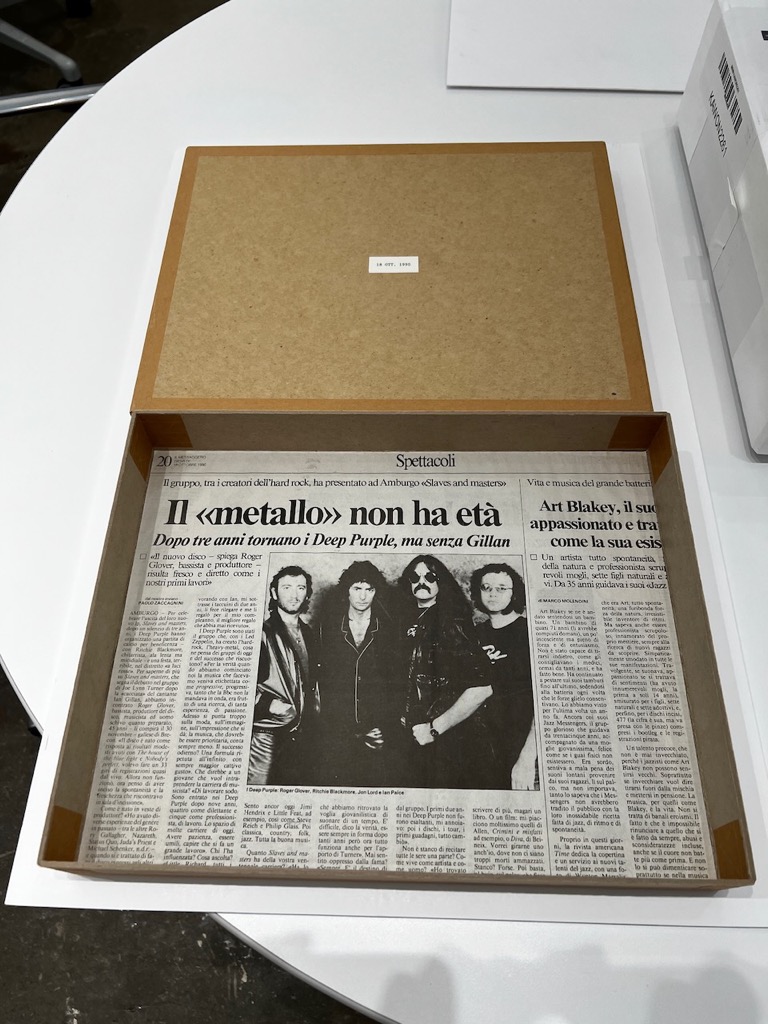
Courtesy of Janice Guy and Million Years Foundation.
Janice translates for me: Il “Metallo" non ha etá means "(Heavy) Metal doesn’t age". Janice wonders if it was the words 'Art Blakey' that caught On’s eye. But if so, surely he would have taken a colun off the Heavy Metal feature and left the Art Blakey story complete.
Janice tells me that On Kawara brought to her attention that she was only ever the second person to watch him while he Date Painted. Hiroko being the first. This no doubt came from them having established an easy personal rapport, but also because of this 'being read to' business. Janice would be in the same room, reading from the paper while he worked away at his Date Painting. It strikes me that he would have been in the same position re the language while a resident in Stockholm in 1971/72. But on that occasion, his studio wasn't far from the Moderna Museet, and On may have taken the newspaper each day to the director's office. I think the 'I WENT' maps suggest that. I would like to have this confirmed, but 1971/72 is nearly twenty years earlier than 1990. Being able to interview someone who had first-hand knowledge of On Kawara 55 years ago is rather a tall order.
I'm further told that a noble family, the Borghese owned the building that was being used as the residency studio. They lived next door on Via dei Riari and they enjoyed inviting the artists who were in residence to lunch at their home. She can't remember specifically if On Kawara attended such a lunch or dinner, but imagines he did. Janice recalls asking them if the family had any connections to the Vatican, as one of the residents, the photographer Thomas Struth wanted permission to photograph in the Vatican Museums. The reply was “Yes, but that was four hundred years ago”. In fact there had been just one Borghese Pope, Paul V (1605-1621), who financed the completion of the new St. Peter’s Basilica - and had his name prominently carved on it’s facade.
I'm told that following an evening in which a film-maker friend of Janice Guy's visited the studio, On Kawara decided he would like to record the process of Date Painting, which had never been done before. (He had allowed Janice in to watch the progress of a Date Painting, why not the whole art world?) Accordingly, Janice set up a camera on a tripod and 72 pictures were taken at regular intervals. Janice thinks it was one photo every ten minutes. Which would mean 72 in 12 hours. She holds up the double-page of images:
Photo taken from The Rome Studio. Courtesy of Janice Guy.
I am familiar with 16 of these images, and I spent 28 OTT, 2026 studying them intensely. See here. The sixteen are visible on a page of One Million Years Foundation's website, ticking through every few seconds from one to sixteen in a never-ending loop. But I didn't know the 16 were a subset of this larger sequence. I tell Janice that over the next three years On Kawara repeated such an exercise in his studios at home in New York (JUNE 9, 1991), Tokyo (6 AUG. 1992) and Paris (20 FEV. 1993). He had specific reasons for doing such additional sequences, but I'll go into that another time.
The final image that Janice shows me is this one:
Photo taken from The Rome Studio ,photographerAntonio Garbasso.. Courtesy of Janice Guy.
It's been taken by a professional photographer shortly after Janice took her own shot of the studio. The angle is slightly different and the inclusion of 22 OTT, 1990 in the foreground tells me that this was a size 'A' canvas, as is the one that On has just finished painting. The rest are size 'B'. The fact that this image is in colour allows it to be seen that the two smaller paintings are darker than the slightly bigger ones. I had thought that all the canvases had a nearly similar, black background. Not so.
Photo taken from The Rome Studio ,photographerAntonio Garbasso.. Courtesy of Janice Guy.
When later responding to the draft of this essay, Janice points out that the sheets of paper with dark lines running across them, to the left of where the painter sat, were records of his daily background colour.
In Rome, On Kawara kept a pot of near-black paint on the go, but he would add to it each day so that each day's background colour was slightly different. Here is such a Date-by-Date record from 1981 when he was mostly doing blue Date Paintings:
Reproduced thanks to the understanding of the One Million Years Foundation
The white rectangles are samples of the daily background that the artist extracted to record more formally in his Journal… 
Reproduced thanks to the understanding of the One Million Years Foundation
…a document that he only updated from time to time, certainly at the end of each year. So the rectangles taken from the working sheets were stuck into those final sheets. Yes?
But the aspect of this more formal photo of On's Rome studio that truly grabs my attention is the personal touches.
Photo taken from The Rome Studio ,photographerAntonio Garbasso.. Courtesy of Janice Guy.
The table nearest the camera has been cleared up, removing On Kawara's keys, his two pairs of glasses and his smoking paraphernalia. What has been added is the umbrella. I'm told this was the studio umbrella, and that it rained during On's October residency so that he made good use of it.
Heavy hangs the head of the Giacometti-like figure! Actually, what the handle of the brolly really looks like is the top of the '2' that On would have been painting that week: 20, 21, 22, 23, 26, 27, 28. Yes, he would recognise the smooth line of the swan's neck all right.
It comes up again in this smaller photograph that Janice promises to send me:
Photo taken from The Rome Studio ,photographerAntonio Garbasso.. Courtesy of Janice Guy.
That's another photo of 20 OTT. 1990, though the photo is not quite good enough to be sure. I have ordered a copy of The Rome Studio which will provide more info about the layout of the studio. Apparently, the room that On Kawara was painting in was a ground floor room that had been a garage.
When a show about The Rome Studio was organised in New York in 2022, Janice quite understandably thought it was important that one of the Rome Date Paintings was included. Accordingly, 18 OTT, 1990 was borrowed from the One Million Years Foundation. This surprises me slightly, since there is a photo in Candida Hofer's book taken in 2004, of 18 OTT. 1990, 20 OTT. 1990 and 21 OTT. 1990 hanging together in a private collection in New York. The insurance charge was high, and the insurer's conditions specified that no-one apart from Foundation staff could touch the painting.
We have been talking for more than an hour. I guess we should call it a day, otherwise I'll be forgetting all this invaluable information as well as abandoning today's Date Painting. However, I am so grateful to Janice Guy for giving up such a big chunk of her Saturday morning to further this project.
Back to work.
At one point during our call, Janice asked why I made Date Paintings of my own. I tried to answer, but I don't think I sounded convincing. I hope that when she looks at this text she'll feel that I have given a more satisfactory response to her enquiry. Show don't tell. That might have been On Kawara's motto also.
With the Date done to my satisfaction (On Kawara spins in his grave, so much work is still needed according to his own high/different standards) I can follow up on a couple of things that Janice told me.
The newspapers. The Janice Guy of thirty-six years ago would open the broadsheet, and read what the article said in Italian. If she thought it might be of interest to On, she would summarise it. Maybe she would just read the headline and On Kawara would indicate whether he wanted her to summarise it, or read the article aloud in full, or pass onto another headline.
I too have an assistant to help me with the papers. Not a 37-year old artist/curator taking a break from her photography practise, but none other than AI. Let me prompt Gemini:
Sounds like a Mafia thing. Not that the Mafia are NATO-backed.
What else?
Something along these lines is going on right now in Paris. Though I think their main complaint is that not enough money is being invested in their education.
Janice mentioned the Panther Movement. It was named after a real black panther that had escaped from some private zoo and was on the loose in Rome and the surrounding countryside. The students' slogan was “La pantera siamo noi!” (we are the panther!) an echo of the 1977 and 1968 slogan (also used by Josef Beuys) "La rivoluzione siamo noi!”.
"We are the revolution?" Not something On Kawara would have said about himself and Joseph Beuys. I thought these two artists had quite a lot in common, but I have come to realise that On Kawara didn't think that way.
What else?
Alright, that's enough.
But that's interesting about the Gulf War build up. Which would have been front page news in New York too, of course.
It all seems like yesterday. Bush and Saddam Hussein. America taking a hard line with Iraq. Though I think it was another Gulf War, about ten years later, that brought an end to Saddam Hussein's rule. And his life.
I suspect that On Kawara would have encouraged more reading from the Gulf War news items than the student unrest or the government corruption. What do the 'I READ' files reveal. These are available to view on Tama Art University's On Kawara resource….
Yes, there are stories on the war in the Middle East. But there are all sorts of other stuff as well, reflecting On Kawara's curiosity about the world.
Of course, On Kawara would want to know what this article about quarks and the Nobel prize for physics was about on 18 OTT, 1990 (taken from the next day's paper):
Reproduced thanks to the understanding of the One Million Years Foundation
And, of course, he would want to know what was prompting the use of photos of religious figures relating to 28 OTT. 1990:
Reproduced thanks to the understanding of the One Million Years Foundation
I wonder if Janice and On took the daily newspapers to the local trattoria where they would eat at lunchtime on a non-painting day. No, I think Janice mentioned that the papers were left in the studio.
After all, this is the scenario. I mean this is the make of bike in question - the Piaggo Si:
Photo taken from The Rome Studio. Courtesy of Janice Guy.
Only instead of visiting artist (Christopher Wool) on the front, and curator (Thea Westreich) on the back, we need to imagine curator (Janice Guy) driving and visiting artist (On Kawara) hanging on. No room for a pile of newspapers, I would suggest. Oh, and On Kawara was less formally dressed than Christopher Wool. On wore a sweater with trousers or jeans. Plus a trench coat when he was outside.
And he did go outside. I've placed a thick, blue line around the prison, Regina Coeli.
And I've marked the Rome Studio near the bottom of the image. The jail is massive. Yet so easy to ignore if you have conventional sightseeing in mind.
How about this next image as a possibility for Janice Guy's and On Kawara's trattoria? Top right corner of the blue outline shape. Sitting at a table with the massive prison wall across the street unable to prevent the international artists sitting in the autumn sun. Plenty places to park the motorino.
I've just remembered that On told Janice that his father drank but didn't smoke. So On decided that he would smoke but not drink.
The prisoners in their cells, ticking off their days. On Kawara, a free man, ticking off his days. Though allowing himself the simple pleasure of escaping the studio whenever he wanted, and visiting a local trattoria with his amenable assistant. Where newspapers were remembered and the talk was anecdotal and philosophical, political and art-historical. One thing they had in common was a liking for Dusseldorf and an admiration for what Konrad Fischer had achieved there. A European home for conceptual art and artists. Then, after all that chat, taking a seat behind Janice on her scooter, and being driven to an exquisite Renaissance church.
But I can't get my own perspective on Rome out of my mind. This is the image that has emerged. There may be a bit of doggerel that goes with it:
The Vatican, massive and overbearing. The penitenza, massive but nothing compared to the Vatican. The Rome Studio, large, but nothing compared to the penitenza, and a grain of sand compared to the Vatican.
VOICE OF VATICAN AUTHORITY
"Those sinners are going to HELL!"
Roar Michelangelo and Raphael.
"And as for you, Date Painting away,
The Pope would like one, Roman grey."
'Roman grey' or 'any old day'? Perhaps it doesn't matter (any old grey!). Let's move on.
I would like to know which churches On Kawara was taken to. But that might be expecting too much of Janice Guy's memory. So I use my own personal assistant:
This is promising.
More, please:
I am going to visit Rome in the middle of November. I really am. Not a virtual residency, as described here. But a real walk in the park. I will be taking this AI information with me.
More, please:
I will be going with Kate. We will not have a scooter between us, but we should be able to access these places easily enough on foot.
I might mange one Date Painting in the week-long visit. That's the plan. Though the Italian abbreviation for November is simply 'NOV.', just like everywhere else.
I didn't think there was any need to stay on Vicolo della Penitenza (there is an Airbnb option further along the street), so we'll be on the other side of the river, slightly further north and closer to the Vatican.
Am I looking forward to our trip to Rome? You might say so. Kate has got two weeks to recover from her cold. Go, girl!
There is an Evelyn Waugh connection to explore also. The fictional fountain at Brideshead Castle, as described so vividly in Brideshead Revisited, was inspired by three specific fountains that are to be found in the centre of Rome. I will be tracking them down.
In mid-November it will be about 19 degrees in Rome. Like an early September day in Scotland when high pressure is in control of the weather.
Bathing in sunshine. Drowning in art. I can't wait.
TWO
But before that, let's push this essay a little further. Janice has got back to me after reading the first draft, giving me more information about On Kawara and his stay at The Rome Studio.
The book, The Rome Studio, which I cannot buy as it is so rare and expensive, was produced for a show of that name that took place at the David Winton Bell Gallery on Rhode Island in 1993. It contained work produced in Rome by each of the dozen artists who were resident there. Representing On Kawara were the Dates: 18 OTT. 1990; 20 OTT. 1990; and 21 OTT. 1990. I dare say they are reproduced in The Rome Studio.
These three Dates were either borrowed from a private collector in New York, or were bought (possibly as a result of this public outing), and in 2004 they were photographed by Candida Höfer for her book, Date Paintings in Private Collections. 
Reproduced with the forbearance, I hope, of Candida Hofer.
By 2022, when Janice Guy curated a similar show to the 1993 one for Higher Pictures (this time called 'Penitence Alley, 1989-1991'), these three Date Paintings may have been bought back by One Million Years Foundation, because Janice was able to borrow 18 OCT. 1990 from the Foundation. She was able to photograph its box (see earlier in this essay), before handing it straight back. She wasn't allowed to handle the painting itself, because of understandably strict insurance conditions, but the Date was exhibited along with work by all the other Rome Studio artists.
Reproduced thanks to the understanding of the One Million Years Foundation
So that's that. But Janice Guy also told me… well let me use her actual words: "I most definitely took On to see the Raphael frescos at the Villa Farnesina on Via della Lungara right by the studio. It was when Raphael was painting these frescos that he had a love affair with the baker’s daughter. There is an ancient bakery by the Porta Settimiana very close-by."
The following map shows the route they may have taken. It is almost an 'I WENT', made with blue ink rather than red:
Would On and Janice have walked to the Villa or gone on the motorino? I expect the latter as On Kawara - I've been told by Jonathan Watkins - was not keen on walking and thought of the activity as a largely English oddity. However, this opinion may have been about the habit of walking for an hour or two as opposed to the ten minutes across town that this journey involved, so I can't be sure.
Let us park that thought, and enter the sumptuous Villa Farnesina, which contains much marble and is embellished with Renaissance paintings and sculptures from floor to ceiling.
I'm going in anyway, and I'm taking 18 OTT. 1990 with me. Please don't tell the insurers, dear reader. This is strictly between me and you, if you choose to accompany me.
So here we are in the loggia. And I've placed the Date Painting on the floor. Looks a bit risky you'll be thinking to yourself… 
Most visitors are looking at the painted walls. Or, high above, to the ceiling. The architecture is wonderful, the decoration sublime.
One of these art lovers could easily kick over the Date Painting without realising what they were committing: a crime against humanity. Specifically, a crime against Twentieth Century conceptual art.
So I've moved it… 
I wonder if this loggia, this man-made space, would have reminded On Kawara of the huge impact entering the Cave of Altamira in 1963 had on his imagination. Seeing those bison painted all over the ceiling, realising that early man had painted them with local dyes and using torchlight, entranced him. How could a Twentieth Century artist possibly achieve the same impact? Three years later he began to make Date Paintings in a New York loft.
The Cave Paintings of 20,000 years ago… The life and death of Jesus Christ… The burgeoning of the Roman Catholic Church into the High Renaissance and its achievements during the lifetime of Raphael, 1483 to 1520…On Kawara might have thought of all that in relation to the development of his own work, however modestly.
From where I now stand I can see both the most famous Raphael wall painting in the villa, The Triumph of Galatea, and the Date Painting on the tiled floor.
Raphael's iconic mythological fresco depicts the Greek sea nymph, Galatea, riding a shell-chariot pulled by dolphins. She is surrounded by tritons and nereids.
At this point I need to use my imagination. I'm holding the Date Painting in my hands and looking from it to the fresco. Back and forth my eyes go until I have this clear in my mind:
Raphael. The Triumph of Galatea, 1508. Plus 'Today' Date Painting by On Kawara.
From here I see Galatea transported from 1508 to the year 1990. (Or do I mean 2026?) Cherubs are protecting her time. It also looks as if they may be firing arrows into the more sexually aggressive of the tritons.
Was Raphael ticking off time here at the Villa Farnesina in 1508, then? Ticking off time as he kissed the lips of a local baker's daughter and painted those same lips onto the face of Galatea? I suppose so.
What is Galatea's robe making me think of? Oh, I know:
The prisoners ticking off time in Regina Coeli. Raphael ticking off time in Villa Farnesina. On Kawara ticking off time in The Rome Studio.
Janice thinks that she may well have taken On Kawara to the Borghese Galleria, which is located over the river, further north and in a park. That is not the same as being certain that she took On Kawara to Villa Farnesina. But it is worth following up, as Cindy Sherman, the first artist to do a residency at The Rome Studio, was taken there by Janice, and she created a photograph of herself as the baker's daughter portrayed by Raphael in 1518 or so.
Correction! Janice Guy has subsequently remembered that the Borghese Galleria was closed during the years of The Rome Studio. She couldn't have taken On Kawara or Cindy Sherman there. Perhaps she told them about the place and they discovered its riches via another route. That's a thing about artists. They listen.
For the 'Penitence Alley' show in 2022, Janice Guy hung the Sherman photo - her take on the baker's daughter, La Fornasina - alongside the Date Painting.
Courtesy of Janice Guy
But there is another painting that can be found at Borghese Galleria that I must mention here. This striking portrait by Caravaggio, painted in 1606, about a hundred years after Raphael was painting at Villa Farnesina:
Caravaggio. Saint Jerome Writing. 1606.
The portrait is of Saint Jerome, who is depicted as an aging, scholarly humanist intently focused on translating the Bible into Latin. Would it be appropriate to see it as On Kawara who was 53 in 1990, rendering the day in Italian? If so, what exactly is the artist writing? Well, we know what he's writing.
'I AM STILL ALIVE. (NO PHOTOGRAPHS PLEASE.)'
Ticks off time.
'I AM STILL ALIVE. (WE ALL KNOW WHERE THIS IS HEADING.)'
Ticks off another day.
'I AM STILL ALIVE.'
NOV. 8, 2026
.