12 VIEWS OF MOUNT FUJI
INTRO
Last night I couldn't sleep. So I listened to a radio program about Hokusai's famous print, The Wave. As I was doing so, I was thinking about the extent of On Kawara's Date Painting in Japan once he'd acquired a house in Tokyo in the 1980s. Then I remembered a specific fact (which I'll eventually get to) that meant I was perfectly entitled to put Hokusai and On Kawara together. And then I really couldn't sleep, obsessed as I was with the following image and the necessity of making it live and breathe outside of my imagination:
Hokusai. The Hollow of the Deep Sea Wave off the Coast of Kanagawa. Plus On Kawara photo from 1975 by Hiroko Hiraoka.
On Kawara concentrating on the day at hand, and ignoring oblivion which threatens to engulf him and our species. Or, as I put it at the end of the last essay:
Million Years Past /TODAY/ Million Years Future
Ever drifting down the stream -
Lingering in the golden gleam -
Life, what is it but a dream?
On Kawara and Mount Fuji, two equally immoveable points of reference…On Kawara and Hokusai, twin maestros separated by a century or so, which is absolutely nothing in the grand scheme of things.
The Radio Four program informed me that Hokusai had come up with the image at a time when Japan had been isolated for two hundred years. But Western ships arrived in the late nineteenth century and they took various Japanese things back to Europe, where Van Gogh (for one) loved the cheap prints of Hokusai and Hiroshige. The first explosion of interest in Japanese culture lasted until the Second World War. But why am I giving a history lesson? Let's try and get back to the vision I am now holding impatiently in my head.
On second thoughts, some specific background does need be given at this stage.
ONE: 1970-1979 (PRELIMINARIES)
On Kawara left Japan in 1959 at the age of 26. He lived in Mexico, travelled to Paris, and settled in New York by the autumn of 1964. By the beginning of 1966 he was Date Painting and he took his Date Painting practice with him to Japan in December of 1970, having been away from his homeland for more than ten years.
He made five Dates in Japan, while staying with the Ishibashis (a married couple) in a suburb of Tokyo.
26 DEC. 1970
30 DEC. 1970
31 DEC.1970
2 JAN. 1971
24 JAN. 1971
The last of these five Dates can be seen on the wall of the Okazakis' home on a page of Candida Höfer's book: Date Paintings in Private Collections. These were also close friends of On Kawara that he'd seen often during that trip. 
Reproduced with the forbearance, I hope, of Candida Hofer.
The table and chairs seem Western. Perhaps that explains why the Okazakis were able to be such close friends of On Kawara.
The artist's 'I MET' lists show that he met both these couples on December 26, 1970. On December 30, he met only the Ishibashis, whom he met on each of his Date Painting days. The Date that they have in their house was made in New York shortly before the artist went Date Painting in Mexico in 1968. Quite a Western looking house again. Though the hat is either Japanese or a sombrero.
Reproduced with the forbearance, I hope, of Candida Hofer.
Once On had married Hiroko - and after their first child was born in 1978 - the artist-father, mother and baby visited their families in Japan. As in 1970/71, On arrived in December and left in January. This time he stayed with the Ishibashis again, but also with On's parents and Hiroko's parents. In December, On and Hiroko went on 'holiday' from their newborn, and On Date Painted in Hong Kong and Seoul. Back in Tokyo, he painted the following Dates:
4 JAN. 1979
5 JAN. 1979
He saw the Ishibashis on both these Dates. So we can safely say that up to this point, On Kawara had painted in Japan exclusively at this particular address which I've marked on the map. It is of course given to us by the 'I GOT UP' cards:
On Kawara
1 - 4 - 6 Tamagawacho
Setagaya-ku
Tokyo
Japan
Tokyo is top right of the above map. Mount Fuji is bottom left. And On Kawara was Date Painting where the red pin is marked. Would On Kawara have been able to see Mount Fuji from the Ishibashis abode? I don't think so, as it was situated close to the River Tama, and I think the intervening hills would have blocked out the view. However, it is possible to see Mount Fuji from Tokyo on a clear day. It is 13,000 feet tall, after all. The highest mountain in Scotland or Britain is Ben Nevis at just 4,000 feet. Mount Fuji is of a different order of magnitude. Of course, you could see it from Tokyo! Apparently it is easier to see from some kind of viewpoint. Like this? 
Hokusai. The Wood Yard at Honjo Tatekawa in Edo (Tokyo). Plus On Kawara photo from 1975 by Hiroko Hiraoka.
Not necessarily, I am just keeping the pot boiling. That Hokusai painting is titled 'The Wood Yard at Honjo Tatekawa in Edo (Tokyo)'. Almost all of Hokusai's prints give information as to where exactly he was looking from as he painted.
On Kawara did love a high viewpoint. Hiroko wrote to Kasper Konig in 1969 that, on his return to New York from South America, On had talked about setting up his studio at the top of the Empire State Building. Only there was no air to breathe at such a height. He also made a point of getting to the top of Montparnasse Tower in Paris in 1977 after seeing his show installed at the Pompidou Centre courtesy of Pontus Hulten. The show consisting of 90-odd Date Paintings, at least one for each and every day of January, February and March of 1970. My God, trying to get a perspective on that achievement might indeed drive you to the highest point in the city.
I've just had a closer look at 'I MET' for January 4, 1979. The names are as follows:
FUMIKO KAWAHARA
JUN KAWAHARA
REIKO ISHIBASHI
YUKIO ISHIBASHI
KOICHIRO ISHIBASHI
MICHIE ISHIBASHI
HIROKO HIRAOKA
AKITO KAWAHARA
In other words, a set of people that included On's mother, his partner and his son. Plus some of his closest friends. It must have been difficult for On to focus on his appointed task with such competing attractions distracting his thoughts.
Hokusai. Morning Snow at Koishikawa. Plus On Kawara photo from 1975 by Hiroko Hiraoka.
I will end these preliminary remarks by presenting another map. This adds the viewpoints from where Hokusai made 11 of the 12 Views of Mount Fuji that my book contains. The other must be held back for plot reasons.

Notice that the majority of them accord roughly with the line of sight given to Mount Fuji from the Ishibashi house. Something that On may have borne in mind when he bought a Tokyo home of his own
TWO: 1979 to 1996 (FULL FUJI)
The Kawaras (Akito now had a sister, Sahe) came back to Japan in the December/January of 1981/82. Actually, I don't know that the whole family came as all the self-examination series had ended. All I know is that On Kawara made Date Paintings in Tokyo as follows:
7 DEC.1981
28 DEC.1981
9 JAN.1982
Was he staying with the Ishibashis again? Or were the four of them staying with On's family or Hiroko's? Well as we don't have 'I MET' or 'I GOT UP' to consult post-1979, we simply don't know. Or at least I don't.
On (and family?) came back to Tokyo in the summer of 1982. He made two Dates in Tokyo and three in Kariya.
9 JUN.1982
18 JULY 1982
23 JUL.1982 Kariya
26 JUL. 1982 Kariya
5 AŬG. 1982 Kariya
Now as Kariya is where On was born and where his parents still lived, it's tempting to suggest that On had not yet bought a house of his own in Japan, and had stayed once again with the Ishibashis when in Tokyo. In which case, given its sight-line to Mount Fuji, let's celebrate the painting of 9 JUN. 1982 with the following image. I hope, dear viewer, its size doesn't baffle the device your using:
Hokusai. Evening at Lake Suwa in Shinano Province. Plus On Kawara photo from 1975 by Hiroko Hiraoka.
No, I don't get away with that. Lake Suwa is not in the suburbs of Tokyo, its north of Mount Fuji.
On the other hand, On Kawara betrayed his 'sentimental' feelings towards his homeland as early as 1965 when coming up with the code that was titled 'Traveler's Song'. That was only decoded in 2023, at my instigation, through the skill of Tommy Wrede and Anders Delbom, not forgetting Hideo Mori. 'Traveler's Song' celebrates the Kiso River which begins in the mountains and ends at the sea close to Kariya. By 1982, all On Kawara had done was transfer his deep affections from Kiso to Fuji.
In any case, the finished painting looked like this.
Reproduced thanks to the understanding of the One Million Years Foundation
Remarkably restrained given the inspiration feeding into it, don't you think? I should say that Hokusai was one of the first artists to make use of high-quality Prussian blue that was newly available in Japan in the first half of the 19th Century. Several of his views of Mount Fuji are primarily rendered in that colour.
In 1983, On again came to Japan in the summer. And this would be the pattern for several years in a row. I strongly suspect that the Kawara family had their own house in Tokyo by this time. With Akito being 6 years old and Sahe about to turn 4, the Japanese side of Akito's schooling had presumably started. I imagine it was a summer school he went to in order to complement the conventional (autumn, winter, spring) schooling he was getting in New York.
On's Date Painting in Tokyo in 1983:
24 MAJ, 1983
13 JUN. 1983
7 JUL.1983
26 AŬG.1983
Where was this newly acquired house? I can't be sure. But Jonathan Watkins was there once (when he was director of Ikon, Birmingham), and he told me that it had a Mount Fuji connection. I can't remember exactly how he put it, but given that the home must have been located in Tokyo (that's where the Dates were painted, and boxed with a Tokyo newspaper extract), the connection with Mount Fuji was presumably the view. So let's celebrate this precious knowledge in as timeless a way as possible:
Hokusai. Horsemen at the Village of Sekiya on the Sunida River. Plus On Kawara photo from 1975 by Hiroko Hiraoka.
This is a Tokyo location. Nice touch, the horsemen only showing the back of their heads. A tribute to the artist's own modesty, privacy and self-effacement.
How did the Date Painting turn out? One of the four Kawara painted that spring-summer is reproduced in On Kawara: Silence, so I can show you:
Reproduced thanks to the understanding of the One Million Years Foundation
In 1984, On and family were again in Tokyo for the summer. And again Kawara managed to make, respectively, 3, 3 and 1 Dates for the summer months.
14 JUN. 1984
18 JUN.1984
20 JUN. 1984
6 JUL.1984
7 JUL.1984
15 JUL.1984
4 AŬG. 1984
Perhaps this is the place to remind you that when in Japan, because of the very different alphabet, the artist used Esperanto instead. Certainly, to begin with this emphasised his loyalty to his adopted Western art world who wouldn't have understood a Date Painting expressed in Japanese characters. But by the 1980s there was no question that On Kawara was bonded with his homeland once more. Too late to abandon the Arabic characters though.
Besides, I suspect he would have loved the breve above the 'U' in AUG. Does it not remind the viewer that Mount Fuji is an extant volcano (last eruption 1707)? In this next image we see the artist poised to complete his Date with the addition of the breve. To do this he must focus on the top of Mount Fuji, not allowing himself to be distracted by the madcap antics of those elegant cranes, symbols of good fortune and longevity.

Hokusai. Cranes at Umezawa in Sagami Province. Plus On Kawara photo from 1975 by Hiroko Hiraoka.
This is in the suburbs of Tokyo or just beyond them. Roughly on the same sightline to Fuji as the Ishibashis' house.
How did the image turn out? Dear reader, you have an absolute right to know. Here it is, courtesy of the Dia Art Foundation. In other words, it is part of their complete (one per year) collection of Date Paintings from 1966 to 2000:
Reproduced thanks to the understanding of the One Million Years Foundation
Did any of you say: "There she blows!" If so, please try to keep a check on such frivolous thoughts as you engage with this essay. If I can do it, surely you can too.
(I am in a great mood. Light of heart, to the nth degree. How could I not be, soaking up the magnificent art of On Kawara and Hokusai while adding my own spicey froth to it? I feel like one of those cranes - wise beyond my years and subject to flying dreams.)
In 1985, the Kawaras were again in Japan for the summer. The Dates painted were:
17 JUL.1985
20 JUL. 1985
3 AŬG. 1985
Why no June Date? Well, On made a Date Painting in New York on June 19. So it would seem that he left the journey until later than usual. Perhaps Hiroko, Akito and Sahe went on ahead to Japan. I would have thought the kids' summer school commitments would mean they would have to be in Tokyo in June as well as July and August. But what do I know?
Anyway, On got to the house in Tokyo as usual. And as usual he took full advantage of the view:
Hokusai. The Mountain Pass of Immune in Kai Province. Plus On Kawara photo from 1975 by Hiroko Hiraoka.
Another one I don't get away with judged by strict geographical criteria. A second view from directly north of Mount Fuji.
This painting is now in Frankfurt, where there is a 1966-2000 collection that complements the one at Dai in New York.
Reproduced thanks to the understanding of the One Million Years Foundation
Some of you may be thinking, 'But hang on, apart from the ones that are wildly inaccurate, you've just shown three slightly different places from which On Kawara was supposedly making his Dates. They can't all be right. So which is it?'
The fascinating fact is that we don't know. On Kawara let the world know exactly where he was sleeping every day for eleven years from 1968 to 1979. After that, he was as secretive and private as possible. I hadn't thought of that as an artistic choice, but now I begin to see it that way. Because it allows such delicious ambiguity as I'm now working with. We know that On Kawara could see Mount Fuji from where he worked. But we don't know which of the exact Tokyo views of Mount Fuji he enjoyed. It might have been any of them. Of course, Jonathan Watkins or someone else may come back to me with more accurate information. But it will be too late to unwrite this essay. Too late to undo these composite images that I've been compelled to undertake.
By the summer of 1986, Akito would have been eight-years-old. I wonder what he thought of his father's occupation. Which was ongoing:
28 JUN. 1986
9 JUL. 1986
10 JUL.1986
14 JUL.1986
3 AŬG. 1986
I suspect this was the year that Akito referred to in a 12-page article he wrote for American Entomologist in 2007. Basically, it's the story of how he became so interested in insects that he went on to be Professor of Entomology at Florida University. He puts that down to his father having introduced him to butterflies and encouraged his interest at every opportunity.
Akito recalls: 'When I was a child attending elementary school in Tokyo, my father bought this book ('A collecting Map of Butterflies'). During the summer, we took a three- to four-hour train ride at 4.00a.m. every Sunday to look for a particular species included in this butterfly treasure map. On one occasion, we went to look for Favonius Yuasai Shirozu, a relatively rare lycaenid which flies in the canopy. When we arrived at the locality, I was shocked to discover over ten lepidopterists with their 30-foot extension poles lined up against a forest just before dawn. The scene reminded me of a line of trout fishermen along a stream in upstate New York. The lepidopterists were staring into the canopy waiting for the morning flight of the drab brown lycaenid. I was the luckiest eight-year-old that day, because while the collectors were diligently looking into the canopy, a female F. Yuasai landed on a low branch a few steps in front of me. It started raining heavily a few minutes later, and I may have been the only one that day to have collected the butterfly.'
Clearly, a treasured memory. Perhaps it was in order to deliver this quality of life to his children that On Kawara had cut back on his own obsessive interests. As well as spending each Sunday chasing butterflies with Akito, On found time to make the five Dates listed above: June 28 (a Saturday), July 9 (a Wednesday), July 10 (a Thursday), July 14 (a Monday), August 3 (a Sunday). I guess that means On and Akito didn't go butterfly chasing every Sunday in the summer of 1986.
Oh, and Google informs me that the place to see the relatively rare butterfly mentioned above is Ogawa Forest Reserve, which is north of Tokyo. Far, far away from Mount Fuji.
On Kawara was a great father then. That's as well as being a master of art from Monday to Saturday.

Hokusai. Windy Weather at Ejiri in Sugura Province. Plus On Kawara photo from 1975 by Hiroko Hiraoka.
On Kawara didn't always paint a date in the same way. He might start with the middle of his row of characters, as here with the month, or he might start with the day or the year.
'JUL' is quite similar to 'JUN' is it not? Though it must have been a two month-long temptation to paint 'FUJ'.
I have chosen the above Hokusai because of what can be interpreted as a single, multi-page manuscript and a number of butterflies being blown by the wind. Blown towards the mountain? With what delicacy has the profile of Mount Fuji been painted in a single flowing line on this occasion! With all the fragile beauty of a butterfly's wing, shall we say?
Which day did the above turn into? The next illustration comes from 10 Tableaux and 16,952 Pages.

Reproduced thanks to the understanding of the One Million Years Foundation
Let's quasi-quote Akito: 'I was the luckiest eight-year-old that day, because when we got home, my father encouraged me to place the butterfly I'd collected in the hollow of the U on his Date Painting of a few days before. It started raining heavily, so we couldn't see the mountain any more. My father suggested that millions of butterflies would be sheltering from the rain in the hollow of Mount Fuji. 'But surely the top of the mountain is open to the rain,' I said. He told me to think about the shape of the mountain and realise for myself how much shelter there was in there. 'The walls of the interior are covered by Cave Paintings,' he told me, "Which is what this is really. A timeless painting for the caves of Mount Fuji."
By 1987, On Kawara was in his mid-fifties. A family man and a Date Painter:
20 JUN. 1987
17 JUL. 1987
21 JUL. 1987
14 AŬG. 1987
The following picture is in the Merry Collection in Nagoya. At least it was when Candida Höfer took the photos for her book in 2005.
Reproduced with the forbearance, I hope, of Candida Hofer.
The Date painting hangs there like Mount Fuji. Everything else in the room looks like ephemera.
Nagoya is about the same distance west of Mount Fuji as Tokyo is east. But Hokusai made no views of Mount Fuji from that angle. Not in my 'Twelve Views' copy of his work anyway.
By 1988, On Kawara was still in his mid-fifties. Ever more the family man and eternally a Date Painter:
17 JUN. 1988
30 JUN.1988
15 JUL.1988
27 JUL. 1988
2 AŬG. 1988
6 AŬG. 1988
The Date made on July 15 is part of Dia Art Foundation's consummate 1966-2000 collection. 
Reproduced thanks to the understanding of the One Million Years Foundation
The Date made on July 27 is included in the aforementioned Candida Höfer book, Date Paintings in Private Collections. It can be seen on the walls of this room, a room which would look ten times better if everything on the piece of wooden furniture were swept away. Especially the TV screen.
Reproduced with the forbearance, I hope, of Candida Hofer.
It's a photo of the On Kawara Dates in the M. Ota collection which is based in Shizuoka-shi. Now, as the following map shows, that is very close to one of the very few of Hokusai's Views of Mount Fuji made from the south. I have marked Shizuoka-shi with a green pin in the bottom left corner of this next map:
That brings to my geographer's mind the following image again. But please don't take it literally, dear reader. On Kawara made this Date in Tokyo (correction: he made it in Saporo, Japan's most northerly island). Although the consummate beauty of the next image is surely not out of place.
Hokusai. Windy Weather at Ejiri in Sugura Province. Plus On Kawara photo from 1975 by Hiroko Hiraoka.
Perhaps that is the image that comes to the collector's mind when he considers 27 JUL. 1988. There is no accounting for the mind of a collector. While in his cups, money spills from his pocket, and the next day there is a painting hanging on the wall in the lounge of his house, which he tries to ignore as he watches a series recommended on Netflix. Pearls before swine? His installation of 27 JULY, 1988 could hardly be further from Mount Fuji.
Dear reader, I am wondering if I can keep this up. It is exhilarating but tiring (and that last paragraph is unfair on collectors). It is a very windy day and pears are falling from the pear tree that dominates my garden. SEPT. 18, 2025, if you're asking. I had always thought that it was the spire of the derelict church next door that was my Mount Fuji. Now I'm thinking it's the pear tree. Many of the fallen pears are being attended to by wasps, not butterflies. Some of the wasps are drunk on the fermenting pear juice. Some are so drunk they appear to be hungover. And some of the wasps are so hungover they appear to be dead. No use trying to count drunk wasps, hungover wasps, dying wasps and dead wasps though, as the creatures pass from one state to the next before an accurate and objective count can be finished.
I need to go for a walk. Back in an hour or so.
THREE: 1979 to 1996 (cont.)
In 1989, On Kawara was again in Japan all summer long. In Tokyo, he painted one Date in June, three in July and three in August. But in addition he made Date Paintings for seven days in a row while based in Nagoja, plus a single Date in Naho. As I said, Nagoja is about the same distance south and west of Mount Fuji as Tokyo is east and north of it.
It would be interesting from a biographical perspective to know what motivated him to do this set of Dates. Was he asked by a friend or art lover? Did the offer to stay in an alternative base prompt the outpouring of Date Painting? Or perhaps he was commissioned to do the work. Moreover, I don't know where the set of seven paintings is presently located.
10 JUN.1989 Tokyo
18 JUN. 1989 Nagoja
19 JUN. 1989 Nagoja
20 JUN. 1989 Nagoja
21 JUN. 1989 Nagoja
22 JUN. 1989 Nagoja
23 JUN. 1989 Nagoja
24 JUN. 1989 Nagoja
14 JUL. 1989 Tokyo
21 JUL. 1989 Tokyo
29 JUL. 1989 Naho
31 JUL. 1989 Tokyo
2 AŬG. 1989 Tokyo
5 AŬG. 1989 Tokyo
17 AŬG. 1989 Tokyo
I hadn't realised before this exercise that the abbreviation of JUN, JUL and AŬG all have U as the middle letter. Putting the U into summer, shall we say?
Hang on, my own essay on '1989' answers that earlier question. Nagoya was the third stop on the 'On Kawara: Again and Against' tour. The exhibition wasn't up until November and December of 1989, so On Kawara must have been in Nagoya in June to talk with the curator in advance of it. After all, 24 works by other artists were to be juxtaposed with Date Paintings made over 23 years from 1966 to 1989. You would have expected one of the June Dates to be the 24th in the show, but it wasn't according to the local curator, Fumio Nano, writing in the catalogue.
Now I have Googled the question 'Can Mount Fuji be seen from Nagoya?', and the answer is that it can't because of intervening high ground. Which means that on this occasion I have no excuse to combine On Kawara in the act of Date Painting with a Hokusai composition. So I need to turn my attention to the seven Dates made in Tokyo in the summer of 1989…
That's strange, I don't have a reproduction of any of the Tokyo dates from summer 1989. Which means I have no excuse to show a Hokusai. Or I could make use of a Hokusai and leave it ambiguous as to which Date On Kawara was in the middle of painting. Yes, I'll settle for that.
Hokusai. View of Fuji from the Tea Fields of Katakura in Suruga Province. Plus On Kawara photo from 1975 by Hiroko Hiraoka.
Actually, that scene is evocative, with those rows of identical huts and barrels and baskets and hay stacks and helmeted peasants. Fours and fives and sixes and sevens. It reminds me that On Kawara was really getting into the swing of Date Painting again now that his children were getting a bit more independent. As well as the seven days in a row in Nagoya in June, he'd painted five days in a row twice while in Stuttgart in Germany in January of 1989.
In the absence of repros of any of the Tokyo Dates from 1989, what I do have is reproductions of 18 JUN. 1989 (Nagoya) and 29 JUL. 1989 (Naho). Both Dates appear in both Date Paintings in 89 Cities (1992) and Date Painting(s) in New York and 136 Cities (2012). .
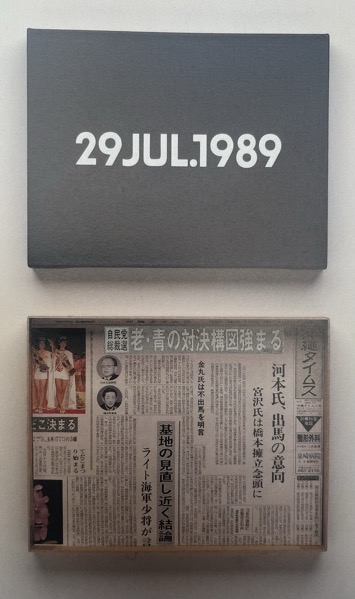
Reproduced thanks to the understanding of the One Million Years Foundation
And so to 1990. Not nearly so much Date painting in Japan as in 1989, and all in Tokyo:
6 JUL. 1990
12 JUL. 1990
7 AŬG. 1990
I don't have repros of any of these, but the August Date appears in Höfer's book, in an Antwerp collection, as follows:
Reproduced with the forbearance, I hope, of Candida Hofer.
A pot plant and what would seem to be a very old piece of carpentry, possibly from Africa, seems like a random setting. Does the owner not know that they have one of On Kawara's Tokyo Dates made in August, with the lid on the volcano motif? A day so calm yet with molten rock about to erupt any century!
Hokusai. Spring Fields at Shimo Meguro, near Edo (Tokyo). Plus On Kawara photo from 1975 by Hiroko Hiraoka.
Just imagine sitting there Date Painting from the last eruption of Mount Fuji in 1707 to the next one in 2707. Exactly a thousand years between eruptions? Hard to believe nature takes time that seriously!
And so to 1991, and another summer in Japan. Only three Dates painted and two of these were made in Hiroshima.
9 JUL. 1991
23 JUL 1991 Hirosimo
24 JUL. 1991 Hirosimo
Hiroshima is near the southern tip of Japan. Nowhere near Mount Fuji. So in this next image, On Kawara simply must be painting 9 JUL. 1991. 
Hokusai. Travellers at Hodogaya on the Tokaido Road. Plus On Kawara photo from 1975 by Hiroko Hiraoka.
How did the painting turn out? It can be glimpsed in this elegant photo in Höfer's book. It's on the left, paired with a December Date painted in New York in 1996.
Reproduced with the forbearance, I hope, of Candida Hofer.
In 1992, there were again three Dates made in Japan. This time all three were made in Tokyo.
23 JUL. 1992
6 AŬG.1992
12 AŬG.1992
I don't have reproductions of any of these Dates. And I've run out of Hokusai prints. So let's just pass on to 1993. When On Kawara was in Tokyo in the spring as well as the summer.
29 MAR. 1993
4 AŬG. 1993
6 AŬG. 1993
26 AŬG.1993
Three breve-lidded August Dates. One of them is reproduced in the Höfer book.
Reproduced with the forbearance, I hope, of Candida Hofer.
That's rather an informal set-up, which I like. Also it puts me in mind of this Hokusai, which I have no hesitation in using again. Early morning on the 26th August, 1993. The world is getting on with the day's work. Fuji is unmoved.
Hokusai. The Wood Yard at Honjo Tatekawa in Edo (Tokyo). Plus On Kawara photo from 1975 by Hiroko Hiraoka.
In 1994, On Kawara was in Japan three times. He was in Tokyo in February and again in summer (July and August). And he was in Fuginomijo in October.
16 FEV.1994
21 FEV. 1994
17 JUL. 1994
25 JUL. 1994
31 JUL. 1994
8 AŬG. 1994
19 OKT. 1994 Fuginomijo
26 OKT. 1994 Fuginomijo
One of the February '94 paintings and one of the October paintings are in a Hiroshima collection photographed in the Höfer book along with other Dates from 1994. 
Reproduced with the forbearance, I hope, of Candida Hofer.
But Hiroshima is not the key city here, Fuginomijo is, as it's the nearest city to Mount Fuji. The title of the Hokusai print where the mountain is in the foreground is called 'Fuji in Clear Weather'. No location is given. So I like to think that the view is from Fuginomijo. And so we see On Kawara, in the early morning, at work on one of his October '94 Date Paintings.
Hokusai. Fuji in Clear Weather. Plus On Kawara photo from 1975 by Hiroko Hiraoka..
Below is a map that shows the situation. On was usually on the outskirts of Tokyo when he made a Date Painting, with a distant view of Mount Fuji. But in October 1994 he was in studio in Fuginomijo (Fujinomiya) with a much closer view of the sacred mountain. Compare the red pins, top right (Tokyo) with bottom left (Fuji).
Kawara was back there in 1995 to make two February dates.
23 FEB. 1995 Fuginomijo
26 FEB. 1995 Fuginomijo
13 JUN. 1995 Tojonako
18 JUN. 1995 Tojonako
19 JUN. 1995 Tojonako
22 JUN. 1995 Tojonako
As you can see, he was in Japan twice in '95. The second time, in summer, he was in Tojonako, a city in the south of the country between Hiroshima and Nagoya. From where there is no view of Mount Fuji. So let's focus on the February '95 paintings. Let's focus on On Kawara nearing completion of 23 FEB:
Hokusai. Fuji in Clear Weather. Plus On Kawara photo from 1975 by Hiroko Hiraoka.
Ha! There is sort of perfection about that. At least it seems so to me.
But at the end of 1995, a terrible thing happens. Kawara stops doing his 'I READ'. These reveal the specific place he was located in when making a painting, and it's all set out for us in the database put online by Tama Art University at the instigation of One Million Years Foundation. From 1996 it can be hard to say whether the artist was in one Japanese city or another. Or indeed in a city outside Japan where he resorted to Esperanto, such as China or Korea.
So I will leave my analysis there. Besides, I have run out of Hokusai prints. Maybe I should have started with '36 Views of Mount Fuji', which was the original publication in Japan in the 19th Century. The 'Twelve Views of Mount Fuji' that I've been using is a British Museum publication from 1981. Though I dare say this essay will have about 36 images in it by the time I'm finished.
Actually, 1996 and 1997 were two years of no international travel by On Kawara. In other words, he was in New York the whole time. Perhaps he was ill, and that was why he stopped doing his 'I READ'. However, he painted consistently throughout these two years, never missing a month to make a Date Painting. So he couldn't have been too bad. And what with Akito and Sahe being 17 and 15, respectively, by the beginning of 1996, maybe he was simply settling back into his old New York lifestyle, centred on his and Hiroko's 6th floor loft at 140 Greene Street.
But those Tokyo summers of 1983 to1995. Mount Fuji ever-present as his children grew up in front of his eyes: beautiful, brilliant, butterflies both. Unforgettable days of consciousness, Date Painting, parenthood, partnership and joy.
OUTRO
Skipping ahead to 2014.
Hokusai. The Hollow of the Deep Sea Wave off the Coast of Kanagawa. Plus On Kawara photo from 1975 by Hiroko Hiraoka.
Not quite the same as where we started. On Kawara can't keep oblivion off for ever, no more than any of us can.
What a vulnerable system each of us is. With all the eating and drinking and breathing that we must stick to, otherwise our life would swiftly come to an end.
The fact that On Kawara ate and drank and breathed (and smoked, much to his cost) and managed to come up with such rigorous and restrained and inspired thoughts and art and a way of living is really quite remarkable. Exemplary artist, father, partner, son and smoker.
I bet he Date Painted until his last day.
No that's hyperbole. I bet he could see Mount Fuji, and hold it there in his mind, until his dying breath in New York. Hard to say if his final thoughts would have involved putting his arms around Hiroko or Hokusai.
Hokusai. The Hollow of the Deep Sea Wave off the Coast of Kanagawa. Plus On Kawara photo from 1975 by Hiroko Hiraoka.