CHATEAU D'OIRON
INTRO
A couple of weeks ago I was sent an email by one John Barnard which opened up intriguingly to display this:
Image supplied by Chateau d'Oiron. Reproduced thanks to the understanding of the One Million Years Foundation.
It's a reproduction of one of the 12 Date Paintings that On Kawara made for a French chateau back in 1993. But it's immediately obvious that the artist had trouble with it. This is readily apparent if the image is zoomed in on:
Image supplied by Chateau d'Oiron. Reproduced thanks to the understanding of the One Million Years Foundation.
Soon I was writing as follows:
Dear Chateau D'Oiron,
I’ve been sent this link to your website showing a very good reproduction of one of the chateau’s On Kawara Date Paintings: chateau-oiron.fr/decouvrir/la-collection-curios-mirabilia/on-kawara
It seems that this particular blue (which was an unusual shade for On Kawara) has faded, unlike most of the Liquitex colours that he used. And this has revealed at least two things. First, he seems to have overpainted the borders of the characters in white (I recall him doing that in one of his 1990 demos: 6 AUG.1992, see On Kawara: Whole and Parts) and then cut back with blue in order to get a ‘crisp’ finish. Second, he has made quite a large mistake in his spacing, not leaving a big enough gap between the 4 and the J. So he has corrected this, and has also had to push back the verticals of the U and the I, though not by as much. Even having made this correction, if you compare it with 2 OCT.1993, painted in Strasbourg, there is not much gap between the day and the month. Though if you ask me he has overdone the October gap!
I would love to analyse the set of Date Paintings that you own from this perspective. In other words, the fading of the blue may reveal hitherto unknown aspects of On Kawara’s practise/process. Would you be willing to send me high quality images of the other 11 Dates so that I could do so? I would envisage adding a chapter to my website, whose home Page is here: onkawara.co.uk I have already said something about the chateau collection at the end of this page: onkawara.co.uk/styled-72/
I hope this is of interest. How fabulous it must be to live/work with this unique set of Date Paintings.
Best wishes,
Duncan
PS Also, the pencil markings left on the painting are quite obtrusive. I know it looks like the pencil marks are on top of the blue background, but I do not think On Kawara would have left the painting in that ‘unfinished’ state which could so easily have been tidied up on the day. Again, I expect it comes from having overpainted those pencil lines with blue, and the blue having faded over time. Perhaps work has already been done on this and you can direct me towards your conclusions.
I received a helpful reply, and now I am sitting here at my desk in rural Perthshire with decent photos of the twelve Date Paintings which the One Million Years Foundation website tells me is a permanent installation that can be seen by anyone who finds themselves in the middle of France looking for timeless culture.
The reply was from Samuel Quenault who is presently responsible for the collection of contemporary art at Chateau d'Oiron. He tells me that the chateau is interested in my research and would be delighted to receive a link to it.
Fair enough, I'll bear that in mind. But I can't promise to stick to the investigation that my own message suggested. The presence of this full set of Date Paintings in my Photos insists on a more ambitious treatment. Though perhaps I'll try to include the narrower technical report that I proposed as I go along.
Reproduced with the forbearance, I hope, of Chateau d'Oiron.
Let me give you, dear reader, a quick historical perspective taken from the chateau's website:
In 1989, the French Ministry of Culture decided to enrich the château's historical heritage by creating a collection of contemporary art, mainly through public commissions, specifically designed for the château. Jean-Hubert Martin was appointed artistic director of the project, and in 1993, the 'Curios & Mirabilia' collection was inaugurated. It represents the most important experiment in France to integrate contemporary creation into an ancient heritage.
The works assembled by Jean-Hubert Martin seek to revive the spirit of curiosity of the Renaissance, based on the idea of the ancient collections that were the cabinets of curiosity. This historical reference, treated freely by the artists, creates a link with the monument, giving the impression of a place inhabited today, while reactivating the memory of Claude Gouffier's prestigious collections (16th century). Curios & Mirabilia is based on the idea of a different relationship to the world, one that in the Renaissance favoured a sensitive approach to knowledge.
Hearing, smell, touch, sight and soon taste are all called upon to transform a visit to a historic monument into a sensory experience. The scents of Wolfgang Laib's wax wall, the sounds of Gavin Bryars' music, John Armleder's armchairs to relax visitors, visual games such as Felice Varini's corridor of illusions, and all the creations created for the château combine to create a journey full of surprises and wonder.
The Chateau commissioned a number of high profile artists to make work for the glorious building which had come into public ownership as far back as 1941. The idea being to showcase contemporary art in a superb architectural setting. The show would be open from July 1 to September 15, 1993, and the commission must have happened in 1992 to allow On Kawara to come up with the plan of painting twelve similar-coloured dates, one per month, for each month in the year of 1993. Of course, only six would have been completed by the time of the opening but we'll cross that bridge when we come to it.
Fine. Let's make a start to my On Kawara adventure. Shall I begin by going through the Dates one by one, month by month? Yes, that is my way forward. Meticulous or tedious? You decide.
Image supplied by Chateau d'Oiron. Reproduced thanks to the understanding of the One Million Years Foundation.
The twelve reproductions that I've been given are all of a much darker blue than the example on the Chateau's website. That clearly was a high quality one-off picture and I suspect it has brightened the blue - absolutely blasted it with light - in order to show as much detail as possible. The set of pictures I have been presented with were taken by a hand-held iPhone and they will have to do. All I can say about the January date, is that it almost looks like the position of the 'J' has been adjusted. But on reflection I don't think this was the case. I think On Kawara was using a sweep of blue to get the edge of his white characters as blemish-free as possible. As for the mark to the left of the 'A', I don't know what that is. Some random blemish that has happened long after the Date was painted, I suspect.
Image supplied by Chateau d'Oiron. Reproduced thanks to the understanding of the One Million Years Foundation.
On Kawara was in New York when he made this first painting. By 1993 the artist wasn't making 'I GOT UP', 'I WENT' and 'I MET' anymore. But there is a list of all the Dates On Kawara painted in New York in the book Date Painting(s) in New York and 136 Other Cities. And there is a second list in that book containing all the Dates painted (in their slightly different formats) in other cities. Of course, the newspaper cutting in the Date's cardboard box would confirm On's location when the Date was painted, but that info isn't always available to a researcher.
I should say that there was an important evolving exhibition of Kawara's Date Paintings at the Dia Center for Art, New York, which would install 1000 Dates over the course of the year. These were installed month by month with a three-month break in the summer. And I'm sure that On Kawara planned his international movements in 1993 to make sure that he saw each individual installation of these Dates, which went from 1966, in January 1993, to 1992, by the end of '93.
Anyway, On Kawara was still in New York when he painted the second Date of the commission. Again the same colour and the same size 'A' (10" by 8"):
Image supplied by Chateau d'Oiron. Reproduced thanks to the understanding of the One Million Years Foundation.
A close up of the middle of this Date just reinforces the impression that On Kawara would go over the edge of his characters in white then use blue to cut back to a crisp finish. That's particularly visible in the punctuation marks, don't you think?

Image supplied by Chateau d'Oiron. Reproduced thanks to the understanding of the One Million Years Foundation.
Kawara flew to Europe before the end of February, but didn't take the opportunity to make a 'FEV.' Date Painting for the chateau. The black Date Painting he made, 20 FEV. 1993, is boxed with the front page of LE FIG-ECO, France's premier financial paper, so I assume he was in Paris when he painted it. I think On Kawara was primarily in Paris to take in the show, 'The World in Pieces, the Work Fractured', held in the Yvon Lambert Gallery, curated by René Denizot, that included several Date Paintings. Denizot was a philosopher, writer and curator who had provided texts for On Kawara exhibitions after prolonged conversations with the artist, so they had a working relationship.
I will add here that I think 1993 was the year that On Kawara bought a flat in Paris. Certainly, he made Paris his European base around then, but with his usual secrecy the exact date has not been made public.
Kawara didn't make a Parisian date for the chateau either, but instead returned to New York by March 6 in order (I presume) to see the third set-up of the Date Paintings at Dia Art Center. This was not a long stay in New York as by March 16 On Kawara had flown to Japan, and it was in Tokyo that the third painting for the chateau was made. The format (Kawara used Esperanto when he was in countries that used 'alternative' alphabets) is almost identical to how it would have looked if it had been painted in France: 'MAR' in Japan; 'MARS' in France.
Image supplied by Chateau d'Oiron. Reproduced thanks to the understanding of the One Million Years Foundation.
Kawara didn't stay long in Tokyo. He was back in New York before April 9. I put it that way because we know that he made another Date Painting in New York on that date. Then, nine days later, he painted the fourth leg of his chateau commission:
Image supplied by Chateau d'Oiron. Reproduced thanks to the understanding of the One Million Years Foundation.
This is another painting that seems to incorporate an adjustment to the spacing of letters.
Image supplied by Chateau d'Oiron. Reproduced thanks to the understanding of the One Million Years Foundation.
The 'A' 'P' and 'R' all seem to have been moved to the left. Not only do you see marks in the blue background a consistent length to the right of each letter, but also a white line near the left edge of each white character where the letter edge was previously painted. So either the artist decided that the 'APR' was too close to the '18' or he felt that the 'APR' needed to be closer to the left edge of the canvas so as to centre the date as a whole. Blimey. On Kawara's relationship to distance was strange in 1993. Either he was making plane journeys over thousands of miles (New York to Paris, 3625 miles; New York to Tokyo, 6739 miles) or he was making adjustments to his paintings of half a centimetre or so. Though I have to say that the final set up shows a satisfying distribution of white marks on the blue background.
I'm assuming On enjoyed the May display at Dia. What a treat to see the moon landing triptych, the three size 'H' paintings installed together along one wall. What a joy to be Date Painting with JULY 16, 20 and 21, 1969, in mind. Which is to say he painted (not for the chateau) APR. 18, APR. 23 , MAY 14 and MAY 16, 1993. Shortly after May 16, On flew to Paris. Did Kawara visit Wien in Austria to meet up with Kasper König and see how his Date Paintings looked in the show König had curated called 'Broken Mirror'? Otherwise, I'm thinking that the Time Artist hunkered down at his flat in Paris, and checked out Bordeaux for a show he had coming up there later in the year. In which vintage city, On Kawara painted another Date three days before he travelled to Chateau d'Oiron itself and painted his fifth chateau number:
Image supplied by Chateau d'Oiron. Reproduced thanks to the understanding of the One Million Years Foundation.
It's worth noticing that On didn't stick to his horizontal lines where a curve was involved. In other words, the top of his '9' broke through the guideline. As did the top and bottom of his '3' and '0'.
Image supplied by Chateau d'Oiron. Reproduced thanks to the understanding of the One Million Years Foundation.
And again it looks as if an internal rearrangement was done concerning the 'I' and the '1'.
But there is bigger story at this point because it seems that On Kawara was staying at the chateau, or at least in the neighbourhood, because he was still on site a few days later when he made the sixth Date for the commission.
Image supplied by Chateau d'Oiron. Reproduced thanks to the understanding of the One Million Years Foundation.
That is the painting which started this essay off, the one where On repainted the 'JUI' to push it further away from the '4'. Why did he do that? Has jet lag somehow become 'JUIN' lag? This is a facetious question that's been superseded in my mind by the following more serious questions:
Where did On Kawara stay when he was Date Painting at the end of May and the beginning of June, 1993?
Who interacted with him during this period?
Was he accompanied by Hiroko? Or by their children Akito (age 15) and Sahe (14)?
How did the international traveller and Date Painter come across to locals? Like a visitor from another planet, perhaps! It's 32 years ago, so it's possible that someone could still provide answers to these questions. They would have to be asked though. Someone at the chateau, having read this text, would have to set the ball rolling by first asking themselves who was working on the 'Curios & Mirabilia' collection/exhibition at the time.
Now, as I mentioned, the high profile exhibition opened at Chateau d'Oiron on the first of July. So some of the commissioned artists may have been installing their work when On Kawara was there. Which leads to another question, how would On Kawara's six paintings have been installed for the show? In a room where the six paintings could be installed at one or two per wall? Or in a bigger room where half of the wall space would be unoccupied, leaving space for the six dates of the commission that were still to be painted? 
Reproduced with the forbearance, I hope, of Chateau d'Oiron.
If I had been the curator (ahem) I may have gone for the latter option. And perhaps included somewhere on an empty stretch of wall the quote from Shakespeare that I repeatedly use in my earlier essay about 1993:
'But O, methinks, how slow this old moon wanes.'
This is a good place to remind ourselves that the moon takes about thirty days to orbit the earth, and that this movement is what gives us the twelve months in our year, the time that the earth takes to orbit the sun. Of course, a day is the time it takes the earth to revolve around its axis. Day, month, year: it all makes sense. It's all just the world moving through space, giving us convenient (real) ways of dividing time into regular chunks.
On Kawara did not wait around for the opening of the show. Maybe he didn't want to listen to this kind of exchange:
Visitor one: "Christ, it's just six dates and nothing else."
Visitor two : "Hang on. The format changes. Three times the day of the month comes first and three times the month itself."
V1: "So?"
V2: "It must mean something. And the abbreviations for the month are sometimes in French and at least once in English."
V1: "You mean Feb is not Fev?"
V2: "Oh, I've just remembered something I was told by Pierre. A couple of weeks ago there was an event at a restaurant in the village. This Japanese guy must have been painting one of these dates! It was like a race against time, apparently. And then the painter decided he wasn't happy with the spacing of his characters so he had to adjust two of the letters. Pierre said you should have seen his focus. Like nothing he had ever seen. 'Ablaze with concentration' was the phrase he used. The Japanese painter finished one minute before midnight."
V1: "Maybe he paints every time the moon is full."
V2: "May 30 and June 4? You don't get one full moon five days after the last."
V1: "I still don't get it."
V2: "Nor do I. But I think something fantastic may be going on here. It reminds me that the universe is expanding as it has been since the Big Bang. Every second our planet travels thousands of miles through space - creating space I should say - our solar system getting further away from every other solar system in our galaxy, while our galaxy gets further away from every other galaxy in the universe."
V1: "I'm back to seeing six blue dates and nothing else."
V2: "Wow… Just wow…"
I want to introduce another perspective here. Early in the nineteenth century, the young J.M.W. Turner was invited by Lord Egremont to stay at his magnificent country house, Petworth Park in Sussex. What did Turner get out of the stay away from London? Oh, not much, except free and luxurious food and lodgings, access to a collection of old masters at a time when there was virtually no public collections of art, permission to remove masterpieces by Claude and transfer them to his private studio for the duration of his stay, commissions to produce large paintings of the house and its Capability Brown landscaped parkland, the opportunity to make sketches while he wandered among the bedchambers of the rich and beautiful house guests…
Here is one painting that Turner made while staying at Petworth in 1827/28. It shows Lord Egremont returning home to his seat (literally) with his dogs running in front of him, ready for a pre-dinner aperitif after a hard day's strolling around his near-limitless property. 
J.M.W Turner. Petworth Park. Tillington Church in the Distance. 1827-28. Clore Gallery, Tate Britain.
I have a feeling that On Kawara would have known how J.M.W. Turner felt. I have a feeling that he would have known how Lord Egremont felt too. Lord of all he surveyed: land, light, air and time. Sorry, lord of all he surveyed with the single exception of time.
On Kawara did visit England for a solid week in 1977. He was hosted by Nicholas Logsdail, director of the Lisson Gallery in London, who introduced him to curators at the Tate. But nothing really big came out of that. I've been told that Nicholas Serota, the Tate's director, decided against On Kawara having a solo show at the Tate because the London public hadn't been suitably primed for it. Britain's loss, I'm afraid.
On flew back to New York by June 16 1993 to see the summer set up at Dia Art Center. He Date Painted a few times at home on the sixth floor of 140 Greene Street, SoHo. That's to say: JUNE 16, 1993; JUNE 16, 1993 (two Dates on the same day); JUNE 29, 1993; JULY 1, 1993; JULY 13, 1993; JULY 15, 1993. The last of these dates being the seventh in the Chateau d'Oiron commission.
Image supplied by Chateau d'Oiron. Reproduced thanks to the understanding of the One Million Years Foundation.
Has he moved the 'J'?
Image supplied by Chateau d'Oiron. Reproduced thanks to the understanding of the One Million Years Foundation.
I think he has. One begins to realise that On Kawara wasn't precious about his initial line-up of characters. It seems that he didn't mind re-jigging things as he went along. If it was a Date Painting day he was more than happy to spend the day Date Painting. In other words, he didn't think about getting done and dusted by lunchtime. He was trying to lose himself in the day-long meditative process…
By August 4, On was in Tokyo again. After all, didn't he usually spend summer there for his children's sake? So that they grew up with a Japanese as well as a Western education and culture. 
Image supplied by Chateau d'Oiron. Reproduced thanks to the understanding of the One Million Years Foundation.
This is the third in what I think of as a Hiroshima triptych. The first was the painting of 24 JULY made in Hiroshima in 1991. The second was 6 AŬG.1992 made on Hiroshima Day in 1992. The third was, as I say, this 6 AŬG.1993, anniversary of the bombing.
It looks like there has been some changes made to 'AUG'. Though I can't be sure.
Image supplied by Chateau d'Oiron. Reproduced thanks to the understanding of the One Million Years Foundation.
To be honest, I'm more interested in On Kawara's movements as he was painting this set of Dates. In September, On flew back to New York. One asks the question: "Was On going to keep this flying up all year?" Knowing that the answer was "Looks like it."
Although he made two Dates in New York, neither was destined for the chateau. Instead he waited until he had flown across the Atlantic again. The next chateau Date was painted in Frankfurt, Germany. The dot after the 28 suggests as much. It wouldn't be there if the Date had been painted in France or Japan.
Image supplied by Chateau d'Oiron. Reproduced thanks to the understanding of the One Million Years Foundation.
On would have wanted one of the Dates in the chateau to have been painted in Frankfurt, where the Königs lived. That's Kasper, his second wife, Eddi, the children by Kasper's first wife, Lili, Coco and Leo, and Johann, Kasper and Eddi's child. Kasper had been a close friend of On's since near the start of Date Painting in 1966. It was largely his efforts that made the project a success in the art world. Though it was the friendship between Kasper, Ilka (Kasper's first wife) On and Hiroko that meant the Kawara and König families grew up to be so close. The parents looking after each other's children when international travel split up families for days or weeks on end.
Image supplied by Chateau d'Oiron. Reproduced thanks to the understanding of the One Million Years Foundation.
This is a clear example of how Kawara has first painted the characters in white, deliberately going over the lines. Then he has come back to his outer edges by painting blue parallel to the edge of each line. See for example, the upper edges of the '1' and the '3'. The left edge of the tail of each '9'.
Remaining in Europe, On painted just a few days later. This time he was in Strasbourg. Who would he have been staying with? Strasbourg, though in France, is not that far from Frankfurt, so it could have been a König family excursion. But I don't know. On Kawara would have had many professional contacts in France by this stage of his career, and so he may have been taking advantage of an invitation.
Image supplied by Chateau d'Oiron. Reproduced thanks to the understanding of the One Million Years Foundation.
If it had been a German Date, there would have been a full-stop after the '2'. Instead there is rather a large gap. A close look at this suggests Kawara moved the 'O' away from the 'C'.
Image supplied by Chateau d'Oiron. Reproduced thanks to the understanding of the One Million Years Foundation.
It still seems to my eyes that the gap between the '2' and the 'O' is too wide. Compare it with 4 JUIN or 6 AUG. Perhaps On was determined that '20' was not read into the Date.
By this time, the October curation at the Dia Center had been installed, so On Kawara flew back to New York to see it. He Date Painted once more in October, but there was no point in getting out the royal blue again until November. In fact, he Dated on November the 2, before getting back to the chateau commission with the following Date:
Image supplied by Chateau d'Oiron. Reproduced thanks to the understanding of the One Million Years Foundation.
No spacing problems here. I would expect the New York Dates to be more straightforward as the format is the one that the artist was most used to. NOV.21,1993 is a nicely balanced line of characters, with an equal density of white line from start to finish. Aesthetically pleasing or what?
On would have seen both the November and December installations at the Dia Art Center before flying over the Atlantic again. On stayed in Europe long enough to see hundreds of his Date Paintings - hung haphazardly on a huge wall - at Bordeaux. Then to Germany (to talk strategy with Kasper?) and to paint this Date in Cologne, the final one for the chateau.
Image supplied by Chateau d'Oiron. Reproduced thanks to the understanding of the One Million Years Foundation.
Cologne is where Kasper König would move his family to, but not until 2000. So either On was being hosted by someone else, or Kasper already had links with Cologne that were taking him to this city.
I imagine On Kawara made a return visit to the Chateau d'Orion with his Dates from the second half of the year. Did he stay there long enough to see them installed? I would have thought so. All that flying free, and all that finicky finishing, to be seen in the confines of a single space. How intense an experience would that have been? 
Reproduced with the forbearance, I hope, of Chateau d'Oiron.
What happens if you consider this installation long enough? For me, oddly enough, the lyrics of 'Nite Flights' come to mind. A Scott Walker song, sung in my memory by David Bowie.
"Glass traps
Open and close
On night flights.
Broken necks
Feather weights
Press the walls.
Be my love
We will be GODS
On night flights.
With only one promise
Only one way
To fall."
Not sure about that. Too romantic? I'll mull it over.
For his final flight of the year, On flew straight from Paris to Tokyo, presumably knowing that the chateau was adorned with five New York Dates, five European dates (three French and two German) and two painted in Tokyo.
Just how many international flights in the year? New York to Paris, four times. Paris to New York, three times. New York to Tokyo, twice. Tokyo to New York, twice. Paris or Cologne to Tokyo, once. That's twelve transatlantic or transpacific or transcontinental flights. One for each Date Painting in the installation at Chateau d'Oiron. Two painted at the Chateau d'Oiron itself and five painted thousands of miles to the west, and two painted thousands of miles to the east. Did that feel right? Would it have been as effective an installation if it was installed somewhere else?
It strikes me that On Kawara made two ambitious moon installations in his time. The twelve monthly size 'A' Dates of 1993, as installed at Chateau d'Oiron. And the triptych of moon landing size 'H' Dates from July 1969, installed at Glenstone Museum on the outskirts of Washington D.C.
Let's imagine all twelve of the 1993 Dates hung on the walls of the room in which I sit at my computer putting together this essay. How do I position them? In columns: the middle column being New York, Tokyo on the left and Europe on the right. Does that work? Is it beautiful? Does it evoke night flights?
…..TOKYO…………………………………………NEW YORK………………………………………..EUROPE
Reproduced thanks to the understanding of the One Million Years Foundation.
Right now, I like the Orion/Paris and Frankfurt/Strasbourg pairings. They would have to merge into single paintings before the whole pattern became a bit more symmetrical. Though obviously On Kawara didn't care about that.
A single Date Painting is about consciousness. Being alive for that single day and not allowing oneself to be distracted from the fact of being alive. Twelve similarly coloured, similarly sized dates may have been an attempt to extend the consciousness of being alive from a day to a year by use of the interim period, a month. Of course, one can't focus on consciousness for a whole year, or even a whole month, but by constantly flying around the world, echoing the movement of the moon around the earth, one might stand a chance.
What a strange life On Kawara led while Date Painting. Not so much lying in the gutter while gazing up at the stars, but pretty close to it: sitting over a canvas, making delicate marks with a paint brush, while being aware of the solar system, its colossal movements complementing his tiny ones.
OK, my turn to be OK. The date is April 1, 2025. I GOT UP AT 8A.M. Check. I am still alive. Check.
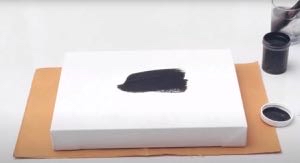
First, I have to give the canvas two coats of raw sienna just to get that formal connection with cave paintings of 30,000 years ago, not to mention J.M.W. Turner of 200 years ago. Here is the first coat:
Now two coats of cobalt blue straight out of the tube. I'm thinking that's what On Kawara would have done in order to ensure each chateau painting was the same colour. This is after the second coat of blue:
I've a feeling it wasn't cobalt blue though. Perhaps it was phthalocyanine blue that Kawara used. Which I haven't got to hand.
I've now gone over all the carefully positioned pencil lines with white… Looks horrible but I have to trust in my process… Next I will use blue on a small brush to get back to the lines of the characters… Now I am working away with two small brushes and moving from blue to white whenever I see a line that is not good enough… Though as yet none of the lines are perfect… Or anything like perfect…. Whoops, I've been forgetting to record my process.
Nothing for it but to keep going… There is work to be done on the 'A'…There is work to be done on the '0'… Now it is 3PM. The sky is still blue outside and I must go for a walk in the spring sun while I still can. It doesn't really matter what the Date looks like at this stage. What it looks like at midnight is what counts.
Even as it is, the above Date is the result of hours of concentrated labour. I had to resist making a deliberate mistake and recovering the position in the manner of the master. Maybe that's what I'll do when I get back.
I don't think a local walk is going to hit the spot. Time to circle the planet. Glasgow to Bangkok or Edinburgh to Seattle? I'll put a girdle round about the earth in forty minutes.
I get as far as Petworth Park in Sussex. I rest at the bench on which someone (presumably Lord Egremont or J.M.W Turner) has written 'LET TIME PASS'. 
I let the sunshine fall on my face for a while. Then I return to my chateau for something to eat before the last leg.
What is the time? 7.30 PM. I would quite like to stop and have a drink now. But I know that once I have even a single glass of wine coursing through my veins I won't be able to summon up the focus needed for the fine finish that I am so close to achieving.
"But O, methinks, how slow this old Fool wanes."
I am now ON HOLIDAY.
Actually, I have returned to my EVELYN WAUGH project and am covering his years at Combe Florey. To find out what this means, follow this link.